Inside the UK’s only licensed bare knuckle fight club
- Text by Isaac Muk
- Photography by John Bolloten

In February 2020, before the UK began its cycle of pandemic lockdowns, photographer John Bolloten travelled to a hotel in his hometown of Bradford. He wasn’t going to spend a night there, but to attend a meeting of the Spartan Bare Knuckle Fight Club – the only licensed hay bale fight club in the UK.
As the crowd began to file in, eventually growing to over 700 people, Bolloten jostled to find a spot to line his camera up and take pictures. An MC’s voice blared over the tannoy speakers, signalling the start of one of the most dangerous combat sports in the world: “Bradford, are you ready for some extreme violence?!”
“Even before the fighting started I was really intrigued, and almost hooked,” recalls Bolloten. “What the first two or three people I spoke to, who were all fighters, told me about themselves made me realise very quickly that it’s not just about the sport and the combat. It was like, who are these guys and why are they doing this?”
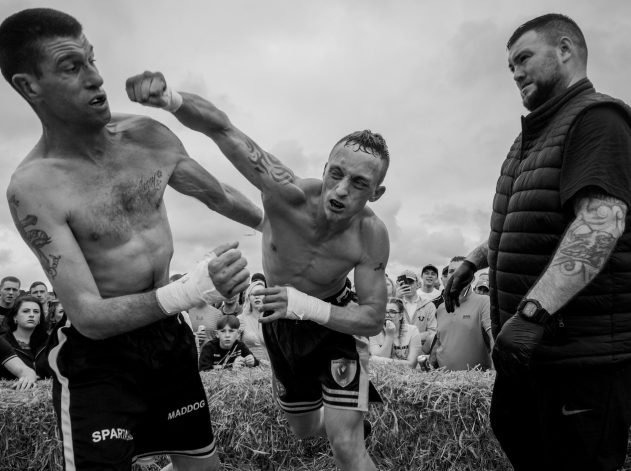
John Best and Andrew Shields battle it out at a bare knuckle pit fight in Oldham in 2021. John Best wins.
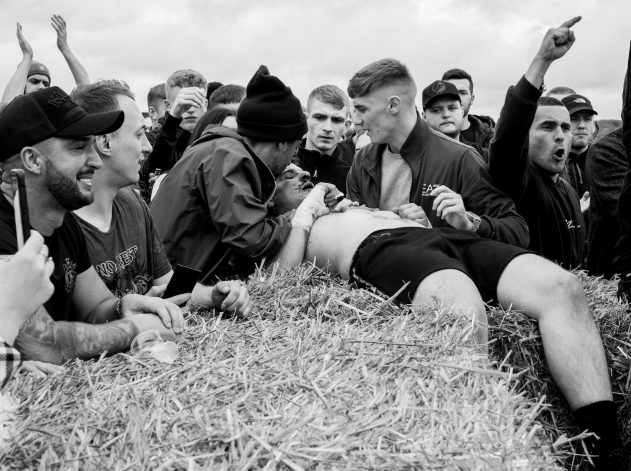
Lee Riach is knocked out by Stefan Davies at the bare knuckle pit fight in Oldham in 2021.
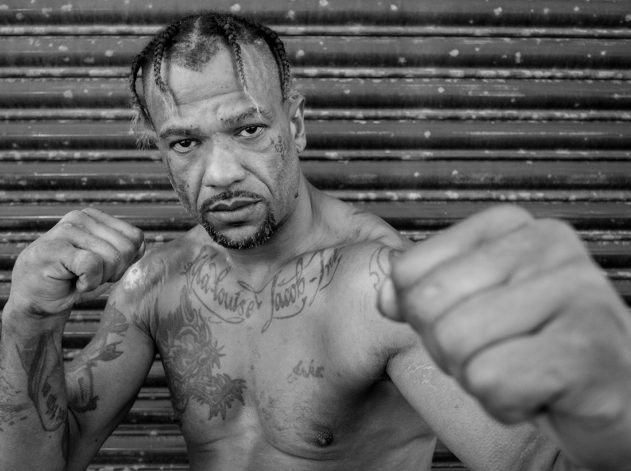
Bare knuckle pit fighter Jacob Williams.
The fighting commenced when two men – shirtless and gloveless – entered a tiny, eight-by-eight-foot area boxed off with hay bales and began throwing everything that they had at each other. The tiny space means fighters are squeezed close together, and there is nowhere to retreat or hide.
“When they made the pit, I could see it was a small space,” says Bolloten. “I decided to jump over and stand inside – it felt like half the size it looked from the outside. I thought: ‘Wow, there’s obviously no time or space for thinking or running or dancing – it’s going to be straight combat.’”
Bolloten has been following the Spartan Fight Club around the north of England ever since, documenting the fights, fighters, and fans. His pictures are collated in his new series Blood Brothers, which capture in visceral detail the energy of the fights – the punches, the knockdowns, the roaring crowds, and the bloodied victors.
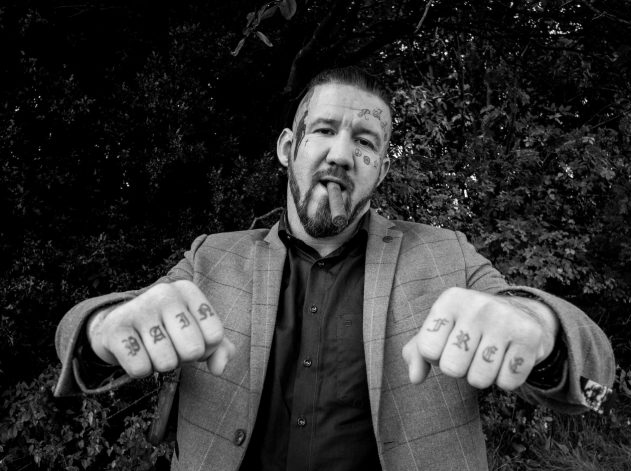
Aaron Lambourne photographed a few hours before his fight in Oldham in 2021.
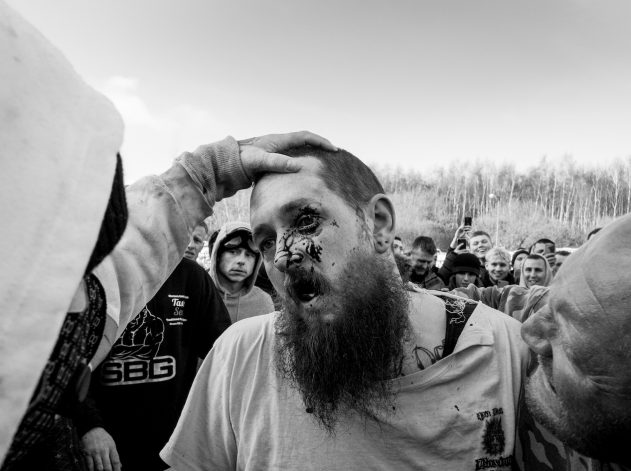
A bloodied Corey Edgar after losing his fight, which was stopped by medics.
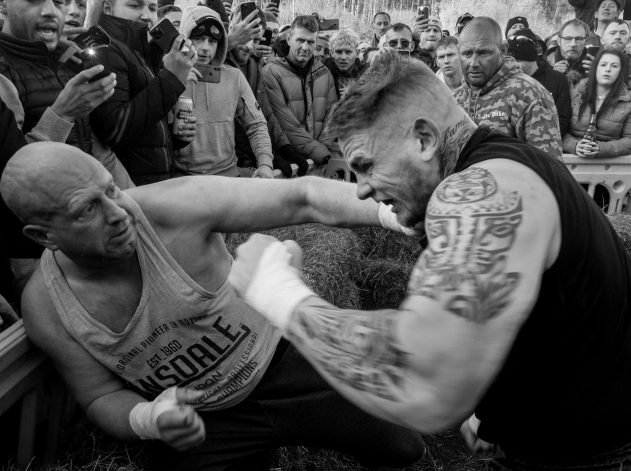
Matti Mongan and Peter Hayes battle it out in a pit fight in Manchester in 2020.
Most fights last less than a minute, and injuries are common – broken noses, cracked jaws and cut eye sockets are habitual, and medics are always on hand to immediately respond if anyone is seriously hurt. So why do people want to take part in such a violent sport?
“Many guys in pit are coming from backgrounds around drug and alcohol addiction, mental health issues,” Bolloten explains. “Many people will say it’s therapeutic for them to face their demons and set a challenge that they’re going to reach and conquer. For me, as a person in recovery, watching it is almost like having a fix.” One guy, who used to be a drug dealer, told him that fighting was “better than smoking crack”.
With its claustrophobic crowds and no-holds barred punching, the Spartan events take boxing back to its raw, old school form. For Bolloten, the event that encapsulated that energy the most came in December 2020. When the country was in the midst of tight lockdown restrictions, around 100 people gathered around a makeshift hay bale pit near Manchester in freezing, two-degree weather, ready to fight.
“It was wild, there was no place for warming up – guys just stripping off their tops and then jumping in because it was completely illegal,” Bolloten says. “It was totally underground, stripped back to its core.”
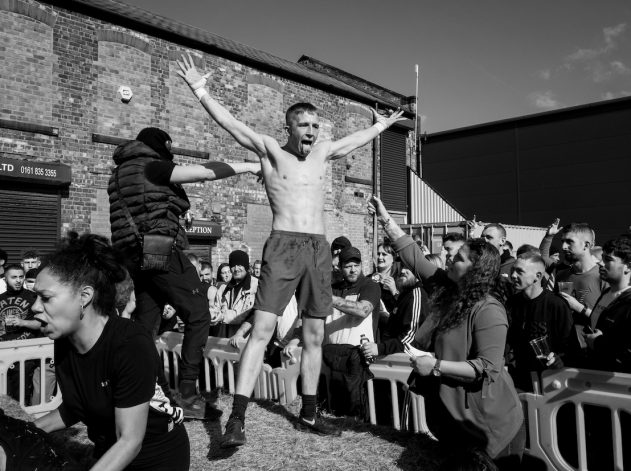
Antz “Anyman” Harrison celebrates after winning his bare knuckle pit fight in Manchester in 2020.
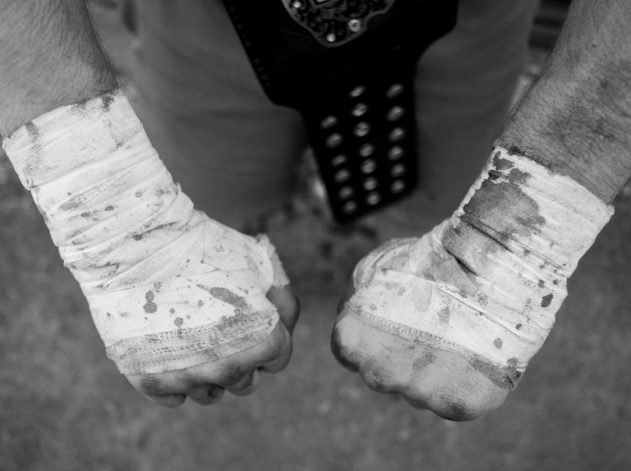
Emanuel Olaru shows his bloodied wraps after winning his fight.
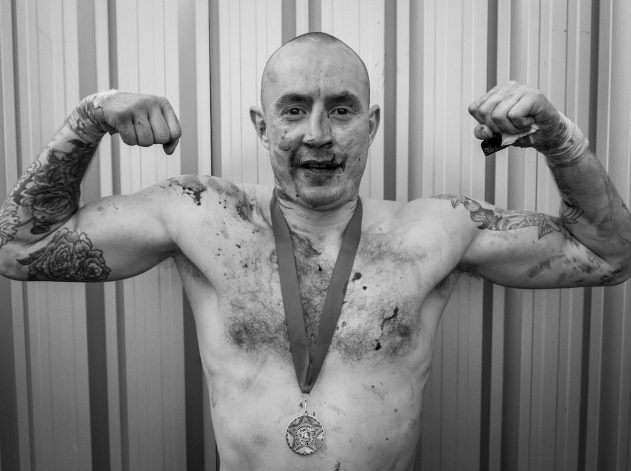
Aaron Woodward, despite losing his fight, is proud to have taken part.
“There’s this thing in society that fighting is bad, but fighting is a way of life for many men. It’s a part of them,” he continues. “A lot of them, young or old, love fighting, but they don’t want to have that on a Friday or Saturday night and go to prison. They want it in a controlled environment.
“And they don’t want to mess around with gloves – they want a proper fight with fists.”
Follow Isaac Muk on Twitter.
Enjoyed this article? Like Huck on Facebook or follow us on Twitter.
You might like

In photos: Black Texas life since emancipation
Kinship & Community — A new photobook and exhibition showcases the rich culture, history and community of African American folks in the Lone Star State, whose existence in the region predates colonial Britain.
Written by: Miss Rosen

Inside Parkuir: the art project queering sport, space and our bodies
Lie and play — Founded by Maria Laudes and Guiu Gimeno, it provides a framework for engaging, subverting, and celebrating the small details that make people unique – and queer.
Written by: Molly Lipson

London’s largest indoor skatepark to be demolished for padel courts
Better Extreme — The Barking skatepark’s fate follows that of similar indoor spaces in recent years, with operators GLL citing falling visitor numbers as the reason behind the decision.
Written by: Isaac Muk

Youthful joy & end-of-era poignancy at a London school prom
Leavers — For several years, Lewis Khan documented young people as they celebrated the last of their school days and the completion of their exams. The series is now collated in a new self-published photobook and short film.
Written by: Zoe Whitfield

Harry Gruyaert’s vintage, kaleidoscopic scenes of New York
A Sense of Place — For 50 years, the Belgian photographer and Magnum Photos member has been capturing NYC’s colourful chaos. A new photobook and exhibition showcase his unique, technicolour view of the city.
Written by: Miss Rosen

In the pit at one of the UK’s last stock car & banger speedways
Stock Car Racing Isn’t Dead — Photographer Liam McCarthy spent time in and around the Arlington Raceway’s circuit, capturing the diehard community that keeps the sport alive.
Written by: Isaac Muk


