Stanley Donwood’s nuclear weapons installation will blow your mind
- Text by Alex King
- Photography by James Arthur Allen

A ball of fire belches into the sky, casting a ghostly orange light over Stanley Donwood’s face. As he gazes upwards, the explosion forms into a rising mushroom cloud.
It’s easy to imagine the world outside this darkened basement has been obliterated by a nuclear apocalypse – but this isn’t a military bunker or a fallout shelter, it’s the United Visual Artists HQ in South London, where Donwood is putting finishing touches to a secretive project, known only as the bomb.
Artist and writer Stanley Donwood is best-known as Glastonbury festival’s artist-in-residence and for his close partnership with Radiohead, having produced all of the band’s iconic artwork since their 1995 breakthrough The Bends. He’s also a longtime anti-nuclear campaigner and the bomb is a terrifyingly immersive installation conceived to push the largely ignored threat of the aggressive use or accidental detonation of nuclear weapons back up the agenda.
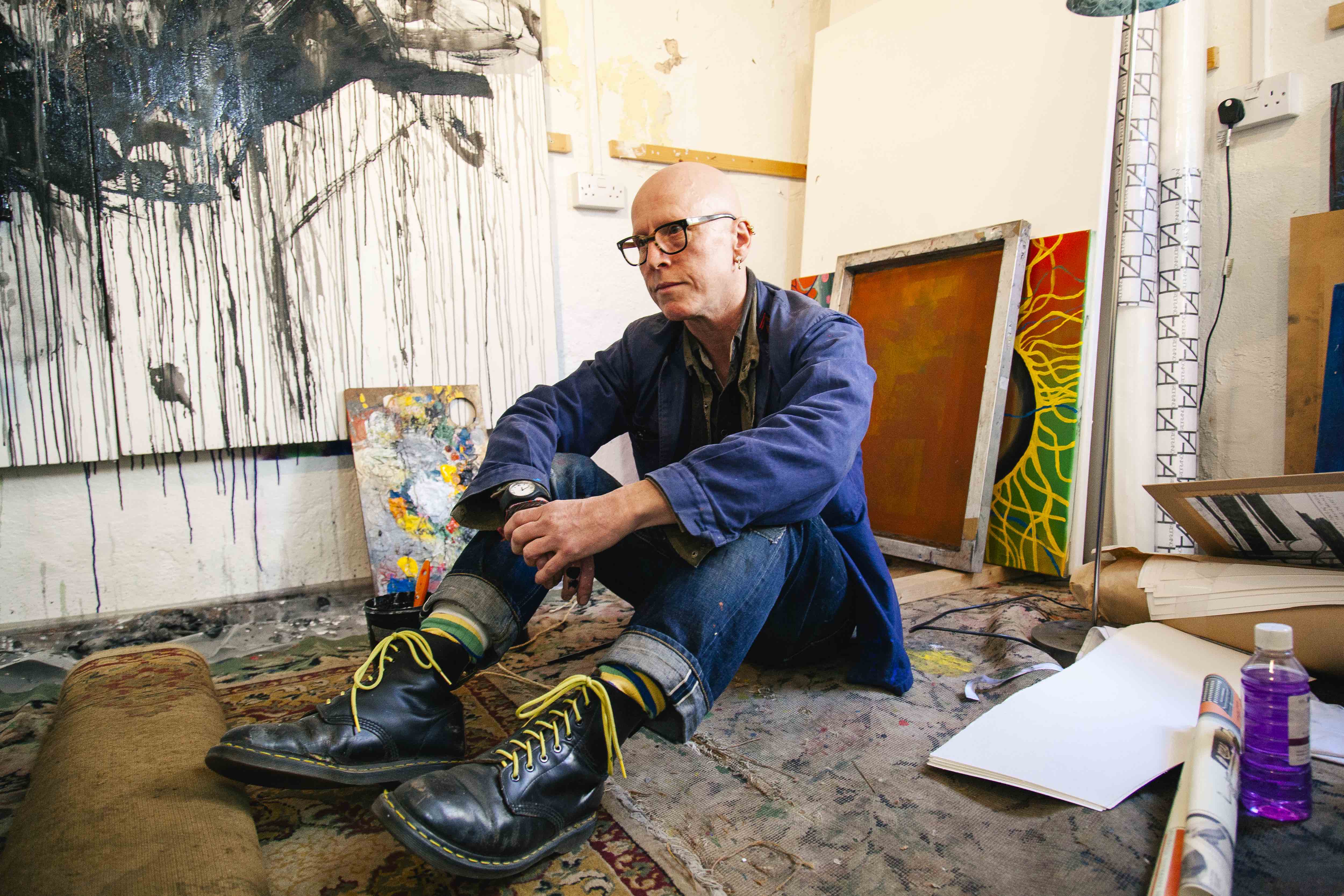
“The nuclear threat is like a dark spectre that has hovered at my back throughout my adult life,” says Donwood.
His first act of civil disobedience came in 1983, aged fourteen, when he joined a demonstration in his hometown of Colchester against America’s decision to station cruise missiles at Greenham Common and Molesworth. “My awareness of nuclear issues increased fast and we set up a Campaign for Nuclear Disarmament (CND) group at school,” he remembers. “It was around then that I began a series of pictures of my hometown with mushroom clouds above.”
Growing up at the end of the Cold War, the possibility of an all-out nuclear war between the West and Soviet Union was very real. “I was extremely conscious of it! It was genuinely a terrifying time,” Donwood reflects. “Thinking about my formative years under the ever-present threat of imminent nuclear annihilation might go some way to explaining [my style].”

‘Hollywood Dooom’ by Stanley Donwood
Themes of destruction and alienation run through Donwood’s post-apocalyptic work – such as his series of covers for dystopian sci-fi writer JG Ballard – which could explain why he struck up an intense working relationship with Radiohead frontman Thom Yorke, who he met while studying at Exeter University.
“I remember when we were working on the artwork for OK Computer, looking out of the window of Thom’s house and having a strange semi-hallucinatory experience, seeing a post-nuclear attack landscape,” Donwood explains. “Not ground zero, but as if we were fifty miles away. The twigs stripped from trees, a strange sky, an emptiness that was curiously pale. Something like a monochrome version of Paul Nash’s war paintings transported to suburban Oxford. We used a lot of white in the artwork – white as the colour of death, of bones, of ash.”
His work on their latest record, A Moon Shaped Pool follows in a similar vein. It has echoes of the curled and burnt photographs discovered in the wake of nuclear strikes on Hiroshima and Nagasaki.
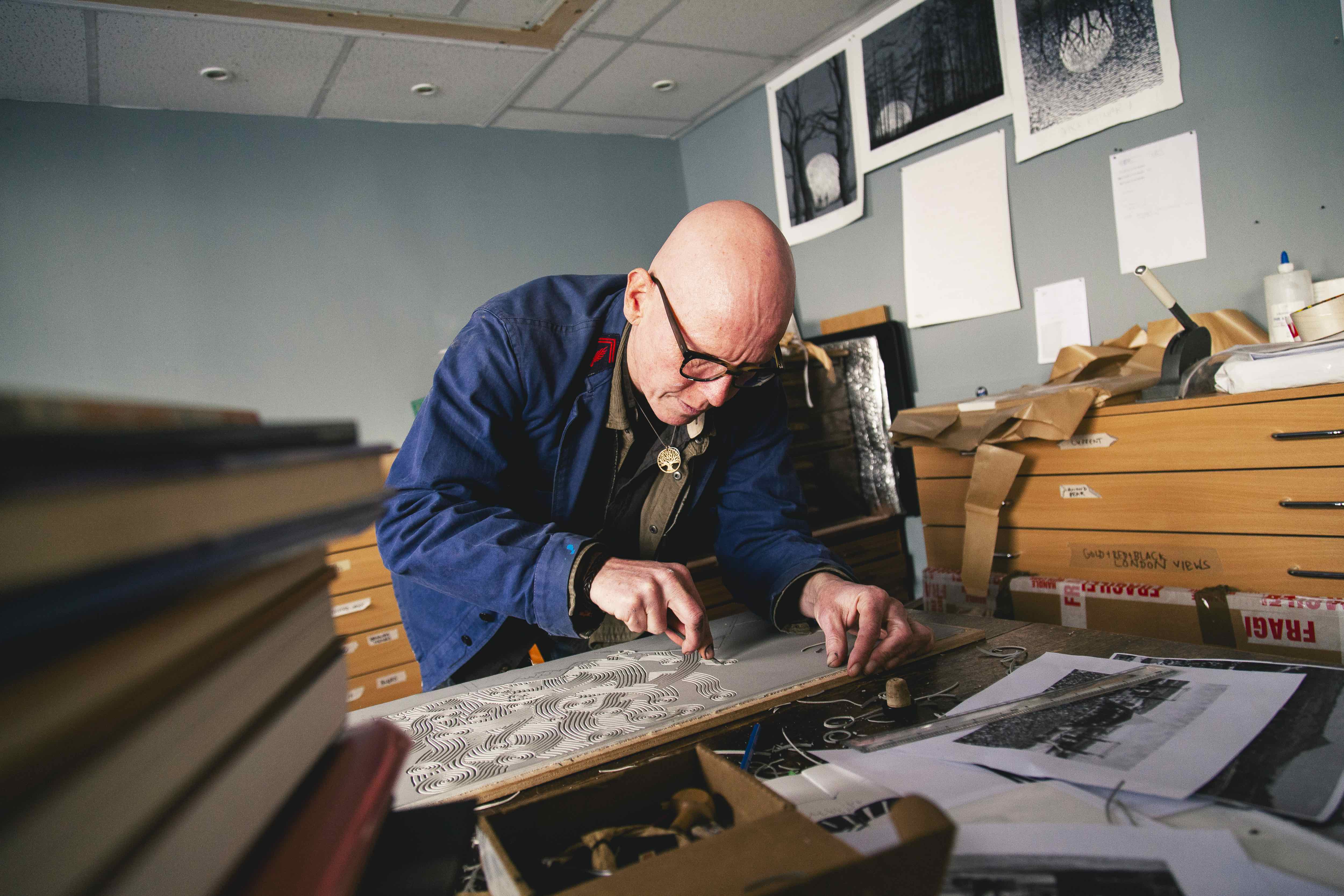
Donwood is art directing the bomb with co-directors Eric Schlosser, Smriti Keshari and Kevin Ford. “The bomb project seemed like a way to try to expose that spectre [of nuclear weapons],” Donwood explains, “because I think that since the end of the Cold War and the cessation of what was hilariously termed ‘mutually assured destruction’ people have forgotten about the threat of disaster from a nuclear source.”
The starting point for the bomb was Eric Schlosser’s 2013 book Command and Control, which questioned whether nuclear weapons can ever be operated safely and centred around a 1980 accident in Arkansas when a missile equipped with a nuclear warhead exploded. Had the warhead detonated, it could have wiped out the entire state.
Sounding the alarm about this largely forgotten threat, when terrorism and climate change dominate the headlines, seems an uphill battle, but Schlosser has driven seismic shifts in public consciousness before. His 2001 book Fast Food Nation outed the food industry’s darkest secrets, catalysing a movement against the unhealthy and exploitative fast food machine.
“The odds of an all-out nuclear war are lower than thirty years ago, but the odds of one city being destroyed by a nuclear weapon is probably higher today because we have the terrorist threat,” Schlosser explains, adding that there are still over 15,000 active nuclear weapons worldwide – many of which are far less secure than we might hope. “The probability of a nuclear detonation is low, but the consequences would just be unbelievably high. There is no country in the world that has the medical infrastructure that could deal with the detonation of a nuclear weapon in a city.”

‘Faster’ by Stanley Donwood
Composed of haunting archive footage of nuclear tests, accidents and public information films, the bomb is a groundbreaking, narrative-free multimedia installation projected on massive floor-to-ceiling screens that surround the audience. It premiered at New York’s palatial Gotham Hall with a live score by The Acid, as part of Tribeca Film Festival, before hopefully touring the globe.
“I’m a real believer in logic and reason and statistics and facts; and yet there are other things that just function on a much deeper level that make an argument more powerful than any set of statistics ever could,” adds Schlosser. “Whether you’re a writer, filmmaker, painter or a photographer, it’s possible to use culture, not just to entertain people but also to energise and wake them up.”
Spending fifty-five minutes in a darkened room, surrounded by instruments of mass destruction is a chilling experience – which was exactly the intention. “the bomb places the audience in the centre of the story of nuclear weapons,” says Keshari.
“It’s not a film for the easily upset,” adds Donwood. “But it’s really a public service film. While we were working on it we would entertain ourselves by asking people how many nuclear weapons they thought there were in the world. No one had the slightest idea that there are currently 15,000 active nuclear weapons on planet Earth. Oh, except Thom Yorke, who we bumped into in Soho. But apart from him, no one had the foggiest idea. So really, the bomb is for those people, enjoying a life of blissful ignorance.”
This article originally appeared in Huck 55 – The Freaked Out Issue. Buy it in the Huck Shop now or subscribe to make sure you never miss another issue.
You might like

In photos: Black Texas life since emancipation
Kinship & Community — A new photobook and exhibition showcases the rich culture, history and community of African American folks in the Lone Star State, whose existence in the region predates colonial Britain.
Written by: Miss Rosen

Youthful joy & end-of-era poignancy at a London school prom
Leavers — For several years, Lewis Khan documented young people as they celebrated the last of their school days and the completion of their exams. The series is now collated in a new self-published photobook and short film.
Written by: Zoe Whitfield

Harry Gruyaert’s vintage, kaleidoscopic scenes of New York
A Sense of Place — For 50 years, the Belgian photographer and Magnum Photos member has been capturing NYC’s colourful chaos. A new photobook and exhibition showcase his unique, technicolour view of the city.
Written by: Miss Rosen

Inside Lower Duck Pond, the nicest town on the internet
/r/HaveWeMet — With a population of 2,500 and no fixed location, the subreddit is a space for roleplaying citizens to solve mysteries, host fictional events and ultimately connect. In an internet that’s often divided and toxic, Vicky Jessop hangs out in one of its most wholesome corners.
Written by: Vicky Jessop

A major Nan Goldin exhibition is coming to London
You Never Did Anything Wrong — Opening at the Hayward Gallery in November, the show will debut a new film from the artist and activist, alongside a slate of recent work.
Written by: Jack Dennison-Thompson

Sepia splashed memories of Britain’s ’90s squatting and free party scene
Bygones — Moving into a Hackney squat at the age of 19, Tom Hunter spent years living on London’s edges, while documenting the vibrant, creative community and culture that it enabled. Huck’s art director Sam White chats to him about the freedom that existed, the collectivism and what’s been lost over the decades since.
Written by: Samuel White


