Sylvia Plath’s visual art is celebrated in new exhibition
- Text by Dominique Sisley

A new exhibition showcasing Sylvia Plath’s secret art collection has opened in Washington D.C’s Smithsonian National Portrait Gallery. The show, titled One Life, offers an insight into the Pulitzer-prize winning poet’s complex creative life – celebrating, for the first time, her natural gift for visual art and imagery.
Plath is most famous for her boundary-breaking literary work; from her savvy coming-of-age novel The Bell Jar to her chilling poetry collection Ariel, written in the months leading up to her suicide. What she’s less known for, though, is her life-long devotion to drawing, painting and the arts.
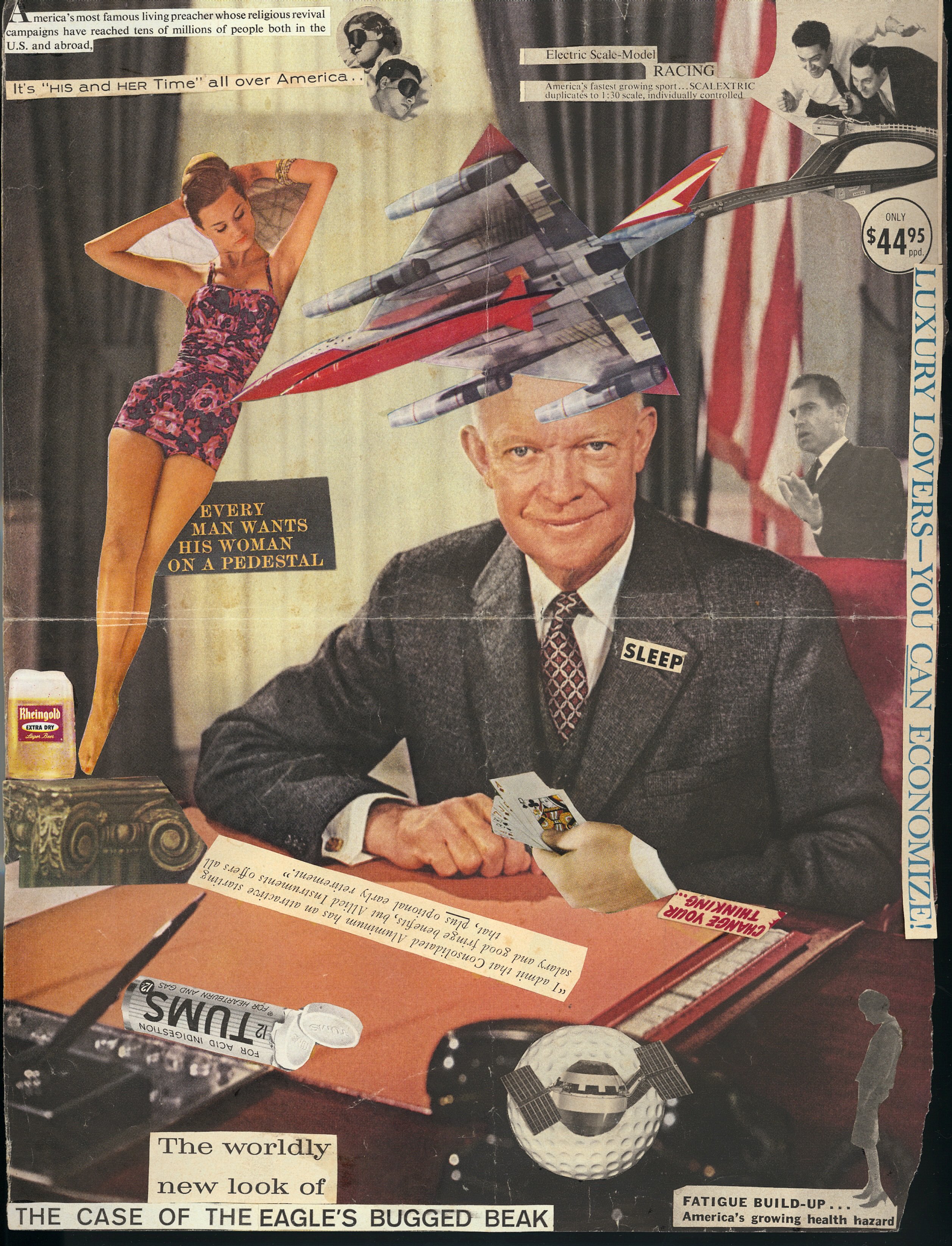
- Collage by Sylvia Plath. Courtesy Mortimer Rare Book Collection, Smith College, Northampton, Massachusetts, © Estate of Sylvia Plath
One Life includes a varied selection Plath’s art. There are politically-charged collages, sketches, water colours, comic strips and a collection of abstract paintings, offering a rare glimpse into the iconic author’s personal life. If that wasn’t enough, the show also displays a number of other personal objects, including “personal letters, self-portraits, and family photographs.”
“Sylvia Plath’s fascination with images and imaging was a strong part of her identity,” says Dorothy Moss, curator of painting and sculpture at the Smithsonian. “The exhibition allows us to see what she described as her ‘visual imagination’ in all its complexity.”

“A War to End Wars” Self-Portraitby Sylvia Plath. Courtesy Mortimer Rare Book Collection, Smith College, Northampton, Massachusetts, ©Estate of Sylvia Plath

Self-Portrait in Semi-Abstract Styleby Sylvia Plath. Courtesy Estate of Robert Hittel, ©Estate of Sylvia Plath

“Twas the Night Before Monday”by Sylvia Plath. Courtesy The Lilly Library, Indiana University, Bloomington, Indiana. © Estate of Sylvia Plath

Triple-Face Portrait by Sylvia Plath. Courtesy The Lilly Library, Indiana University, Bloomington, Indiana, © Estate of Sylvia Plath
Sylvia Plath: One Life will be shown at the Smithsonian National Portrait Gallery until May 20, 2018.
Enjoyed this article? Like Huck on Facebook or follow us on Twitter.
You might like

Kristina Rozhkova’s scatty, confronting portrait of captivity
Gut Feeling — The Russian artist’s 2024 arrest and subsequent detention opened her eye towards the omnipresent dynamics of power and control. Her new photobook is a stark exploration of being trapped.
Written by: Isaac Muk

Washing strangers’ feet at Houghton Festival
Pedilavium — As part of artist Henry Krokatsis’s performance piece at the weekender, we sat down with over 30 others to clean the dusty digits of passersby, while reflecting on the power of collective ritual and human connection.
Written by: Isaac Muk

The anti-tourism guides revealing Lisbon’s true, radical heart
We Hate Tourism Tours — The Portuguese capital sees millions of people visit a year, against a backdrop of political turbulence and a housing crisis fuelled by short term holiday lets. Jack Burke meets the crew subverting their city’s perception, while bringing lesser seen stories and monuments to light.
Written by: Jack Burke

The art of paying attention: How Austria’s Alps reward slowing down
Lebensgefühl — With a growing movement of art and music rooted in the area’s mountains, trees and waterfalls, the region is showcasing the importance of the human relationship to nature.
Written by: Sophie Lou Wilson

Inside Parkuir: the art project queering sport, space and our bodies
Lie and play — Founded by Maria Laudes and Guiu Gimeno, it provides a framework for engaging, subverting, and celebrating the small details that make people unique – and queer.
Written by: Molly Lipson

A major Nan Goldin exhibition is coming to London
You Never Did Anything Wrong — Opening at the Hayward Gallery in November, the show will debut a new film from the artist and activist, alongside a slate of recent work.
Written by: Jack Dennison-Thompson


