The dystopian megacities of anime architecture
- Text by Gunseli Yalcinkaya
- Illustrations by Metropolis, scene 12, Shuichi Kusamori, 2001 (main image), courtesy Thames, Hudson

In 1988, Japanese director Katsuhiro Otomo turned his best-selling manga into a $10 million feature-length anime. Set in the dystopian not-so-distant-future of 2019, Akira would captivate viewers with its vision of a lawless and post-apocalyptic Neo Tokyo, inhabited by motorcycle gangs, corrupt government officials, and undercover science experiments.
The same decade, in art studios across the capital, early pioneers such as Mamoru Oshii (Ghost in the Shell) and Hideaki Anno (Neon Genesis Evangelion), would join Otomo in utilising the onrush of new and invasive technologies in the ’80s – a period of economic boom in Japan – to imagine brave new worlds. Typically drawn by hand, these images would envision futuristic cities that would become defined by, and sometimes victim of, their own advancements.
“They were envisioning a future which was beyond their technical facilities at the time,” says Stefan Riekeles, author of Anime Architecture (Thames & Hudson). “Of course, that’s different today.” His book highlights the hand-drawn illustrations behind some of anime’s most prolific cityscapes. By looking at these original images, Riekeles believes that we can gain insights that are often lost on screen.

Akira, cut no. 2211, final production background, Hiroshi Ono, 1988

Akira, cut no. 426, final production background, artist unknown, 1988
In Akira’s post-nuclear civilisation, for example, the vastness of Neo Tokyo, its countless highways and flyovers, is punctuated by key locations: the government research labs, the run-down bars, and the construction zone of the Kenzo Tange-inspired Olympic stadium. Towering high-rise buildings nod to Fritz Lang’s science-fiction drama film Metropolis, while the influence of Ridley Scott’s Blade Runner – also set in 2019 – can be felt in Neo-Tokyo’s neon lit and distinctly cyberpunk landscape.
“The whole city is designed to be destroyed,” Riekeles says, referencing Akira’s final 30 minutes, where a telekinetic Tetsuo triggers a thanatotic succession of events that results in the full annihilation of the city. At its most basic, the ending is a critique of late-capitalism and Japan’s doken kokka (construction state), where large amounts of public money was shovelled into government vanity projects at the expense of the public.
“As symbolised by the construction of the new Olympic Stadium and its subsequent destruction, Akira expresses the joy and sense of liberation that accompanies cataclysmic devastation, with its tearing down of old institutions,” explains Riekeles.
Unlike Neo Tokyo, Ghost in the Shell’s New Port City comes without either the destructive backstory of its predecessors, nor the feel of Tokyo itself, designed as it was to be more of a stand-in for the state of Hong Kong. Mamoru Oshii’s cyberpunk epic of an AI entity roaming cyberspace and hacking victims’ cybernetic brains takes place in 2029, where a global electronic network connects the world.

Ghost in the Shell, cut no. 683, final production background, Hiromasa Ogura, 1995
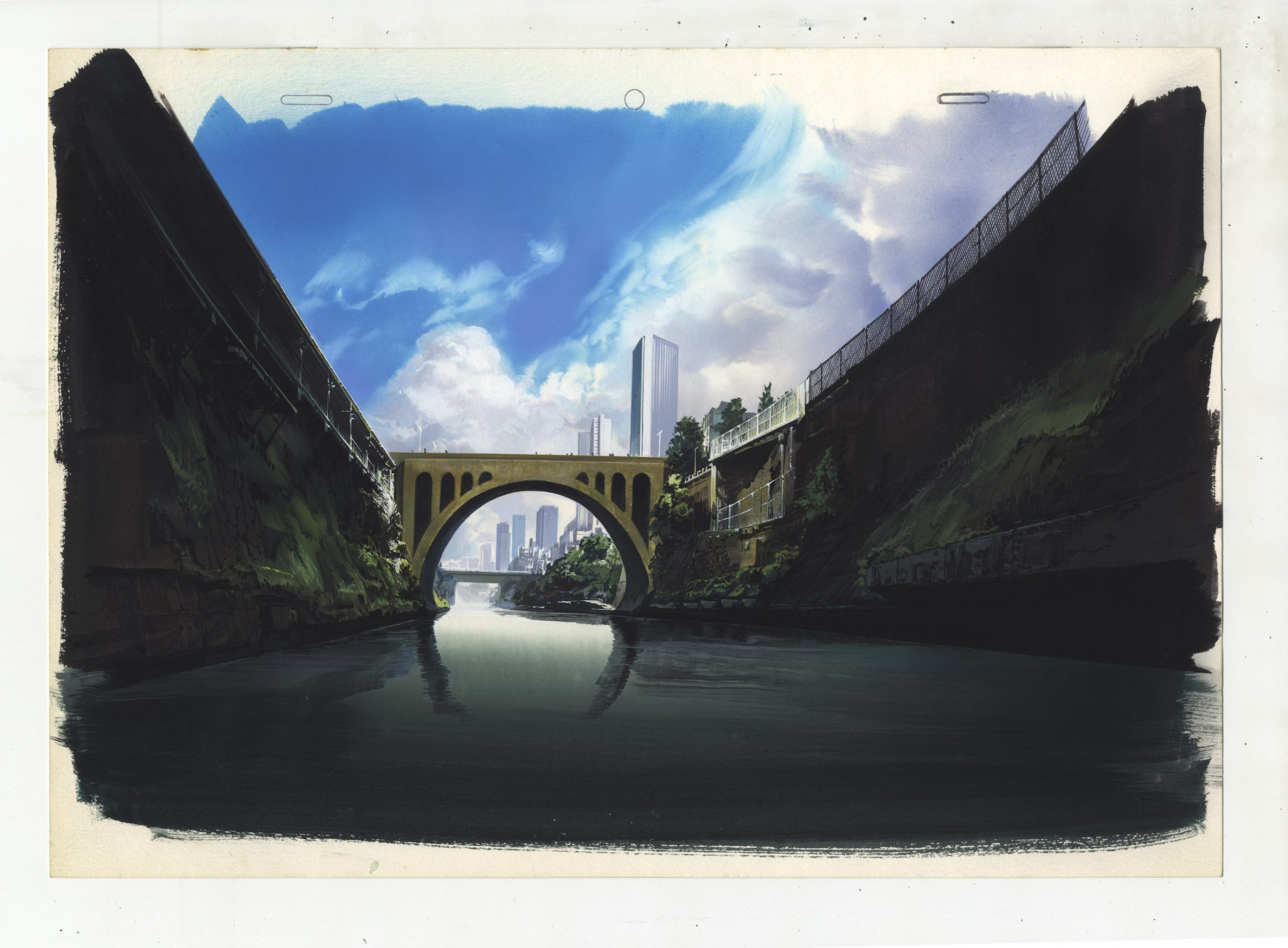
Patlabor: The Movie, cut no. 182, final production background, Hiromasa Ogura, 1989
When imagining New Port City’s dark and dystopian landscape, art director Hiromasa Ogura took inspiration from Hong Kong’s old waterways and newly built high-rises to symbolise the information flow that turns the city into a gigantic data space. “He felt that the city of the near future will possess an element of the unknown – to achieve this uncanny quality, he sought to express the flood of information surging through this disparate environment,” explains Riekeles.
Neon Genesis Evangelion, in contrast, takes inspiration from the miniature sets of tokusatsu films, a popular genre of Japanese film, where the set is constructed in miniature and forms the arena for a battle between good and evil. The show is set 15 years after a worldwide cataclysm, in the futuristic fortified city of Tokyo-3. Vast machinery retracts buildings underground, defending the city from the encroaching threat of the ‘Angels’ – a race of giant monstrous beings hellbent on destroying humanity.
Anno would deploy techniques used in films like Ishiro Honda’s Godzilla (1954) and Hajime Tsuburaya and Akio Jissoji’s Ultraman TV series (1966-67), to transform Tokyo-3 – a vast fortress city – into a battleground between Angels (big, evil) and humans (small, good).
Unlike Akira and Ghost in the Shell, Anno’s skyline has no cyberpunk stylings. “It’s somewhere between a small Japanese town and the metropolis of Tokyo,” says Riekeles. What they do have in common, however, is their use of architecture to bolster the storyline. “In Anno’s radical perspective, the city appears as the sum total of all available technologies. As the ultimate extension of human senses and organs, it is both artificial and organic, thus Tokyo-3 itself is a cyborg,” he explains.
Whether built as an extension of the surrounding technology, or simply to be destroyed, these cities – and the illustrations that inspired them – serve as backdrops for profound and often existential reflections on the relationship between person and machine. Their visions of a near-future where tech has ‘taken over’ not only reveals the prevailing fears of the era – they also draw disconcerting parallels with our present.

AKIRA, cut no. 207, final production background, Toshiharu Mizutani, 1988

Patlabor 2: The Movie, cut no. 567, final production background, Hiromasa Ogura, 1933

Patlabor: The Movie, cut no. 186, final production background, Hiromasa Ogura, 1989

Ghost in the Shell, cut no. 509, final production background, Hiromasa Ogura, 1995
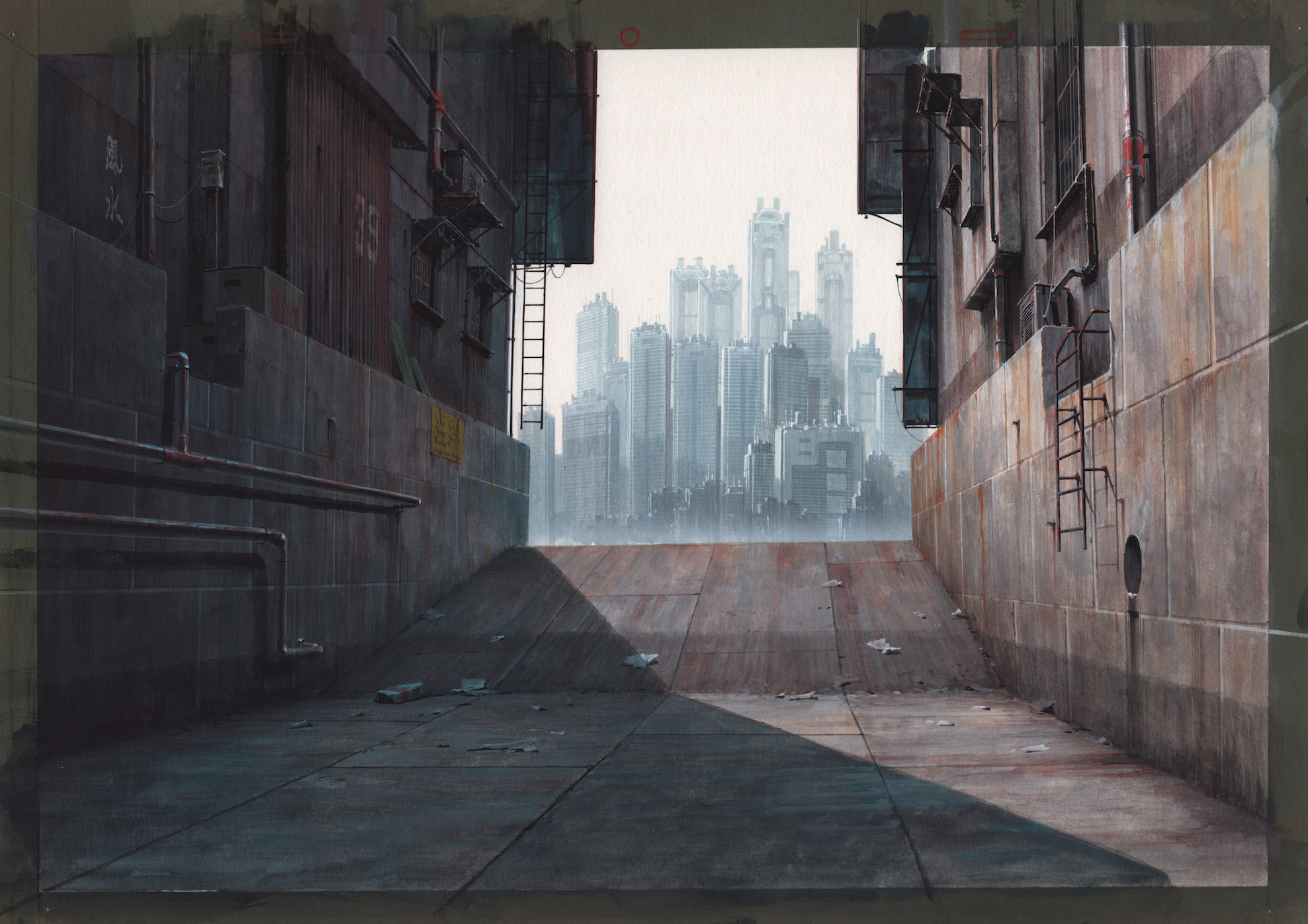
Ghost in the Shell, cut no. 239, final production background, Shuichi Kusamori, 1995

Ghost in the Shell, cut no. 477, final production background, Hiromasa Ogura, 1995
Anime Architecture is published by Thames & Hudson.
Follow Gunseli Yalcinkaya on Twitter.
Enjoyed this article? Like Huck on Facebook or follow us on Twitter.
You might like

In photos: Black Texas life since emancipation
Kinship & Community — A new photobook and exhibition showcases the rich culture, history and community of African American folks in the Lone Star State, whose existence in the region predates colonial Britain.
Written by: Miss Rosen

Inside Parkuir: the art project queering sport, space and our bodies
Lie and play — Founded by Maria Laudes and Guiu Gimeno, it provides a framework for engaging, subverting, and celebrating the small details that make people unique – and queer.
Written by: Molly Lipson

Youthful joy & end-of-era poignancy at a London school prom
Leavers — For several years, Lewis Khan documented young people as they celebrated the last of their school days and the completion of their exams. The series is now collated in a new self-published photobook and short film.
Written by: Zoe Whitfield

Harry Gruyaert’s vintage, kaleidoscopic scenes of New York
A Sense of Place — For 50 years, the Belgian photographer and Magnum Photos member has been capturing NYC’s colourful chaos. A new photobook and exhibition showcase his unique, technicolour view of the city.
Written by: Miss Rosen

Inside Lower Duck Pond, the nicest town on the internet
/r/HaveWeMet — With a population of 2,500 and no fixed location, the subreddit is a space for roleplaying citizens to solve mysteries, host fictional events and ultimately connect. In an internet that’s often divided and toxic, Vicky Jessop hangs out in one of its most wholesome corners.
Written by: Vicky Jessop

A major Nan Goldin exhibition is coming to London
You Never Did Anything Wrong — Opening at the Hayward Gallery in November, the show will debut a new film from the artist and activist, alongside a slate of recent work.
Written by: Jack Dennison-Thompson


