The London squatters who resisted evictions in the ‘70s
- Text by Miss Rosen
- Photography by David Hoffman

While living in York in his late teens, British photographer David Hoffman did odd jobs to survive (“some more nefarious than others,” he admits). He began selling pictures to the Yorkshire Evening Post. The paper had no interest in publishing stories on the horrific living conditions of the working class, so Hoffman resolved that this was something he had to pursue for himself.
In the early 1970s, Hoffman arrived in Whitechapel in London’s East End. “It was filthy and felt abandoned,” he remembers. “Much of the housing was semi-derelict and many of the shops were on their last legs. For many it was the place where they ended up when their lives fell apart. It was clearly a dead end.”

Squatters waiting to resist eviction behind the barricaded front door of a squat, Parfett Street, 1973
Many lived in squats to escape homelessness. “Squatting is mostly a communal activity,” Hoffman says. “It brings people together to repair and improve the, mostly broken-down, housing available. The mutual support – and mutual tensions – helped form political understanding and brought us together in activist groups.”
Hoffman found it shameful that the City of London, located just one mile away, offered no support. “While I was powerless to change any of it, I felt that I could and should at least document it,” says Hoffman.
Under the banner of slum clearance and “urban renewal,” the city council decided to tear down the crumbling buildings where squatters lived, with landlords forcing evictions. With the release of Parfett St Evictions 1973 (Café Royal), Hoffman revisits what became the first British protest photography book when it was first published in 1976.

Waiting for the bailiffs before the eviction of squatters, Parfett Street, 1973
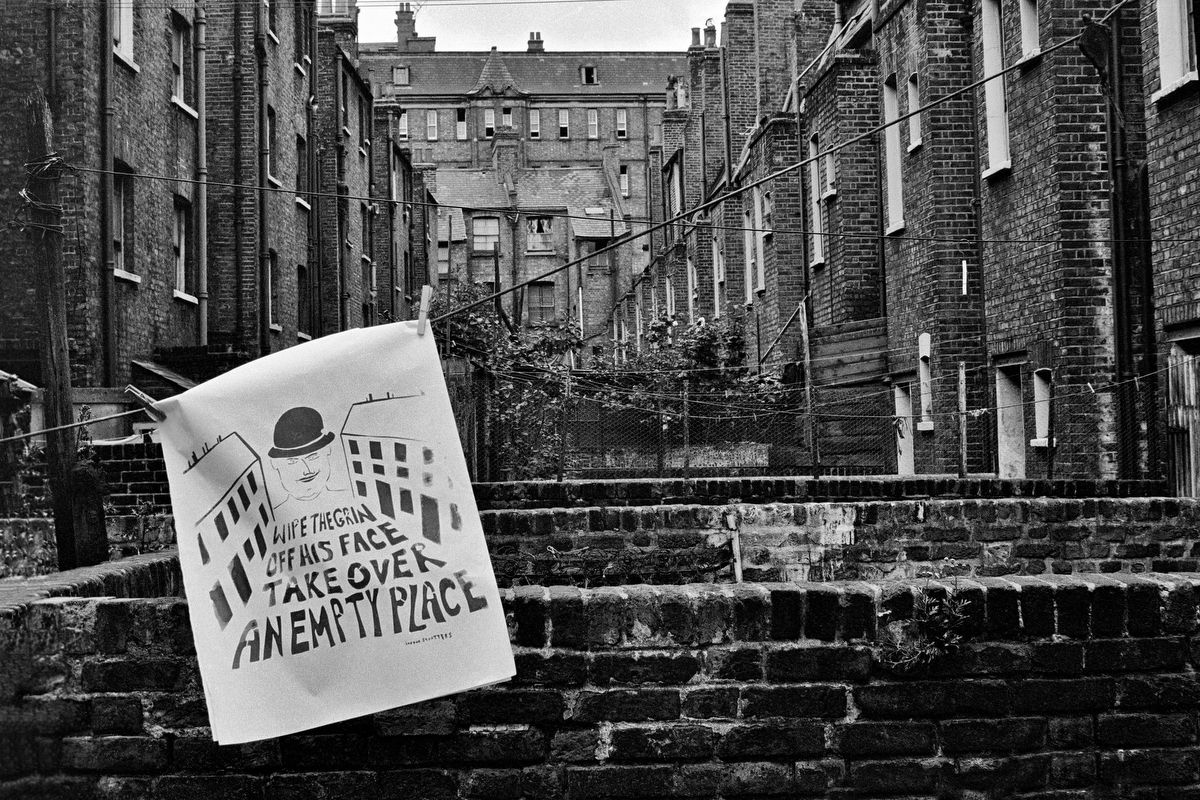
One of many posters around the East End protesting at the eviction of squatters, Parfett Street, 1973
Like many squats the one in Parfett Street housed a wide range of people. “Doris Lerner was the oldest and had been a political activist all her life. Doris would go to auctions of squatted houses and buy them. Being penniless this would delay the sale and extend the life of the squat,” Hoffman says.
“Tony was an early and resolute Gay Rights activist. Duncan was an anarchist and believer in redistribution. Bonkers Piers Corbyn, brother of Jeremy Corbyn would turn up occasionally, try and steal some limelight and then wander off when there was work to be done. We had sex workers, architects, performers, jewellers, musical instrument makers and drug dealers. A healthy mix.”

March on Tower Hamlets Town Hall in Patriot Square protesting against the eviction of squatters, Parfett Street, 1973
Police would regularly harass people around the squats who looked “different,” often stopping and searching them for drugs in the hopes of an easy arrest. “They’d turn up to protect bailiffs in an eviction but they didn’t bother to patrol the area much and generally saw anything to do with us as rubbish work, beneath their dignity,” Hoffman says. “When landlords sent in heavies to make an unlawful eviction, the police were nowhere to be seen.”
Nearly 40 years since these photographs were made, and the lessons they offer are timeless. “We cannot expect the state or those with power to do anything meaningful to alleviate social ills,” Hoffman says. “Banding together is our only route to social justice. If you need a home, take one.”

Police try (and fail) to force a path through squatters and their supporters, Parfett Street, 1973

Fieldgate Mansions, a 19th century tenement block due to be demolished in 1972 but preserved by squatters occupying it

Council official tells squatters who had marched on Tower Hamlets Town Hall that they should go away. Patriot Square, 1973

Fieldgate Mansions, Whitechapel Summer 1985. Scheduled for demolition in 1972 it was squatted by homeless people, artists & Bengali immigrants preventing destruction

Empty house graffitied following the eviction of squatters, Whitechapel, 1973
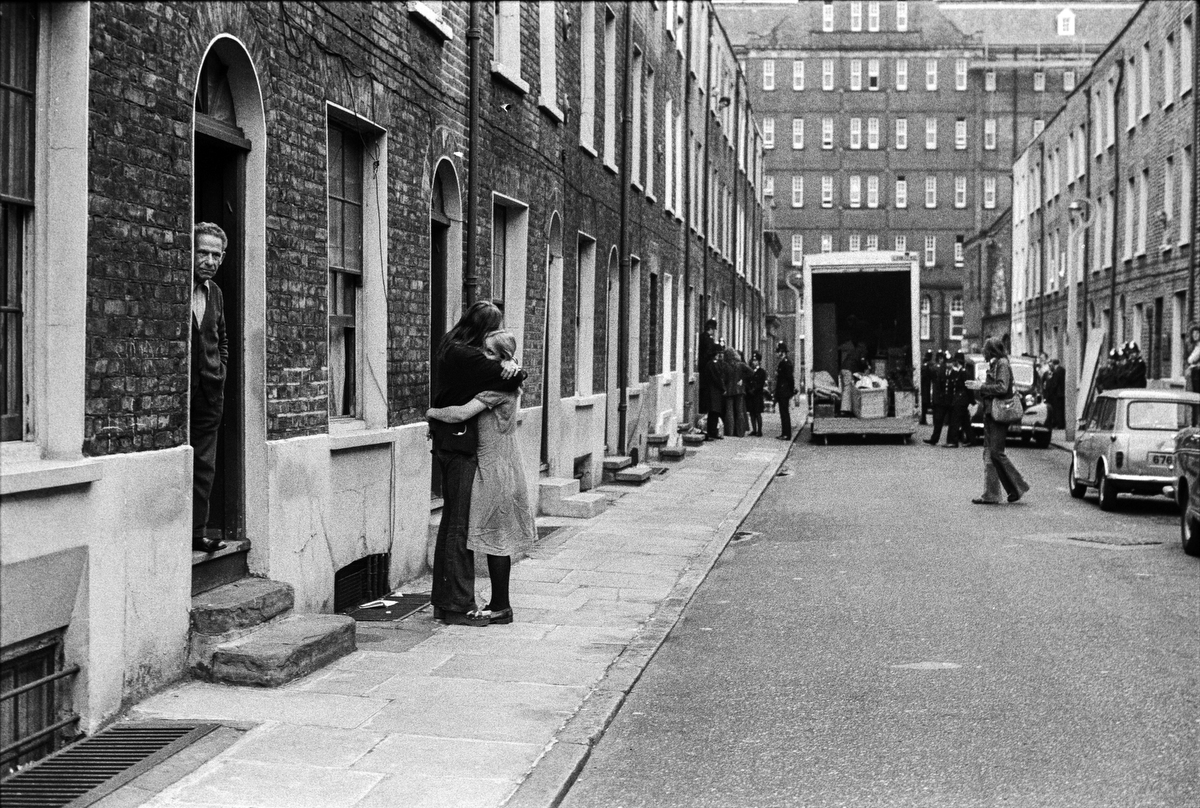
Eviction of squatters from private rented property that was being kept empty in Parfett Street, 1973
Parfett St Evictions 1973 is out now on Café Royal Books.
Enjoyed this article? Like Huck on Facebook or follow us on Twitter.
You might like

In photos: Black Texas life since emancipation
Kinship & Community — A new photobook and exhibition showcases the rich culture, history and community of African American folks in the Lone Star State, whose existence in the region predates colonial Britain.
Written by: Miss Rosen

London’s largest indoor skatepark to be demolished for padel courts
Better Extreme — The Barking skatepark’s fate follows that of similar indoor spaces in recent years, with operators GLL citing falling visitor numbers as the reason behind the decision.
Written by: Isaac Muk

Youthful joy & end-of-era poignancy at a London school prom
Leavers — For several years, Lewis Khan documented young people as they celebrated the last of their school days and the completion of their exams. The series is now collated in a new self-published photobook and short film.
Written by: Zoe Whitfield

Harry Gruyaert’s vintage, kaleidoscopic scenes of New York
A Sense of Place — For 50 years, the Belgian photographer and Magnum Photos member has been capturing NYC’s colourful chaos. A new photobook and exhibition showcase his unique, technicolour view of the city.
Written by: Miss Rosen

In the pit at one of the UK’s last stock car & banger speedways
Stock Car Racing Isn’t Dead — Photographer Liam McCarthy spent time in and around the Arlington Raceway’s circuit, capturing the diehard community that keeps the sport alive.
Written by: Isaac Muk

Inside Lower Duck Pond, the nicest town on the internet
/r/HaveWeMet — With a population of 2,500 and no fixed location, the subreddit is a space for roleplaying citizens to solve mysteries, host fictional events and ultimately connect. In an internet that’s often divided and toxic, Vicky Jessop hangs out in one of its most wholesome corners.
Written by: Vicky Jessop


