The man who taught America how to grow weed
- Text by Miss Rosen
- Photography by Mel Frank, courtesy of Benrubi Gallery

The year was 1967, the city: New York. At the age of 23, Mel Frank had completed four years of service in the Navy before settling into an apartment on the Upper West Side (a room formerly occupied by Nico of the Velvet Underground).
“It had beautiful eastern light,” Frank recalls. “Not having much money, I filled it with plants. I built a stereo cabinet and within that, I put up fluorescent lights and grew smaller plants.”
He started smoking marijuana and purchasing nickel bags on the street. “In those days, Mexican or Colombian marijuana came packed with seeds – it didn’t take me long to start growing it.”
“The only thing I knew was the plant was field crop so I could treat it like corn. I had a small room and put down plastic, made a big box, filled it with sand and manure, and hung fluorescents over it, then eventually moved to pots, which made it easier to control the light intensity on top of the plants.”

Sativa Landraces, Sierra Nevada Foothills CA 1978
In 1971, while looking for work, a journalist suggested Frank write an article to make ends meet. He wrote about what he knew: how to grow marijuana. It was later published as a two-part story in the New York Flyer, an insert found in local copies of Rolling Stone. Once this seed was planted, a new world began to bloom.
“At the exact same time, Ed Rosenthal was trying to sell an article to Rolling Stone – except his was a promotion for his company that would set up planters in your home,” Frank says. “The publisher put him in touch with me, and within five minutes of meeting me, he said we should write a book together. I didn’t really want to write a book with him but he was very persistent. Within a year, I relented.”
Their first effort was a 94-page book with what Frank describes as “an incredibly long name,” published in 1974. “When it came out I was studying biology at City College and I realised the little guide was embarrassing,” he remembers.
Inspired to do better, Frank moved to California and spent two years researching marijuana in botanical libraries where he made five cent photocopies of more than 300 scientific papers. The result was the 1978 publication of Marijuana Grower’s Guide Deluxe, which was unexpectedly given a glowing review by The New York Times.

Afghani Congolese backcrossed Afghani NY 1982
“Suddenly everyone was reviewing the book and all the stores were carrying it,” Frank shares. “The book set out the basics for how to grow indoor or outdoor. It put into the heads of the general public that they could grow their own. The book really started a revolution.”
In order to illustrate the book, Frank taught himself photomicrography. He also documented the guerilla growers who went out into remote areas to farm, creating a phenomenal archive of work now on view in Mel Frank: When We Were Criminals. (“Mel Frank” is a pseudonym, used in order to publish his work without placing himself in danger of persecution from the law prior to the 2016 passage of the Adult Use of Marijuana Act in California.)
“To me, it’s really criminal what the government has done for the last 80 years, which is lie about all of this,” Frank says. “If you see the posters for movies like Reefer Madness, they were serious. This is what they told you it was. They completely tried to erase the entire history of cannabis in this country.”
“All of the government funding that goes into cannabis is to find something wrong with it.”

Seeded Colombian Landrace Backyard Oakland CA 1979

Afghani Landrace, Sonoma County CA 1979

Cazadero Sonoma County CA 1977

South Indian Landrace, Oakland CA 1980

Mokelumne Hill Calaveras County, CA 1978
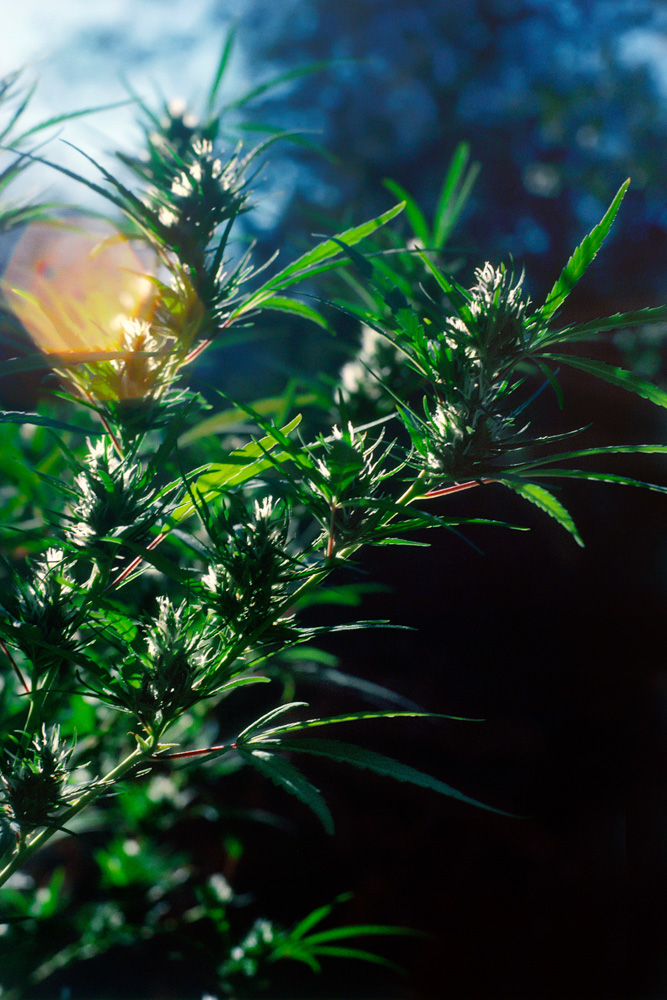
Backyard Berkeley CA 1977

Nigerian Landrace Greenhouse, Oakland CA 1979
Mel Frank: When We Were Criminals is on view at Benrubi Gallery, New York, through November 20, 2018.
Follow Miss Rosen on Twitter.
Enjoyed this article? Like Huck on Facebook or follow us on Twitter.
You might like

In photos: Black Texas life since emancipation
Kinship & Community — A new photobook and exhibition showcases the rich culture, history and community of African American folks in the Lone Star State, whose existence in the region predates colonial Britain.
Written by: Miss Rosen

Youthful joy & end-of-era poignancy at a London school prom
Leavers — For several years, Lewis Khan documented young people as they celebrated the last of their school days and the completion of their exams. The series is now collated in a new self-published photobook and short film.
Written by: Zoe Whitfield

Harry Gruyaert’s vintage, kaleidoscopic scenes of New York
A Sense of Place — For 50 years, the Belgian photographer and Magnum Photos member has been capturing NYC’s colourful chaos. A new photobook and exhibition showcase his unique, technicolour view of the city.
Written by: Miss Rosen

In the pit at one of the UK’s last stock car & banger speedways
Stock Car Racing Isn’t Dead — Photographer Liam McCarthy spent time in and around the Arlington Raceway’s circuit, capturing the diehard community that keeps the sport alive.
Written by: Isaac Muk

Inside Lower Duck Pond, the nicest town on the internet
/r/HaveWeMet — With a population of 2,500 and no fixed location, the subreddit is a space for roleplaying citizens to solve mysteries, host fictional events and ultimately connect. In an internet that’s often divided and toxic, Vicky Jessop hangs out in one of its most wholesome corners.
Written by: Vicky Jessop

A major Nan Goldin exhibition is coming to London
You Never Did Anything Wrong — Opening at the Hayward Gallery in November, the show will debut a new film from the artist and activist, alongside a slate of recent work.
Written by: Jack Dennison-Thompson


