Capturing West Coast skaters, the Victorian way
- Text by Biju Belinky
- Photography by Jenny Sampson

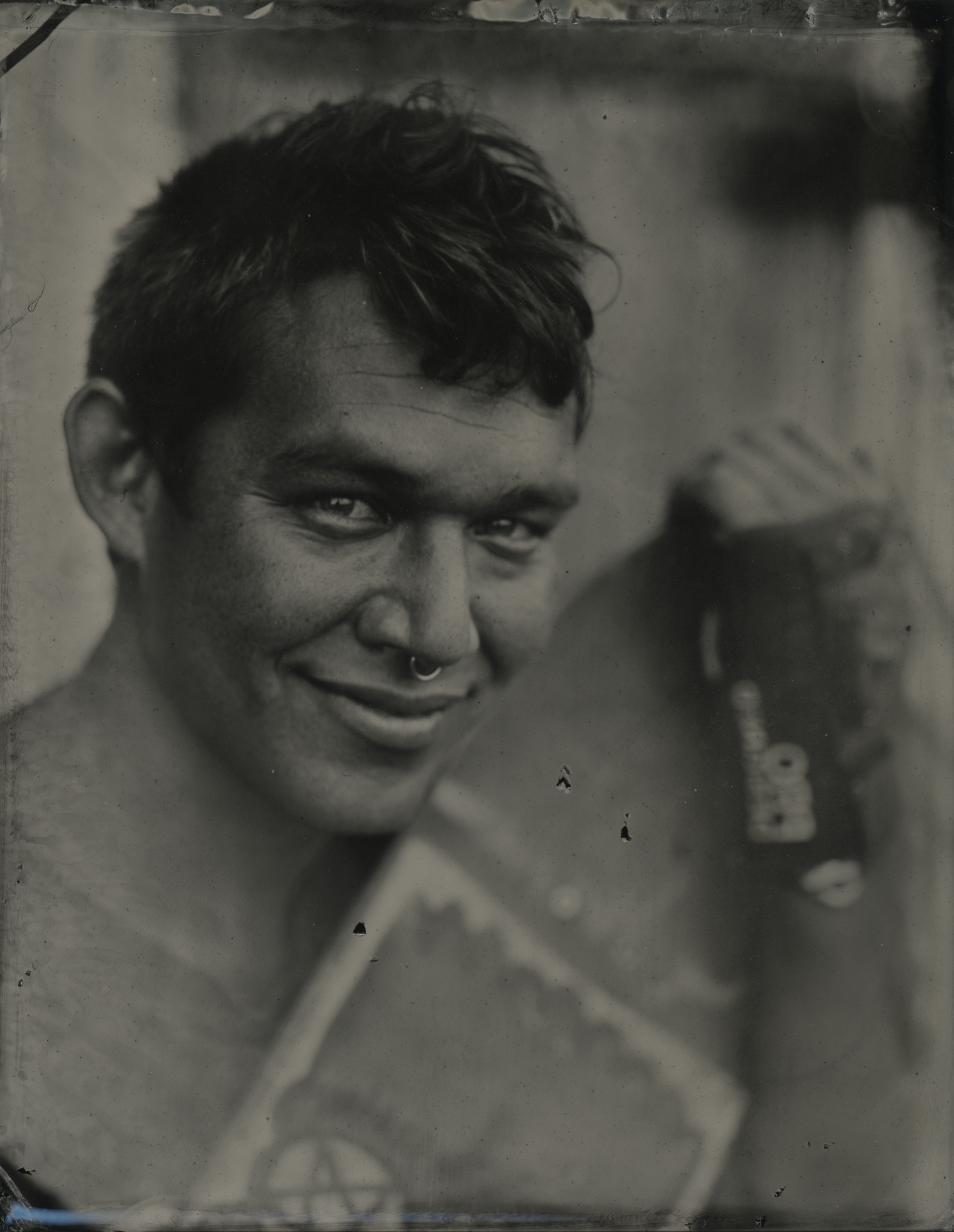
Tintype is a century-and-a-half old Victorian photographic process that requires the subject to keep very still for a few seconds – which is why it’s surprising Berkeley-based photographer Jenny Sampson decided to use it to capture skaters for her latest book named after the subculture.
With an intro by pro-skater and writer Bret Anthony Johnston, over 70 portraits capture the intricacies of the skating scene of the West Coast – through seven years of images, multiple states and skateparks, beyond tricks and stereotypes.
“I loved photographing people in more candid ways and I imagined inconspicuously hanging out and photographing –their gestures, postures, interactions,” Sampson tells me. “Skaters attracted me. I always kind of thought of them as rebellious, and I think I wanted to be rebellious as well, but I was afraid to be. I never got up the courage to approach the skaters at that skate park.”
These photographs remained an idea until 2010 when she finished building her own portable darkroom – something which would allow her to develop tintypes on the go. From that moment on, the series started developing (both literally and figuratively). We caught up with her to find out more about the project.

What do you think makes skating such a unique scene?
I think that skating is a powerful equaliser. It’s a club that anyone can belong to. Of course it has been a male-dominated scene for a long time, however, there are so many girls and women skating now. There is a camaraderie that exists at the skateparks, and the seemingly unspoken rules are respected. I’ve observed skateparks that are the ‘home away from home’, where teens congregate every day after school and older folks hang out with them as their mentor. I’ve observed older, experienced skaters literally pick up six-year-olds who have fallen attempting a trick (while said six-year-old’s mother is on her mobile). I’ve observed guys talking and skating together, seemingly old friends, but then learn that they just met.
What are some misconceptions about the scene that you would like to dispel?
This idea that they are troublemakers and rebellious – at least in the sense that being rebellious is a bad thing. Skaters are lawyers, educators, directors of creative writing at upstanding universities, writers, musicians, politicians, students – the list is endless. They are a group of people who are true to themselves, supportive of each other, impressively disciplined and self-driven, empowered and creative.

 How did you pick your subjects for this series?
I would ask anyone whose attention I could garner if I could make their portrait. Once someone would agree to sit for me, I felt like I won the lottery. They were willing, patient and often excited about the process since many only knew digital photography. For my portraits, they had to sit for a few minutes in front of my large camera, which is the absolute opposite experience of their style of photographing. Then, as with most people who have never been tintyped before, when they saw their seemingly holographic, silvery faces emerge in the potassium cyanide fixer, they were blown away – and then quickly back to the ramp.
You’ve used tintype for a lot of your projects – what do you like about this particular method?
The wet plate collodion process is magical, and there are many reasons beyond that as to why I love this technique. The tactile and analog qualities of the process; the way it forces me to slow down and immerse myself in the process, engaging with my subjects in a more personal way. The end result is a unique object.


 Skaters by Jenny Sampson is available for pre-order now, via Daylight Books.
Biju Belinky is Huck’s staff writer. Follow her on Twitter.
Enjoyed this article? Like Huck on Facebook or follow us on Twitter.
You might like

In photos: Black Texas life since emancipation
Kinship & Community — A new photobook and exhibition showcases the rich culture, history and community of African American folks in the Lone Star State, whose existence in the region predates colonial Britain.
Written by: Miss Rosen

London’s largest indoor skatepark to be demolished for padel courts
Better Extreme — The Barking skatepark’s fate follows that of similar indoor spaces in recent years, with operators GLL citing falling visitor numbers as the reason behind the decision.
Written by: Isaac Muk

Youthful joy & end-of-era poignancy at a London school prom
Leavers — For several years, Lewis Khan documented young people as they celebrated the last of their school days and the completion of their exams. The series is now collated in a new self-published photobook and short film.
Written by: Zoe Whitfield

Harry Gruyaert’s vintage, kaleidoscopic scenes of New York
A Sense of Place — For 50 years, the Belgian photographer and Magnum Photos member has been capturing NYC’s colourful chaos. A new photobook and exhibition showcase his unique, technicolour view of the city.
Written by: Miss Rosen

In the pit at one of the UK’s last stock car & banger speedways
Stock Car Racing Isn’t Dead — Photographer Liam McCarthy spent time in and around the Arlington Raceway’s circuit, capturing the diehard community that keeps the sport alive.
Written by: Isaac Muk

Inside Lower Duck Pond, the nicest town on the internet
/r/HaveWeMet — With a population of 2,500 and no fixed location, the subreddit is a space for roleplaying citizens to solve mysteries, host fictional events and ultimately connect. In an internet that’s often divided and toxic, Vicky Jessop hangs out in one of its most wholesome corners.
Written by: Vicky Jessop


