Tracing Susan Meiselas’ journey through photography
- Text by Miss Rosen
- Photography by Susan Meiselas / Magnum Photos

For more than 40 years, American photographer Susan Meiselas has grounded her work in the idea of place. Whether working on the front lines of civil war in Nicaragua or backstage with carnival strippers in New England, Meiselas is fully present in the moment, seeing not just the surface of things but that which lies beneath – the spirit within the flesh and bone that continues to live in her photographs long after they are made.
Mediations, her newest book (Damiani/Jeu de Paume/Fundació Tàpies) traces her singular journey across time and space, exploring the ways in which the photograph works as object, art, and evidence. The book, which accompanies a touring exhibition that will open at SFMoMA on July 21, is not so much a catalogue as it is a meditation on the threads that weave the complex tapestry of Meiselas’ career.
In it, a variety of writers offer their take on the issues that inform the questions at the heart of her work; such the language of the body, the meaning of place, the position of the photographer, and the legacy of documentary work. They also begin to consider the ways in which the photograph works as a book or a print, a scan or a memory.

Everyone traveling by car, truck, bus or foot is searched, Ciudad Sandino, Nicaragua 1978
“Pictures live in time,” Meiselas explains. “Pictures live in memory. Pictures are out of one’s hands once they are in some form that can be reproduced. The work dwells in you in a way and you rediscover it, you rediscover links to it, and questions you have about it.”
With every project, Meiselas adapts to the requirements the story demands. The book and exhibition begin in a very intimate space, with small black and white photographs from the 1971 series, 44 Irving Place. Among those included is a self-portrait made at 23 years old, present yet nearly invisible due to the use of a long exposure. It is the perfect visual metaphor of Meiselas at work, whether behind the camera or long after the print has been made.

Susan Meiselas / Magnum Photos
“The exhibition and [book] take its title from early work where I am trying to make sense of the distribution of images, which I am really experiencing for the first time having been part of Magnum Photos and part of the network of distribution,” she says. “I was starting to see what happened to all of the photographs and the object of the photograph.”
In the exhibition, we see her work running in three rows across a very long wall, presented as work prints, finished prints, tearsheets, slides, and pages from books in order to “show the life of an image and the notion of re-appropriation of images that travel beyond that time.”
“I literally got something this morning on Facebook, with someone using the Molotov Man [one of Meisela’s most famous shots] and tied it to an image that was photographed by someone anonymously yesterday in the streets of Nicaragua – which are in flames right now in response to some of the actions that Ortega took and are trying to take him down. They went back to this image made almost 40 years ago to draw a parallel. It’s a continuous dialogue of images. People are constantly revising old forms and going beyond what we could imagine then. I think about that a lot.”

Susan Meiselas / Magnum Photos
The questions of possibilities, of thinking anew, of considering fresh perspectives that the situation demands have allowed Meiselas to question and examine the possibilities of what the photograph is and does. For Meiselas, the photograph goes beyond the object itself, becoming a means to connect, collaborate, and converse with her subjects and viewers.
“It makes life more meaningful, that’s for sure,” she confirms. “Looking backwards, there is so much memory loss. Doing a show like this opens up some of the caverns of memory: finding bits and pieces and trying to figure out the appropriate amount of artefact to try to give a feel for the process within a specific time frame. Going back to go forward as they say.”

Traditional Indian dance mask from the town of Monimbo. 1978

Self-Portrait, from the series 44 Irving Street, 1971
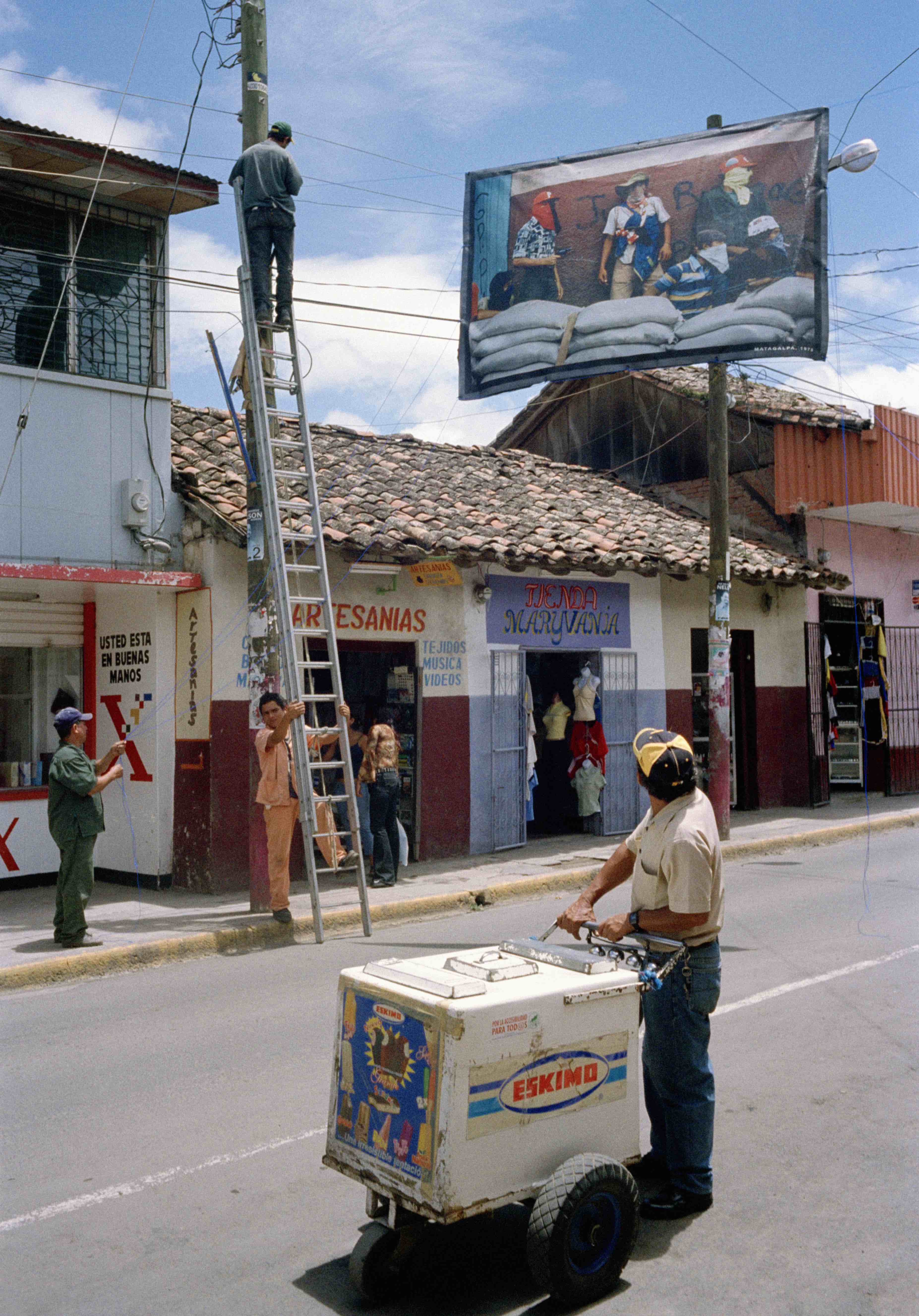
Awaiting counterattack by the Guard, Matagalpa, September 1978 from the series Reframing History

Signed portrait, Marrakech, Morocco, from the project 20 dirhams or 1 photo?, 2013

Susan Meiselas / Magnum Photos
Mediations is available now.
Follow Miss Rosen on Twitter.
Enjoyed this article? Like Huck on Facebook or follow us on Twitter.
You might like

In photos: Black Texas life since emancipation
Kinship & Community — A new photobook and exhibition showcases the rich culture, history and community of African American folks in the Lone Star State, whose existence in the region predates colonial Britain.
Written by: Miss Rosen

Youthful joy & end-of-era poignancy at a London school prom
Leavers — For several years, Lewis Khan documented young people as they celebrated the last of their school days and the completion of their exams. The series is now collated in a new self-published photobook and short film.
Written by: Zoe Whitfield

Harry Gruyaert’s vintage, kaleidoscopic scenes of New York
A Sense of Place — For 50 years, the Belgian photographer and Magnum Photos member has been capturing NYC’s colourful chaos. A new photobook and exhibition showcase his unique, technicolour view of the city.
Written by: Miss Rosen

In the pit at one of the UK’s last stock car & banger speedways
Stock Car Racing Isn’t Dead — Photographer Liam McCarthy spent time in and around the Arlington Raceway’s circuit, capturing the diehard community that keeps the sport alive.
Written by: Isaac Muk

Inside Lower Duck Pond, the nicest town on the internet
/r/HaveWeMet — With a population of 2,500 and no fixed location, the subreddit is a space for roleplaying citizens to solve mysteries, host fictional events and ultimately connect. In an internet that’s often divided and toxic, Vicky Jessop hangs out in one of its most wholesome corners.
Written by: Vicky Jessop

A major Nan Goldin exhibition is coming to London
You Never Did Anything Wrong — Opening at the Hayward Gallery in November, the show will debut a new film from the artist and activist, alongside a slate of recent work.
Written by: Jack Dennison-Thompson


