A trip back in time to the dark heart of Los Angeles
- Text by Miss Rosen
- Photography by All images courtesy Jim Heimmann / Taschen

The golden sun of Los Angeles casts a dark shadow across the California coast, hiding a multitude of sins that have been long buried in the archives of newspapers, magazines, and the police department. For every image of free spirits frolicking on the surf, there lurks its counterpoint among the pimps, pushers, politicians, and police who used their power to prey upon the weak, wayward, and vulnerable.
For years, Los Angeles noir was the stuff of legend, fueling the filmmakers, novelists, and journalists with sensational stories such as the Black Dahlia, a gruesome unsolved murder in 1947 that later became the subject of a 1987 James Ellroy book and a 2006 Brian DePalma film. To put it plainly, we can never seem to get enough of the seedy, seamy underbelly of the City of Angels, where demons and devils dwell.

A bartender bites the dust in a Hollywood robbery gone awry, ca. 1940. Copyright: Cliff Wesselmann Photo Courtesy of Gregory Paul Williams, BL Press LLC / TASCHEN
Jim Heimmann, the executive editor of Taschen America, understands this all too well. A cultural anthropologist, historian, and avid collector, Heimann has a profound love for the grime and grit found in the cracks and crevices across La-La Land. As an avid fan of mid-20th-century writers like Raymond Chandler, James M. Cain, and Nathaniel West, Heimmann came to discover that often times they were referencing actual crimes and illegal activities.
As he turned over stones, a new history began to pour forth – one that he has collected and compiled for the sumptuous volume, Dark City. The Real Los Angeles Noir (Taschen).
“I started to find the artefacts and images these guys were writing about,” he explains. “Then I started to expand this idea into the other things about Los Angeles that were more arcane: the underbelly, the evangelists, the kooks and the crazies, the hermits who lived up in the hills and the physical culture – Muscle Beach and nudist colonies.

The bloody evidence of a murder spree awaits processing at police headquarters, ca. 1930. Copyright: Cliff Wesselmann Photo Courtesy of Gregory Paul Williams, BL Press LLC / TASCHEN
“It all supported this idea that what the Chamber of Commerce was promoting like sunshine and health, movies stars and glamour, surfing – there was a flipside that was just as present and influential in the development of the city. There was plenty of film and fiction that developed around Los Angeles noir period, but there wasn’t anything that substantiated in reality what was going on.”
That’s where Dark City comes in. Here, 480 pages of meticulously researched stories, photographs, and documents including bound-in facsimile magazine clippings, allow tales of the sensational and the sordid to quietly unfold, taking us back to a time when the West was truly wild.
The book features a wide selection of photographs drawn from several different archives, including the Los Angeles Police Department.

Betty Rowland reclines on a sofa backstage at the Follies, ca. 1938. Copyright: Cliff Wesselmann Photo Courtesy of Gregory Paul Williams, BL Press LLC / TASCHEN
“The LAPD always had a cameraman along with them when they were investigating a crime,” Heimmann reveals. “Even though these photographers were just hired hands to accompany the police, they really had a sensibility about them. There was a large depository of all these great photographs and they weren’t just reporting bluntly, they really had a nuanced feel with shadows and the way the bodies are positioned, while others are very blatant. They were very much artists unknowingly.”
“But then there was also the pool of photographers covering the Hollywood scene. These independent freelancers would also be following a lot of the other things like crime… At that time photographers had amazing access to these crime scenes where they could actually pose the victim or the perpetrator in jail and light him a certain way to make him look more evil. The police let them do it and that was the photo that would be published in the newspaper.”
Heimmann brilliantly assembles the photographs and media, in many cases side by side, to illustrate how photographers, a great many of them anonymous, were able to define the look of the times. This aesthetic, which is at one glamorous and gruesome, continues to capture our imagination and weave a spell, seducing us with the thrills it may bring: the good, the bad, and the ugly.

A cigar-chomping detective examines the murder weapon, ca. 1940. Copyright: Cliff Wesselmann Photo Courtesy of Gregory Paul Williams, BL Press LLC / TASCHEN

Two prospective yardbirds are kept in check by a downtown police officer, ca. 1955. Copyright: Jim Heimann Collection / Courtesy TASCHEN

A reluctant suspect winces as a police officer takes things into his own hands, ca. 1934. Copyright: Cliff Wesselmann Photo Courtesy of Gregory Paul Williams, BL Press LLC / TASCHEN
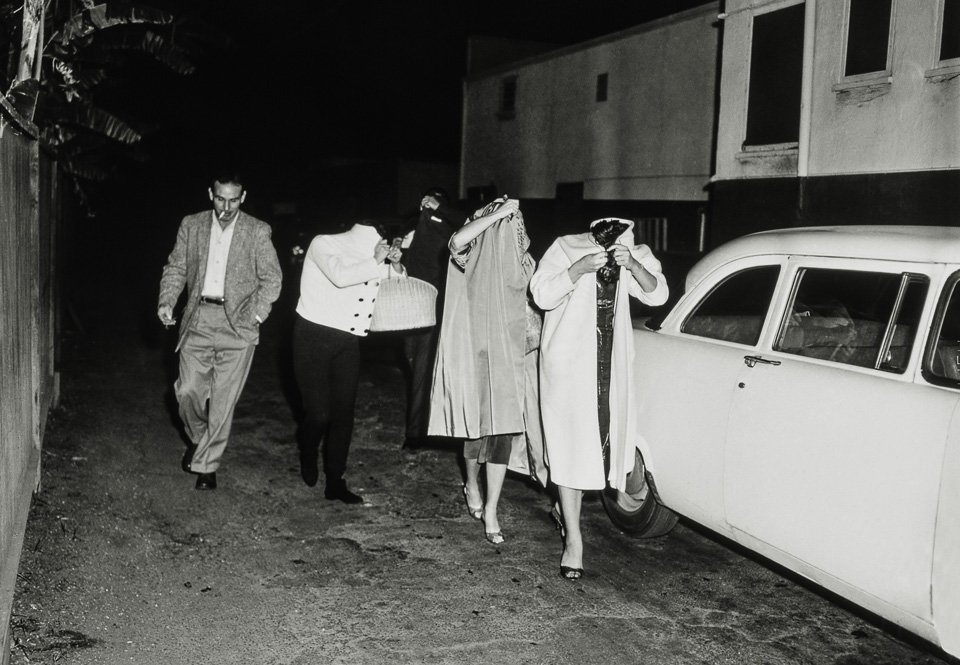
A bevy of hookers cover up after a vice squad raid at the Carolina Pines Restaurant on Melrose Avenue, ca. 1957. Copyright: Cliff Wesselmann, Photo Courtesy of Gregory Paul Williams, BL Press LLC / TASCHEN

Detectives hover over the body of actress Carole Landis, who, after a roller-coaster life of depression and failed marriages, overdosed on Seconal, 1948. Copyright: Jim Heimann Collection / Courtesy TASCHEN

James “Two Gun” Davis was the emblem of L.A. police corruption, 1937. Copyright: Cliff Wesselmann Photo Courtesy of Gregory Paul Williams, BL Press LLC / TASCHEN

Dark City. The Real Los Angeles Noir is available now on Taschen.
Follow Miss Rosen on Twitter.
Enjoyed this article? Like Huck on Facebook or follow us on Twitter.
You might like

In photos: Black Texas life since emancipation
Kinship & Community — A new photobook and exhibition showcases the rich culture, history and community of African American folks in the Lone Star State, whose existence in the region predates colonial Britain.
Written by: Miss Rosen

Youthful joy & end-of-era poignancy at a London school prom
Leavers — For several years, Lewis Khan documented young people as they celebrated the last of their school days and the completion of their exams. The series is now collated in a new self-published photobook and short film.
Written by: Zoe Whitfield

Harry Gruyaert’s vintage, kaleidoscopic scenes of New York
A Sense of Place — For 50 years, the Belgian photographer and Magnum Photos member has been capturing NYC’s colourful chaos. A new photobook and exhibition showcase his unique, technicolour view of the city.
Written by: Miss Rosen

In the pit at one of the UK’s last stock car & banger speedways
Stock Car Racing Isn’t Dead — Photographer Liam McCarthy spent time in and around the Arlington Raceway’s circuit, capturing the diehard community that keeps the sport alive.
Written by: Isaac Muk

Inside Lower Duck Pond, the nicest town on the internet
/r/HaveWeMet — With a population of 2,500 and no fixed location, the subreddit is a space for roleplaying citizens to solve mysteries, host fictional events and ultimately connect. In an internet that’s often divided and toxic, Vicky Jessop hangs out in one of its most wholesome corners.
Written by: Vicky Jessop

A major Nan Goldin exhibition is coming to London
You Never Did Anything Wrong — Opening at the Hayward Gallery in November, the show will debut a new film from the artist and activist, alongside a slate of recent work.
Written by: Jack Dennison-Thompson


