Vintage scenes of suburban America in the 1970s
- Text by Miss Rosen
- Photography by Bill Owens

After serving in the Peace Corps during the 1960s, Bill Owens returned home with the vision of becoming a photographer. “I went back to college and took some photography classes,” he says. “I remember they projected a photograph of a pile of rocks by Aaron Siskind and spent 20 minutes taking out it. Meanwhile there was an anti-war protest going on.”
In 1968, Owens got his first job as a news photographer for the Livermore Independent, a local paper based in a suburb outside San Francisco. On a $110 (£83) week salary, Owens could afford to buy a $2,000 (£1510) house with a two-car garage, and swimming pool for just $99 (£75) down.
Owens, his wife, and two children settled into suburbia well – and soon enough, the young photographer realised there was a story to tell. Owens was fascinated by the cultural mores of mid-century suburban life and sought to create an in-depth portrait that went beyond the shallow, dismissive tropes of suburbia.

We Like to Play War, 1971
At the time, the suburbs had a bad rap. “Malvina Reynolds had a song [‘Little Boxes’] about the ‘ticky tacky’ homes because everyone who lives there must be ‘ticky tacky’ as well,” Owens says.
But he remained resolute, knowing there more to suburbia. Owens envisioned his project as a sociological study inspired by Levittown, which laid the blueprint for the explosion of suburbia across American after World War II.
From the outset Owens crafted a plan, inspire by a visual anthropology class with John Collier. “He told me that when Roy Striker at the FSA sent photographers out in the 1930 and ‘40s they had a shooting script,” Owens says. “So I made my own shooting script and listen 30 things to photograph.”

Richie, 1971

Sunday Afternoon, 1971
Securing a small grant of $3,000 (£2,263) to fund the project, Owen went out every Saturday over the course of the year to document holidays and birthdays, as well as prototypical scenes of suburban life like Tupperware parties, Sunday grilling on the patio, and kids playing on the street.
Envisioning the photographs as a larger project that would eventually become the groundbreaking 1973 book Suburbia, selections from which are currently on view at PDNB Gallery, Owens met the people he photographed six months later with a release form.

‘My dad thinks its a good idea‘, 1971
He then asked them for a comment about the picture, which he included as captions in the book. In Damned Dishes, a woman with curlers in her hair holding a baby stands in her kitchen looking at the sink with contempt. She asked Owens, “How can I worry about the damned dishes when there are children dying in Vietnam?”
“The quote totally flips the image,” Owens says. “It gives you more information, allowing the people to speak for themselves so all of a sudden your stereotypical view of people is gone.”
Half a century later, Owens photographs maintain their fascination and allure, capturing a mythic moment in American life: the apotheosis of the middle class.
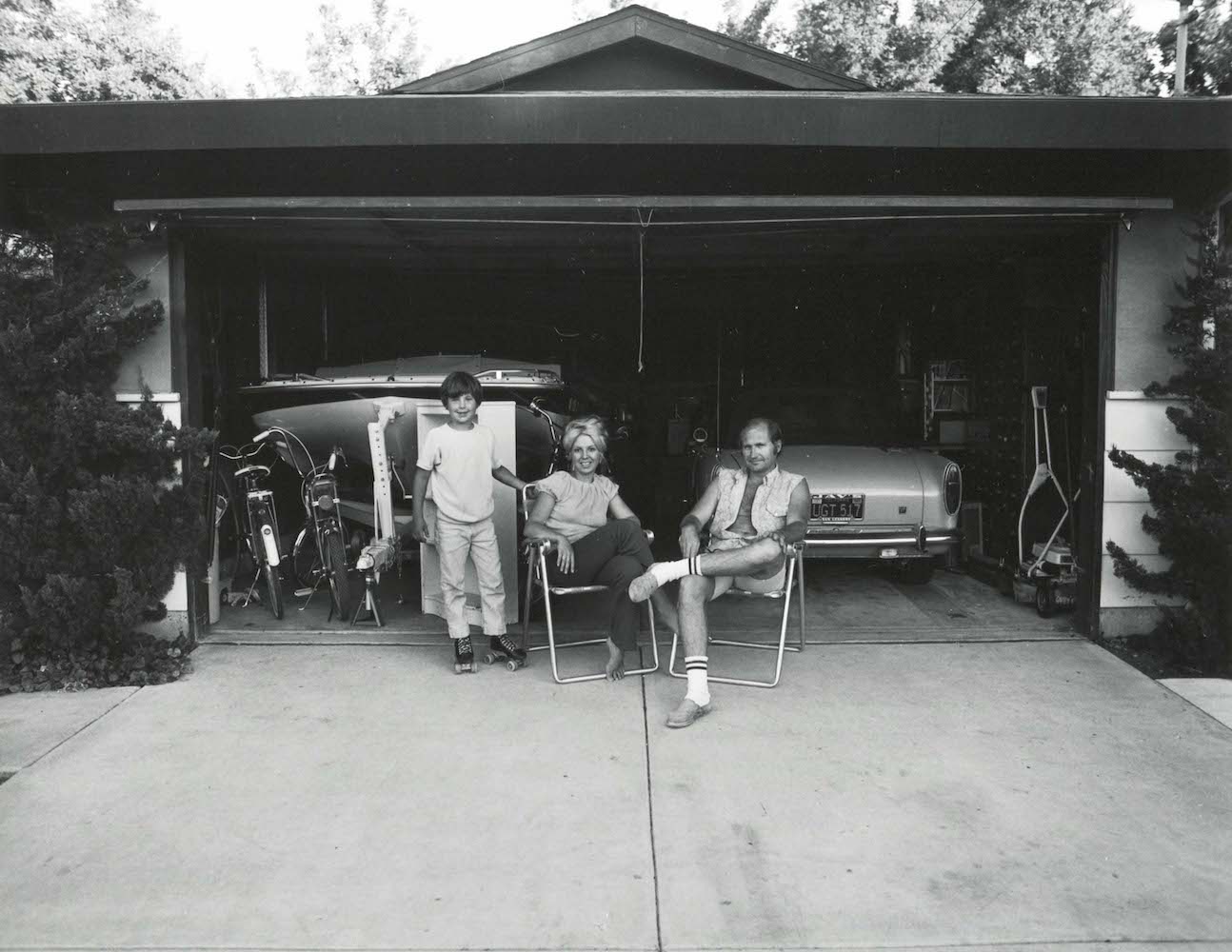
‘Our house is built with the living room in the back, so in the evenings, we sit out front of the garage and watch the traffic go by‘, 1971

‘I enjoy giving a Tupperware party in my house‘, 1971

Monday Tuesday Wednesday Thursday, 1971
Bill Owens: Suburbia is on view at PDNB Gallery in Dallas, Texas, through February 12, 2022.
Follow Miss Rosen on Twitter.
Enjoyed this article? Like Huck on Facebook or follow us on Twitter.
You might like

In photos: Black Texas life since emancipation
Kinship & Community — A new photobook and exhibition showcases the rich culture, history and community of African American folks in the Lone Star State, whose existence in the region predates colonial Britain.
Written by: Miss Rosen

Youthful joy & end-of-era poignancy at a London school prom
Leavers — For several years, Lewis Khan documented young people as they celebrated the last of their school days and the completion of their exams. The series is now collated in a new self-published photobook and short film.
Written by: Zoe Whitfield

Harry Gruyaert’s vintage, kaleidoscopic scenes of New York
A Sense of Place — For 50 years, the Belgian photographer and Magnum Photos member has been capturing NYC’s colourful chaos. A new photobook and exhibition showcase his unique, technicolour view of the city.
Written by: Miss Rosen

In the pit at one of the UK’s last stock car & banger speedways
Stock Car Racing Isn’t Dead — Photographer Liam McCarthy spent time in and around the Arlington Raceway’s circuit, capturing the diehard community that keeps the sport alive.
Written by: Isaac Muk

Inside Lower Duck Pond, the nicest town on the internet
/r/HaveWeMet — With a population of 2,500 and no fixed location, the subreddit is a space for roleplaying citizens to solve mysteries, host fictional events and ultimately connect. In an internet that’s often divided and toxic, Vicky Jessop hangs out in one of its most wholesome corners.
Written by: Vicky Jessop

A major Nan Goldin exhibition is coming to London
You Never Did Anything Wrong — Opening at the Hayward Gallery in November, the show will debut a new film from the artist and activist, alongside a slate of recent work.
Written by: Jack Dennison-Thompson


