We all love drag queens – but what about drag kings?
- Text by Megan Wallace
- Photography by Theo McInnes

“Drag”: a word which conjures up a world of lipstick, lip-syncing and not-so-ladylike behaviour. However, while the movement is typically associated with extreme femininity, there’s a wealth of drag kings out there who are actively reimagining what masculinity can be.
Much like their queen counterparts, aesthetics are only one aspect of a king’s routine. With a playful disregard for convention, they poke fun at established gender roles and keep the audience entertained with a repertoire of dance, comedy, and music.
This, at least, is what Boi Box offers up to both performers and audiences. The cult drag night – which celebrated its fifth anniversary last month at London queer pub The Glory – is the love child of drag king Adam All and his partner (both on and off stage) Apple Derrieres.
Since its inception half a decade ago, Boi Box has grown exponentially. From its early beginnings as “a box of clothes in a Soho basement,” it has managed to become a hub of masculine mischief for the capital’s LGBTQIA community. The night’s ever-growing roster of talent reflects the scene’s rapid development. As Adam, who has been performing in drag for 10 years puts it; “Over the last decade, the drag king community has spread across the UK. Increasing from a handful of performers to well over a hundred kings, it truly feels like just the beginning of a wave of change. I can see the beginnings of a revolution for queer voices and it’s very exciting.”


While you’re likely to have caught an episode or two of Drag Race, the components of a drag king performance might be something of an enigma. So what is the difference?
“Drag kings bring all sorts of different elements to their performances – from live singing and lip syncing to acrobatics and magic,” explains Adam. “Costuming and makeup – particularly facial hair – also plays a big role in the way a King is received and perceived by the audience. I think beneath the various branches and varieties of drag king performance, the common thread is empowerment and freedom of expression.”
Freedom of expression and empowerment are essential elements for high-femme burlesque act Jada Love, who also performs in a baseball shirt and cap as drag king JeRome. Jada explains that, even though her two personas couldn’t seem further apart, they’re a lot more similar than they first appear.
“I’ve been doing burlesque for about eight years and I just got into doing drag over the last year,” she explains. “I like to be able to come on stage and be ultra femme as Jada Love, and switch it to be very masculine as JeRome. I like to be cheeky and have a bit of comedy, but some of my acts are ultra sexy and dark – it depends on how I feel. Personality-wise, JeRome’s a cheeky chappy, whereas Jada likes to get a reaction. They’re different but they’re the same; they love the attention and live for the applause.”
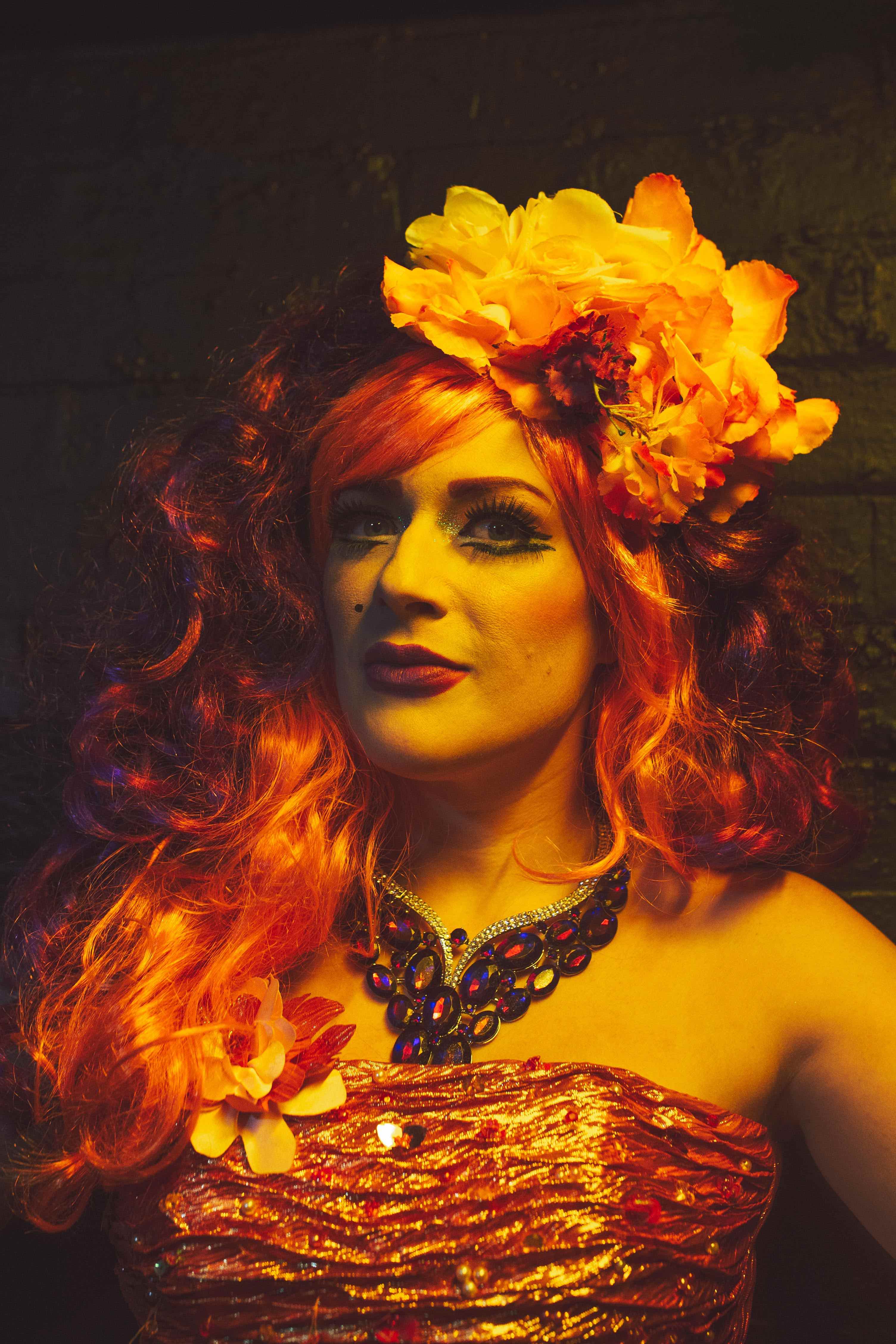

As with cabaret, when it comes to drag anything goes. Performances really can take any shape or form – take the example of Christian Adore and Eaton Messe’s Dragprov Revue. The double act sees king Christian team up with queen Eaton in an improvised comedy act which, more often than not, can get a little political. As Christian attests, gender play might be a lot of fun, but it’s always inherently subversive: “I love drag because it’s an opportunity to explore masculinities which you don’t normally come into contact with, or unpick what masculinities can mean and how that maybe doesn’t gel with who we are as human beings. It can show how gender can be trappings for all people; men, women and non-binary people.”
While drag can demonstrate and ridicule the restrictive nature of gender roles, it can also be a way for trans and non-binary people to celebrate their true gender identities in a space free from judgement and restriction.
This is the case for Romeo De La Cruz, a king whose scintillating drag sets have been tearing up the UK scene for the past six years. Out of costume, Romeo would identify as trans non-binary, and drag has been a powerful tool for self-acceptance: “Drag is a great way, especially for me as a trans-non-binary person, to experience the person you want to be in the future. It was a stepping stone for me to get to where I am today. Drag is a way to bring yourself more self-knowledge.”


Drag king Sammy Silver uses his stage time and comedic song lyrics to explore male identity from the perspective of an AFAB (assigned female at birth) man. “Masculine AFAB are just shamed and told they’re ugly,” he says. “Their masculinity is not something that’s celebrated. Drag kinging was my way into celebrating and showcasing my natural masculinity and it’s made me love me a lot more.”
While performers like Romeo and Sammy are prime examples of drag king’s importance within queer spaces, will kings ever attract the now-mainstream appeal enjoyed by drag queens? “I want with all my heart to see kings heralded as equal to queens but I do feel there is still a long way to go before we reach that point,” says Adam.
“The elements and skills associated with king performance are in some ways completely different to that of queens, we are fighting a different fight with different words and we are speaking from a different platform to a different audience – so naturally the two can’t really be compared. But there are huge similarities in terms of strength, self-ownership, respect and defiance, which are at the base of drag of all kinds. I hope that more people come to understand that. From my perspective, it’s definitely happening.”


Boi Box returns to The Glory on the 25th of October. Tickets can be bought via Outsavvy.
Follow Theo McInnes on Instagram.
Enjoyed this article? Like Huck on Facebook or follow us on Twitter.
You might like

In photos: Black Texas life since emancipation
Kinship & Community — A new photobook and exhibition showcases the rich culture, history and community of African American folks in the Lone Star State, whose existence in the region predates colonial Britain.
Written by: Miss Rosen

Youthful joy & end-of-era poignancy at a London school prom
Leavers — For several years, Lewis Khan documented young people as they celebrated the last of their school days and the completion of their exams. The series is now collated in a new self-published photobook and short film.
Written by: Zoe Whitfield

Harry Gruyaert’s vintage, kaleidoscopic scenes of New York
A Sense of Place — For 50 years, the Belgian photographer and Magnum Photos member has been capturing NYC’s colourful chaos. A new photobook and exhibition showcase his unique, technicolour view of the city.
Written by: Miss Rosen

Inside Lower Duck Pond, the nicest town on the internet
/r/HaveWeMet — With a population of 2,500 and no fixed location, the subreddit is a space for roleplaying citizens to solve mysteries, host fictional events and ultimately connect. In an internet that’s often divided and toxic, Vicky Jessop hangs out in one of its most wholesome corners.
Written by: Vicky Jessop

A major Nan Goldin exhibition is coming to London
You Never Did Anything Wrong — Opening at the Hayward Gallery in November, the show will debut a new film from the artist and activist, alongside a slate of recent work.
Written by: Jack Dennison-Thompson

Tender portraits of women serving life sentences in America
Looking Inside — While working as a public defender attorney in New York State, Sara Bennett found dilapidated prisons and forgotten people. Her new photobook harnesses the power of images and shines a humanising light on those imprisoned for serious crimes and their reintegration into society, while asking questions of the USA’s incarceration system.
Written by: Miss Rosen


