So what comes next for Extinction Rebellion?
- Text by Ben Smoke
- Photography by Theo McInnes

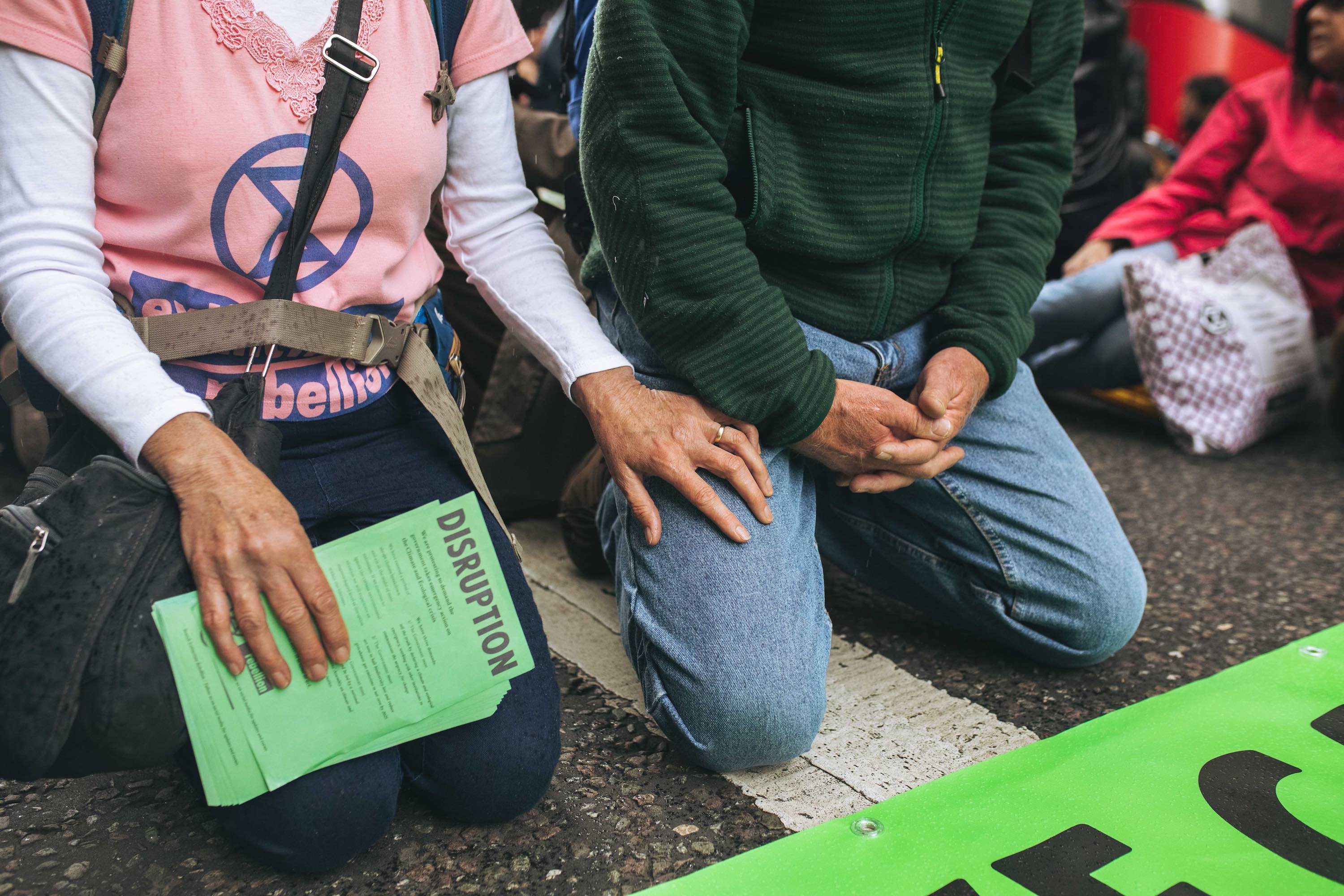
Today, 11 days after it began, Extinction Rebellion (XR)’s first stage of action on climate change came to an end. The group, launched last November, began their ‘international rebellion’ last Monday at London’s Marble arch. In the following days, over 1,000 people were arrested in actions that saw key parts of the city targeted, including Waterloo Bridge, Oxford Circus and Canary Wharf.
The actions had three key aims: to get the government to tell the truth on climate change, to bring greenhouse net emissions to zero by 2025, and to create a citizen’s assembly on ecological and climate justice. In the run up to the launch, much of the rhetoric around the use of mass arrests prompted concern from activists across the movement – myself included.
As the dust settles, now is the time to take stock – to look at what the movement achieved, whether the concerns of people like me were founded, and where XR can go next.
Extinction Rebellion are the largest set of climate protest and actions in the UK in a decade. At one point, camps and occupations were in place at Parliament Square, Marble Arch, Oxford Circus and Waterloo Bridge (each represent a key point in the city’s overly congested travel network). The reclamation of a space normally reserved for polluting vehicles was undoubtedly one of the most valuable material elements of the action. Instead of the usual cloud of exhaust fumes, there were trees, plants and space for workshops on Waterloo bridge, and a set of solar panels at Marble arch. It’s one thing to imagine what the busiest parts of our city could be like without cars, but to see it in action was something else altogether.
The XR occupations gave us the opportunity to radically reimagine what our cities could look and feel like if we weren’t beholden to vehicles, and that was just the beginning.

Since the infamous pink boat moved into place in Oxford circus, XR hasn’t been far from the front pages. In doing so, it placed climate change at the heart of the conversation in a way that it has rarely been up until now. Actions at the Shell building, Canary Wharf and the London Stock Exchange centred that conversation on the biggest offenders in greenhouse emissions.
Earlier this week, Swedish teenager Greta Thunberg, who started a climate strike outside the Swedish Parliament last summer, spoke in Westminster, calling out MP’s for their ‘irresponsible’ lack of action on climate change and Britain’s ‘creative’ accounting where carbon emissions were concerned. In the aftermath, environment secretary Michael Gove admitted that much more must be done, and agreed to meet with XR activists.
It is without argument, that there has been an effectiveness to XR’s relentless tactics – the bringing of a government minister to the negotiating table being a testament to that – but underneath this sheen of (potentially) superficial success, there are still big questions to be answered.
In the week and a half since actions started, there have been a number of controversies involving XR comms and activists, particularly surrounding interactions with the metropolitan police.
On Wednesday last week, XR tweeted a video of an activist talking about having a chat with the police whilst in custody – something which protest law experts repeatedly warn against. Elsewhere, a video emerged of XR activists saying ‘we love you’ to hordes of the police as they marched into a throng of protestors on Waterloo Bridge. More worryingly, reports of XR activists calling the police on two young people of colour surfaced. The two were accused of pickpocketing, and once searched by the police – who found nothing – were then subjected to immigration checks.
 Incidents like this in their isolation are, at best, unfortunate, and can be put down to the inherent messiness of a rapidly expanding movement: one that jumped from hundreds to thousands of activists in a matter of hours. The worry, however, is that they belay something more troubling underneath.
In the last 30 years there have been 1705 deaths in police custody. Most of those have been people of colour. The environmental movement has, historically, been incredibly white, with a lack of diversity being one of the key accusations levelled at XR. At a time when black people are 4.3 per cent more likely to be stopped and searched by the police than white people – and BAME people make up 25 per cent of the prison population, despite representing just 14 per cent of the population – the messages of cooperation and geniality with the police strike a deaf tone.
The infiltration of environmental groups by undercover officers – particularly those who formed sexual relationships with activists, have left scars on the movement – and rightly so. That lessons around the lengths the state will go to to quell environmental activism appear to be easily forgotten or ignored, which is a bitter pill for many to swallow.
As arrested activists move from custody to courtroom, questions remain about XR’s tactics and capacity to support those facing charges, as three activist remain held on remand. Behind closed doors, those involved in the legal cases have called it ‘chaos’.
The reality, though, is that XR has been wildly more successful than any of us could have ever dared to dream. That there are issues is perhaps indicative of this. Will Mccallum, ocean lead at Greenpeace wrote on Twitter: ‘Is this what social movements are like? messy, emotional, inspiring..’ – and perhaps he’s right. For those of sitting on the sidelines, still unsure, perhaps it is time to engage. To empower and embolden the movement with our shared wisdom, to learn from the energy, the ideas and the excitement of those involved; to work together to make a more perfect movement, and a better world.



Follow Ben Smoke on Twitter.
Enjoyed this article? Like Huck on Facebook or follow us on Twitter.
You might like

London’s largest indoor skatepark to be demolished for padel courts
Better Extreme — The Barking skatepark’s fate follows that of similar indoor spaces in recent years, with operators GLL citing falling visitor numbers as the reason behind the decision.
Written by: Isaac Muk

Youthful joy & end-of-era poignancy at a London school prom
Leavers — For several years, Lewis Khan documented young people as they celebrated the last of their school days and the completion of their exams. The series is now collated in a new self-published photobook and short film.
Written by: Zoe Whitfield

A major Nan Goldin exhibition is coming to London
You Never Did Anything Wrong — Opening at the Hayward Gallery in November, the show will debut a new film from the artist and activist, alongside a slate of recent work.
Written by: Jack Dennison-Thompson

Tender portraits of women serving life sentences in America
Looking Inside — While working as a public defender attorney in New York State, Sara Bennett found dilapidated prisons and forgotten people. Her new photobook harnesses the power of images and shines a humanising light on those imprisoned for serious crimes and their reintegration into society, while asking questions of the USA’s incarceration system.
Written by: Miss Rosen

Activists replace Union Jacks with ‘Tax The Rich’ flags in Farage’s Clacton
Take Back Power — It comes after the Reform UK leader resigned as an MP and triggered a by-election in the constituency, following scrutiny over a £5 million donation that he had not declared.
Written by: Ella Glossop

Tish Murtha’s searing documentation of broken Britain
Vandalism on a Grand Scale — Capturing youth unemployment and poverty in north-east England during the ’80s, the photographer never lived to see her work published. A new photobook by British Culture Archive brings her eye-opening work to light.
Written by: Miss Rosen


