Shooting the faded glory of Britain’s seaside shelters
- Text by Niall Flynn
- Photography by Will Scott

Picture the scene:
You, your entire family and at least three inflatables, packed like sardines into a four-door saloon, hurtling down the motorway on your way to the beach. The sun’s shining, there’s not a cloud in the sky and your sister’s well on her way to being off her head on travel sweets. Life’s grand.
Except, of course, when you get there, it rains. It rains like its angry. A biblical kind of rain, so nasty and relentless that you forget what it was like to ever feel truly safe. Your sister is crying. You want to go home, but your parents won’t budge. “Well, we’re here now,” says your mum, resolute as the wind shakes the car. “We might as well try and enjoy it.”


Chances are, if you grew up in the British Isles, the fated trip to the seaside is something you know all too well. It’s a rite of passage: journeying across the country to find a beach, only to get there and moan about the weather.
For photographer Will Scott, Britain’s relationship with its seaside towns has always been a point of fascination. Raised in North Berwick, Scotland, he’d grown up witnessing it first-hand. However, it was only stumbled across some images of beach shelters – bygone structures, built to protect holidaymakers from the elements – that he saw the opportunity for a project.
“I knew straight away it would work as a series and when I realised it hadn’t been done before, I made a list and started shooting them,” he explains. “I think the fact that they are so small – and often one-offs – makes them really interesting individually, as they are so unique. And as a set, it’s fascinating seeing the differences between eras and towns.”


Over the course of three years, Scott travelled across Britain, hopping from town to town. Today, the photos make up Seaside Shelters, a book (and accompanying exhibition) that maps his journey via the structures he shot.
For him, the structures depict a faded glory: a time when urban development didn’t answer to a grand plan, and where one person find themselves responsible for shaping the aesthetic of an entire town’s seafront. Above all, though, the project is an ode to the Great British holiday – rain and all.


“In an age when much of our urban built environment is becoming more uniform I think its important to recognise the places that are retaining their own character and I think that the shelters often do reflect ‘their’ towns,” Scott adds. “Brits love to moan about the weather, too hot, too cold, too wet – and the shelters existence is based on the UKs changeable weather.”
“I remember going on family holidays, always [in] the UK, and it didn’t really matter what the weather forecast was. If you decided you were going to the beach, you went. I shot it with a similar mindset!”


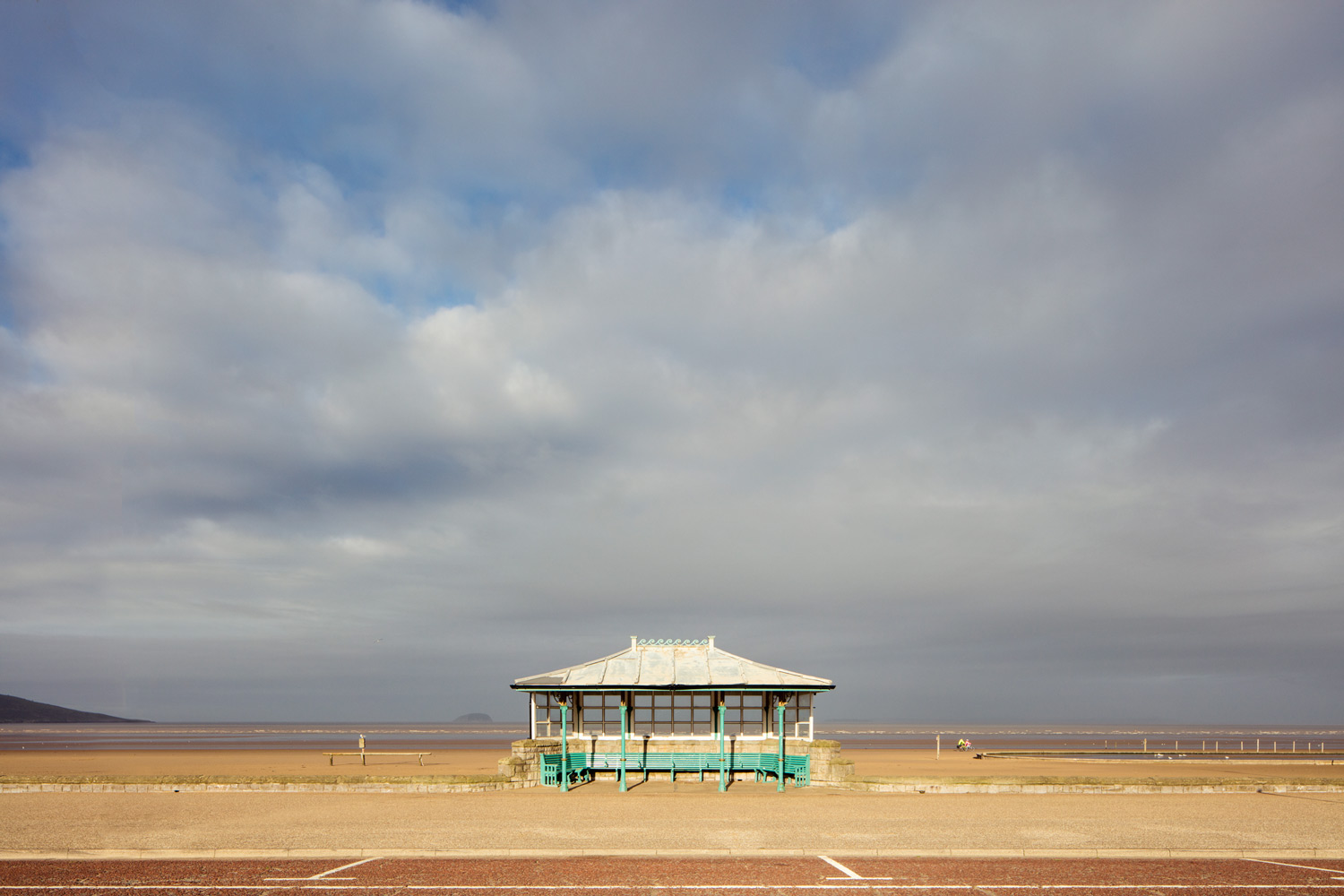
 Seaside Shelters is available now from HENI Publishing.
The exhibition is showing at HENI Gallery from 20 July – 19 August, 2018.
Enjoyed this article? Like Huck on Facebook or follow us on Twitter.
You might like

In photos: Black Texas life since emancipation
Kinship & Community — A new photobook and exhibition showcases the rich culture, history and community of African American folks in the Lone Star State, whose existence in the region predates colonial Britain.
Written by: Miss Rosen

Youthful joy & end-of-era poignancy at a London school prom
Leavers — For several years, Lewis Khan documented young people as they celebrated the last of their school days and the completion of their exams. The series is now collated in a new self-published photobook and short film.
Written by: Zoe Whitfield

Harry Gruyaert’s vintage, kaleidoscopic scenes of New York
A Sense of Place — For 50 years, the Belgian photographer and Magnum Photos member has been capturing NYC’s colourful chaos. A new photobook and exhibition showcase his unique, technicolour view of the city.
Written by: Miss Rosen

In the pit at one of the UK’s last stock car & banger speedways
Stock Car Racing Isn’t Dead — Photographer Liam McCarthy spent time in and around the Arlington Raceway’s circuit, capturing the diehard community that keeps the sport alive.
Written by: Isaac Muk

Inside Lower Duck Pond, the nicest town on the internet
/r/HaveWeMet — With a population of 2,500 and no fixed location, the subreddit is a space for roleplaying citizens to solve mysteries, host fictional events and ultimately connect. In an internet that’s often divided and toxic, Vicky Jessop hangs out in one of its most wholesome corners.
Written by: Vicky Jessop

A major Nan Goldin exhibition is coming to London
You Never Did Anything Wrong — Opening at the Hayward Gallery in November, the show will debut a new film from the artist and activist, alongside a slate of recent work.
Written by: Jack Dennison-Thompson


