‘Women have only one way to survive: learning to fight’
- Text by Eva Clifford
- Photography by Alessandro Grassani

The Democratic Republic of Congo (DRC) has endured decades of widespread sexual violence by government forces and militia groups – especially in the eastern conflict zones. Unsurprisingly, those most affected are women and children.
Widely dubbed the ‘rape capital of the world’, the city of Goma, capital of the DRC’s North Kivu province, is one of the world’s worst places to be a woman. Yet against this backdrop of daily violence and injustice, women are donning boxing gloves and learning to fight.
Photographer Alessandro Grassani landed in the DRC for the first time on assignment for an Italian NGO called AVSI, which runs several clinics in the region to provide support for the most vulnerable, specifically women who have been victims of violence. While documenting the NGO’s work, he had the opportunity to meet and converse with these women, hearing firsthand about the horrific violence they had experienced.
“I was so impressed by their stories, particularly by their desire to react and forget this dramatic past, that I felt the need to work on a story about women in the DRC, without reducing them to victims of any sort of injustice,” explains Grassani. “Instead, I wanted to represent them as protagonists of their own destinies.”

Democratic Republic of Congo. Goma. 28/05/2018. 18 year-old Blandini portrayed on the building site where she occasionally spend her nights. She trains in the so-called Friendship Boxing Club.
Grassani knew about the women boxers before arriving in the DRC, but it was only when he was in Goma himself that he realised focusing on this story was the right choice.
Accompanied by writer Carlo Marsilli, Grassani spent 10 days in the DRC, during which time he paid several visits to the boxing clubs, mainly The Club de l’Amitié (The Friendship Club), situated inside Les Volcans stadium and the Radi Star Girls Club.
The Friendship Club is run by coach Balezi Bagunda (aka Kibomango), a Congolese ex-child soldier and ex-boxing champion. Abandoning the ring to dedicate himself to teaching boxing, his club now accommodates a group of women who have found hope and passion in boxing.
“The spirit of the club is that of a family,” says Grassani, “and in a certain sense, Kibomango is the father who, through sport, helps his members have a purpose and objective in life.”
The Radi Star Girls Club is an all-woman boxing club captained by coach Gabriel Moke, an ex-amateur boxer who trains his daughters, granddaughters and other girls living in the vicinity.
“Some of these female boxers are boxing for passion, some to become a champion, some to find a purpose in life and abandon street life, but all of them are boxing to feel stronger and more prepared to face their everyday life and be able to defend themselves,” says Grassani.

Democratic Republic of Congo. Goma. 24/05/2018. Aimerance, 16 years old, portrayed during the daily boxing training session at the Radi Star Girls Boxing Club.
“I asked each of the women if there was a link between the violence of the place they live and their boxing practice, and to tell it in the words of one of the boxers I met, this is the answer: ‘women here have only one alternative to survive: learning to fight.’”
Frequently, Grassani was met with stories of horrific violence. He recalls one story in particular of a woman named Blandini, who has been living on the streets since she was abandoned by her family. One night she was raped, covered with petroleum and set alight by a group of men. Now, burns cover her body, a perpetual reminder of that night. In the DRC, stories like Blandini’s are not uncommon.
Discriminatory social norms are highly restrictive for women in Congolese society – particularly married women, and often place them at greater risk, fuelling permissive attitudes towards gender-based violence.
Despite these societal pressures, Grassani says that, “at the official boxing clubs and the Radi Star Boxing Club, there are women like Gracia Elga, who has a job and a normal life and her dream is to leave Africa, go the USA to become a champion like Mohammed Ali, earn enough money and then return to Goma and open an orphanage for the local abandoned kids.”
Listening to stories like Gracia and Blandini’s was fundamental to the project and helped build trust with the women. “I’m not the kind of photographer who thinks he’s found the story and the subject to photograph. On the contrary, I believe that there was a ‘meeting’ between us and that these women decided to be portrayed by me because they trusted me, and the trust they placed in me is equivalent to the respect I feel for them.”

Democratic Republic of Congo. Goma. 25/05/2018. Nadine, 17 years old, portrayed during the daily boxing training session in the old football stadium of the popular district of Birere.
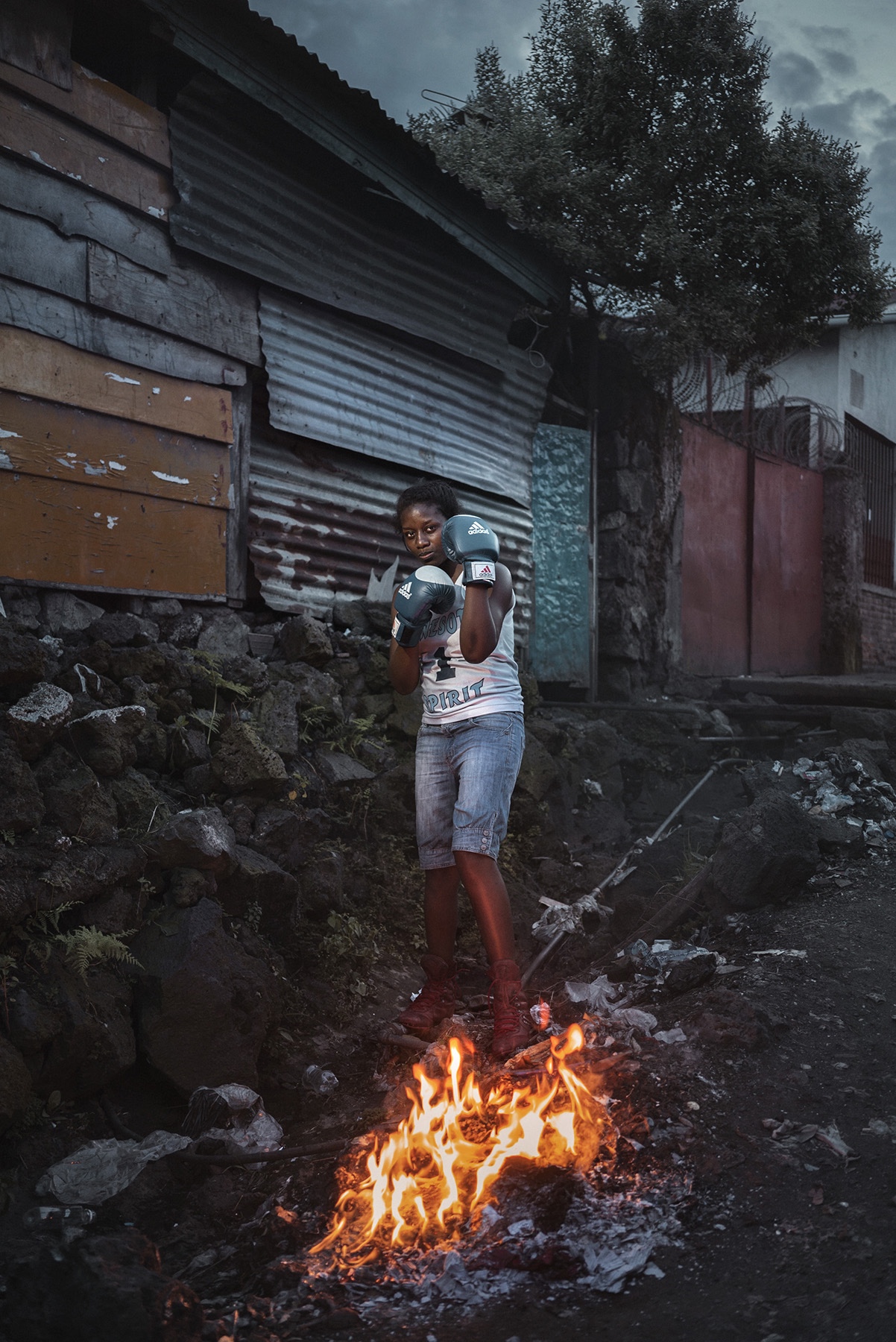
Democratic Republic of Congo. Goma. 24/05/2018. Asitu, 24 years old, portrayed on the streets of Goma just in front of the Radi Star Girls Club.

Democratic Republic of Congo. Goma. 29/05/2018. Elysèe, 16 years old. portrayed on the streets of central Goma, She is part of one of the official boxing clubs of the city.

Democratic Republic of Congo. Goma. 25/05/2018. Gracia Elga, 18 years old, portrayed during the daily boxing training session at the Radi Star Girls Boxing Club.

Democratic Republic of Congo. Goma. 25/05/2018. 14 year-old Anna portrayed during the daily boxing training session in the old football stadium. She trains in the so-called Friendship Boxing Club.
Alessandro Grassani’s series Boxing Against Violence: The Female Boxers of Goma was awarded First place in the Sport category at the 2019 Sony World Photography Awards.
Enjoyed this article? Like Huck on Facebook or follow us on Twitter.
You might like

In photos: Black Texas life since emancipation
Kinship & Community — A new photobook and exhibition showcases the rich culture, history and community of African American folks in the Lone Star State, whose existence in the region predates colonial Britain.
Written by: Miss Rosen

Inside Parkuir: the art project queering sport, space and our bodies
Lie and play — Founded by Maria Laudes and Guiu Gimeno, it provides a framework for engaging, subverting, and celebrating the small details that make people unique – and queer.
Written by: Molly Lipson

London’s largest indoor skatepark to be demolished for padel courts
Better Extreme — The Barking skatepark’s fate follows that of similar indoor spaces in recent years, with operators GLL citing falling visitor numbers as the reason behind the decision.
Written by: Isaac Muk

Youthful joy & end-of-era poignancy at a London school prom
Leavers — For several years, Lewis Khan documented young people as they celebrated the last of their school days and the completion of their exams. The series is now collated in a new self-published photobook and short film.
Written by: Zoe Whitfield

Harry Gruyaert’s vintage, kaleidoscopic scenes of New York
A Sense of Place — For 50 years, the Belgian photographer and Magnum Photos member has been capturing NYC’s colourful chaos. A new photobook and exhibition showcase his unique, technicolour view of the city.
Written by: Miss Rosen

In the pit at one of the UK’s last stock car & banger speedways
Stock Car Racing Isn’t Dead — Photographer Liam McCarthy spent time in and around the Arlington Raceway’s circuit, capturing the diehard community that keeps the sport alive.
Written by: Isaac Muk


