The Naked Truth: Protestors strip bare to demand fair access to drugs
- Text by Michael Segalov
- Photography by Seb Heseltine

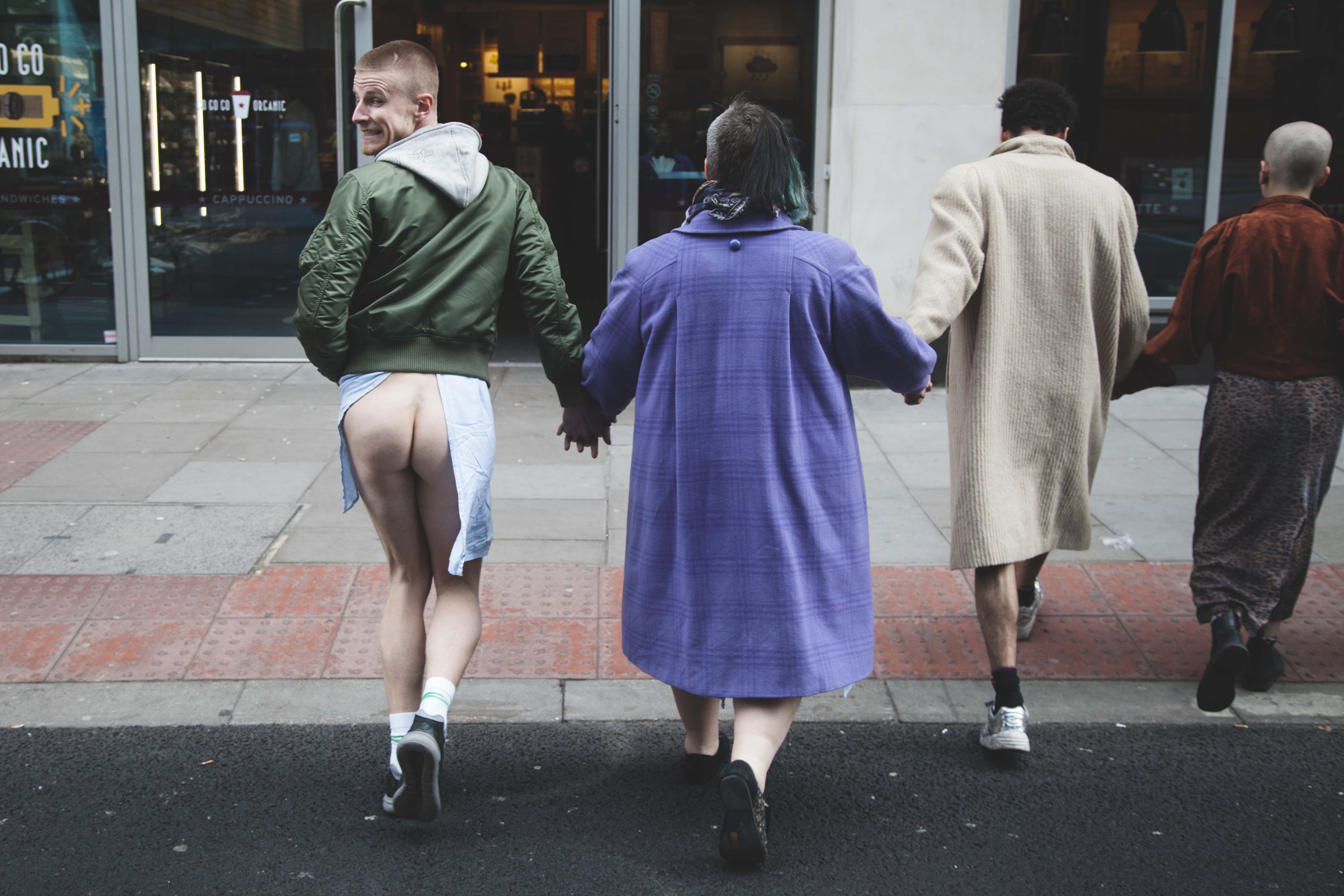
“Act Up, fight back, fights AIDS” echoed through High Holborn this afternoon, as a slightly bizarre looking crowd of people darted towards an imposing glass fronted building in central London.

As a bemused looking security guard watched on, five protestors stripped off their specially donned hospital gowns and stood brazenly in the window, the word “greed” carefully painted out on their skin. The action, co-ordinated alongside 25 healthcare advocacy groups spanning 6 continents, was part of a wave of 11 protests taking place across the globe.

The London leg of the protest was targeting international drug company Gilead, who despite making billions in profits continue to charge tens of thousands of pounds for lifesaving hepatitis C treatments.
“The current system enables big pharma to charge extortionate costs for life saving medication”, Jake Chambers told me, as Gilead staff watched on from above. “They’re preventing millions of people accessing lifesaving treatment, 10 million people die every year because of this, and 2 billion people don’t get the drugs that they need.”
Back outside the chanting grew louder, as bright pink banners unfurled, spelling out “Pharma Greed Kills” combined with the naked bodies lining the floor to wall glass.

“I’m here to fight pharma greed,” Clare told me, while photographers and passers by stopped to capture the action. “We want to call to account pharmaceutical corporations around the world for the lack of equal access to lifesaving medicine and treatments – we demand that there’s broader access to treatments irrespective of the individuals ability to pay.”

As another large banner blocked traffic heading through the city, Dani Singer spoke to me from their nude window spot. “The NHS is obliged to pay the exorbitant prices set by an oligarchy of pharmaceutical giants. The public won’t be taken for fools by Big Pharma anymore!”
A recent U.S. Senate report found that Gilead put profit ahead of hepatitis C patients, pointing out that in Indiana, the Medicaid programme spent an extortionate $40 million to treat just 462 people.

Jake
In the United Kingdom NICE, the National Institute for Health and Care Excellence, offer commission guidelines to the NHS, suggesting what they can and can’t prescribe to patients. They reported that a 12 week course of Gilead’s hep C medication, Solvadi and Harvoni, comes to a staggering £38,979.99.
NICE estimate that if Sovaldi was used by every patient in its licensing remit, the cost would top £1 billion, stating this is “prohibitive”, and that it “could not be considered a cost-effective use of NHS resources.”

“There’s been studies that show the manufacturing cost of these drugs is between $60-$250”, Jake continued, as passing taxis slowed down to take a peak. “It’s an outrage.”
The campaigners are calling on people around the globe to commit to direct action, as they say other means of campaigning have not yet been working. “These problems have been going on for years”, Jake continued, “Act Up started in 1980, and we’ve been fighting these polices for over 30 years.

The campaigning may have spanned three decades, but in reality nothing has changed.
“We’re calling on governments to adopt police frameworks to prevent these extortionate prices legal to charge, and for a review of Research and Development policies to allow great equality in access to treatments.”

Another protestor, Dan, explained that in a climate of austerity, the NHS “simply cannot afford to pay the £5.8 billion in drug purchases they spent last year. “Public money should not be used to line the pockets of wealthy shareholders,” he said.
Huck has approached Gilead for a comment.
You might like

Defiant photos of New York’s ’80s & ’90s queer activists
Arresting Images — Dona Ann McAdams’ photographs document the AIDS crisis, lesbian organising and civil disobedience from one of the most fraught eras in American LGBTQ+ history. A sale of her archive takes place later this month.
Written by: Sydney Lobe

Joe Bloom’s View From a Bridge
More stories, more human — The artist and creator of the vertical video generation’s most loved storytelling platform explains the process behind creating the show, and the importance of bucking trends.
Written by: Isaac Muk

New documentary spotlights Brixton’s community in the face of gentrification
Beyond Brix & Mortar — With property prices rising by 1,700% since the ’80s, the film explores the rich cultural history of the area’s Afro-Caribbean community, and the threat to the area’s soul.
Written by: Sydney Lobe

In photos: Euphoric joy at the UK’s biggest ever anti-racism march
Together — 500,000 people marched through central London on Saturday to protest the far right and racism, followed by a packed House Against Hate rave taking place in Trafalgar Square.
Written by: Isaac Muk

In photos: The newsagents keeping print alive
Save the stands — With Huck 83 hitting shelves around the world, we met a few people who continue to stock print magazines, defying an enduringly tough climate for physical media and the high street.
Written by: Ella Glossop

The last days of St Agnes Place, London’s longest ever running squat
Off the grid — Photographer Janine Wiedel spent four years documenting the people of the Kennington squat, who for decades made a forgotten row of terraced houses a home.
Written by: Isaac Muk


