London’s ‘public’ spaces are not as free as they seem
- Text by Tom Jamieson
- Photography by Tom Jamieson

London’s ever-changing landscape is not in itself news. The city seems to reinvent itself on a near-daily basis. But over the last two decades a new phenomenon has emerged – though you’d be excused for having missed it.
As huge areas of the city have been re-developed, great swathes of previously common land have been privatised and sold off to corporations. These ‘pseudo-public’ spaces are everywhere – and they aren’t as ‘free’ as they seem.
Guardian Cities recently published a map identifying 50 such spaces in London, but there are countless more. This is a trend not seen in the city since the 17th century when segregated and sealed-off areas existed in certain areas of London.

Despite their outward appearance – lovely looking squares with nice little features like benches and fountains – these areas are not public spaces. Instead they are governed by their own opaque rules, which vary from site to site depending on the whims of corporate owners.
In some areas, selfies are banned. In others, you aren’t allowed to nap. Most withhold the right to stop all political demonstrations, as was seen in the 2011 eviction of Occupy protesters from Paternoster Square, private land owned by the Mitsubishi Estate. But these rules are seldom, if ever, made public or delivered in a transparent way.
I first became aware of these spaces through skateboarding. Growing up skating in London, you get used to being told to move on, not by police or other civil bodies but by privately hired guards. These areas are just another example of control being exercised over ‘free space’ – and I mean that in the widest possible sense.
It’s happening everywhere, from not being allowed to snooze in the park, to the internet no longer being the free space we were brought up to believe it could be. It’s happening in every aspect of our lives.
To dig further, I decided to go for a walk. My first destination is City Hall and the 13-acre More London estate, owned by the sovereign wealth fund of Kuwait. The square is littered with people taking naps during their lunch break, a potential offence depending on the land owners’ rules.
Every bench is lined with ‘skate stoppers’, a frequent sight in most public areas much to the annoyance of skateboarders across the UK.
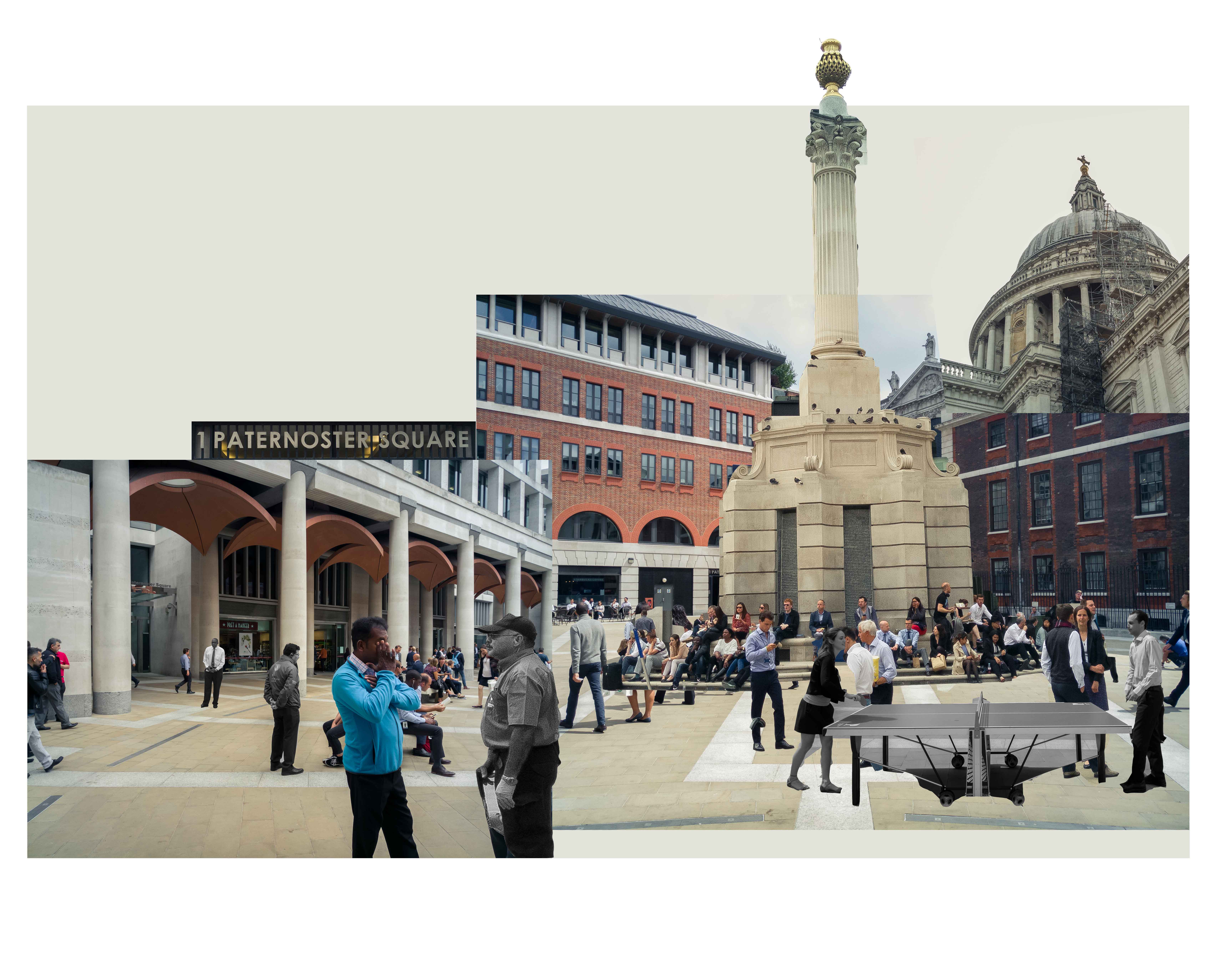
At Paternoster Square next to St Paul’s, there’s a large television screen blasting out corporate messages, table tennis and what appears to be multiple guards on patrol. At Granary Square, on the Kings Cross estate, the story is much the same.
Security guards wander around while families with children run through the fountains. People sit around on benches that are designed to stop anyone from falling asleep. It’s a bizarre mixed message that seems to welcome people in, but only for so long and on somebody else’s terms.
As a photographer, my job is to push beyond surface scenes like these and find a moment that holds a broader message. In this instance, a smartphone was more unobtrusive than a camera and allowed me to operate below the radar. I wanted to explore how these spaces feel and how they make people behave.
I was also looking for private surveillance features, examples of what is known as ‘defensive architecture’: CCTV cameras, benches specially designed to prevent homeless people sleeping on them, and those annoying little metal knobs that ruin perfectly skateable features.
 It’s only when I got home, and started manipulating what I had shot, that things began to click. I created the images as hi-res RAW files and then turned them into a collage, combining various elements I found interesting into one final frame.
In making these images, and manipulating what I saw, I’m reaching for a deeper truth. You’re not supposed to notice tools of control – security cameras, skate stoppers or the cleaners walking around with earpieces in their ears. You’re not supposed to question why everything is disguised in this horrible corporate fluffiness, with TV screens and deck chairs placed next to office blocks. Our environment is being fundamentally changed, and not everyone is welcome. Maybe it’s time we opened our eyes.
Pivot Points: Stories of Change from Huck Photographers are shot entirely on the KODAK EKTRA Smartphone, a 21 megapixel camera with 4K video capability.
Enjoyed this article? Like Huck on Facebook or follow us on Twitter.
You might like

The last days of St Agnes Place, London’s longest ever running squat
Off the grid — Photographer Janine Wiedel spent four years documenting the people of the Kennington squat, who for decades made a forgotten row of terraced houses a home.
Written by: Isaac Muk

How Japan revolutionised art & photography in the ’60s and ’70s
From Angura to Provoke — A new photobook chronicles the radical avant-garde scene of the postwar period, whose subversion of the medium of image making remains shocking and groundbreaking to this day.
Written by: Miss Rosen

In west London, Subbuteo is alive and flicking
London Subbuteo Club — The tabletop football game sees players imitate vintage teams with tactics and tiny painted replica kits. Ryan Loftus takes a trip to Fulham to meet a dedicated community and witness a titanic Brazil vs Coventry City showdown.
Written by: Ryan Loftus

Artifaxing: “We’ve become so addicted to these supercomputers in our hands”
Framing the future — Predominantly publishing on Instagram and X, the account is one of social media’s most prominent archiving pages. We caught up with the mysterious figure behind it to chat about the internet’s past, present and future, finding inspiration and art in the age of AI.
Written by: Isaac Muk

The lacerating catharsis of body suspension in Hong Kong
Self-Ferrying — In one of the world’s most densely packed cities, an underground group of young people are piercing their skin and hanging their bodies with hooks in a shocking exploration of pain and pleasure. Sophie Liu goes to a session to understand why they partake in the extreme underground practice.
Written by: Sophie Liu

What we’re excited for at SXSW 2026
Austin 40 — For the festival’s 40th anniversary edition, we are heading to Texas to join one of the biggest global meetups of the year. We’ve selected a few things to highlight on your schedules.
Written by: Huck


