
A heartwarming portrait of pre-gentrification Bushwick

When American photographer Meryl Meisler arrived in Bushwick, Brooklyn, for a job interview at I.S. 291 Roland Hayes in December 1981, she was shocked at the state of the neighbourhood.
“I got out of the subway and everything was boarded up or burned down. It looked like there was a war going on but this was a quiet time,” she recalls. “I thought to myself, ‘It’s a week before Christmas and there’s a job opening? Maybe the other art teacher was killed.’”
Meisler, who had previously been a hostess in Manhattan’s famous go-go bars, arrived at the junior high school on Palmetto Street. The school stood at the edge of an area that had been destroyed by a devastating fire that wiped out 23 buildings that occurred just one week after the infamous 1977 blackout unleashed a wave of arson and looting across the community.

Palmetto St., Bushwick, Brooklyn, NY, 1982
Four years later, Bushwick remained in dire straits, with 45 per cent of the population living below the poverty level. “I later found out it had one of the highest vacancy rates in the city – people were leaving,” says Meisler.
Upon arriving at I.S. 291, Meisler was enveloped in a sea of frenetic energy typical of middle schools and she met with the principal. “He was dressed in a three-piece suit – very refined, despite the sense of chaos in the air,” she remembers. Meisler took the job.
“I didn’t carry a camera at first because of the danger. While teaching on the Lower East Side, I was robbed in school – so I wasn’t going to be an idiot twice,” she says.

The School Yard Fence Face to Face, Palmetto St., Bushwick, May 1983
But her love of photography triumphed and Meisler began capturing everyday scenes in school and around the community. Forty years later, a selection of the images from Meisler’s first three books is now on view in Paradise Lost & Found: Bushwick, which has been installed on the chainlink fence outside I.S. 291.
“I’ve always wanted to show this work in Bushwick,” says Meisler, who teamed up with current Principal Janice E. Bruce to co-curate the exhibition. “Ms. Bruce is probably the same age as the kids in the photographs. She’s a success story – she went to Cornell University, came back, taught in other schools in the neighbourhood, then became the principal here.”

Beauty Salon, Bushwick, circa 1984
As an insider, Bruce’s experience gave her the necessary insight to co-curate the exhibition to ensure it would resonate for students and members of the community alike. After the exhibition went up, Meisler ran over in the morning to see it for herself. “A lot of people still lived on the block, went to the school, or to the church across the street are still in the neighbourhood. The current custodian at I.S. 291 recognised his niece and nephew in one of the pictures!”
Someone asked if I was the photographer because I was wearing a camera around my neck. I said, ‘Yes,’ and they told me, ‘This is so uplifting!’”

Bus Study, Bushwick, September 1983

Sneakers, I.S. 291, Bushwick, Brooklyn, 1984
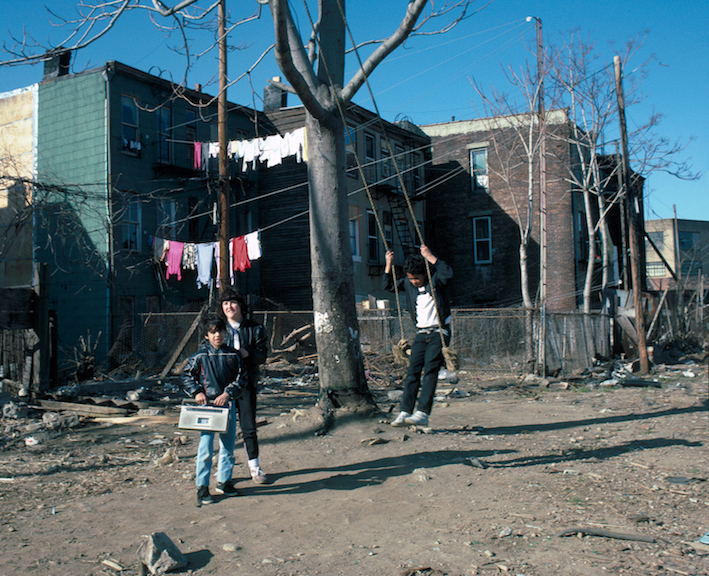
Boom Box, Swing, and Laundry, Bushwick, Brooklyn, NY. March 1983

Bushwick, Brooklyn, NY circa 1984
Meryl Meisler: Paradise Lost & Found: Bushwick is on view at Photoville, Brooklyn, through December 2021. Signed copies of Meryl’s latest book New York PARADISE LOST Bushwick Era Disco are now available.
Follow Miss Rosen on Twitter.
Enjoyed this article? Like Huck on Facebook or follow us on Twitter.
You might like

The sharp rise of video game photography
Point, shoot — As the entertainment medium’s fidelity levels increase and developers build more powerful tools, a growing community of gamers are pushing the boundaries of image making in virtual worlds. Vicky Jessop meets people at the forefront of the emerging artform.

Joyous photos from the heart of the UK’s radical free festival movement
Common Grounds — The photographer has been capturing British counterculture for the past half century. A new exhibition looks at his archive sitting at the intersection of music, community and grassroots protest.

Introducing ‘The Chaos Isles’, a new photozine by Huck and Yushy
Normal Island — From unlicensed raves to the solstice at Stonehenge, furries to giant vegetable growers, Yushy is one of the UK’s best lensmen of its wild side. ‘The Chaos Isles’ will be sent out exclusively to Club Huck+ members.

Join Club Huck+ to get the most from Huck
Dispatches from the sharp edge of culture — Members get our print magazine, special photozines, The Huck Long Read newsletter, discounts from our friends and partners, digital versions of back issues and priority access to events.

Landmark new exhibition is celebrating 50 years of female punk
God Save the Queens — The Museum of Youth Culture is bringing together rare photography, archive material and a one-night-only supergroup featuring members of X-Ray Spex, The Slits and The Raincoats.

Halcyon, end of summer days in ’80s Massachusetts
Bell Pond — Stephen DiRado’s new photobook is a nostalgic look at blissed out moments of young love, family and coming of age at a swimming pond in Worcester, Massachusetts.


