What comic books can teach us about war, guilt and trauma
- Text by Samuel Horti
- Photography by Benjamin Dix / Lindsay Pollock / PositiveNegatives

“I could’ve easily become a crack addict to get away from the pain,” says Dr Benjamin Dix. Instead, he found comic books.
From 2004 to 2008, Dix was part of the United Nations team based in the Vanni region of Sri Lanka, one of the focal points of the country’s decades-long civil war. The region, at the time controlled by the militant group Liberation Tigers of Tamil Eelam (better known as the Tamil Tigers), was pummelled by government bombs during the final flames of the conflict. The UN would later say it had evidence “strongly indicating” that government forces committed war crimes: tens of thousands of Tamil civilians were indiscriminately blown up on the beaches of Northern Sri Lanka in the Army’s final push. Writing last year, Dix recalled finding “sandals, clothing and other detritus” strewn in the sand during an emotional 2017 return.
The UN’s international staff evacuated in 2008 – a year before the war ended – when the Sri Lankan government warned it could no longer guarantee their safety. Dix was forced to part with his Tamil friends and colleagues, and as his convoy rolled out, he heard the bombs falling behind him. “I was 32, so I still had that naivety that I’d been working for an organisation that would actually help in these situations, instead of just running,” he tells me.
Back in London, Dix was racked with guilt, and battled with PTSD. He recalls one afternoon when, near Tower Bridge, he thought he heard a fighter jet engine, and dived into a nearby shop doorway. “It was just a woman going past with a rolly suitcase on the concrete,” he says.

“I was back here in London, but my soul was still in Sri Lanka. My friends were dead, or dying, or in trouble, or stuck on a boat heading to Australia, or in a prison in Qatar, and it was terrible. And that manifested itself into all kinds of anxiety, and no sleep.”
To stop himself spiralling, Dix set about telling the stories of those left behind. He teamed up with illustrator Lindsay Pollock and began creating what would become Vanni: a beautiful, haunting graphic novel told from multiple, semi-fictional Tamil viewpoints during the conflict (the names and families are made up, but the experiences real). The book was finally published late last year after a decade of work within the literary agency PositiveNegatives, which Dix set up after returning from Sri Lanka. To date, the organisation has created 57 animations and comics about persecution, exploitation and crises across the globe. Vanni started it all.
The early research was “cathartic”, Dix says. He and Pollock visited Tamil families in Zurich, London and India. In Tamil Nadu, they met an old friend of Dix’s who had fled Sri Lanka. “When you’re suffering from something like this, sitting in front of an old colleague who’s been tortured, there’s almost a comfort in re-traumatising yourself,” he says.
One of the main challenges Dix and Pollock faced with Vanni was deciding how to portray the scale of the violence and brutality the ethnic minority Tamil civilians faced. They wanted to reach a broad audience without “sanitising” the reality of the conflict, Pollock says. Thankfully, his drawing style, which he likens to that of a children’s book illustrator, provided a natural “aesthetic buffer” to the horror.

“That’s the only way I know how to draw,” he says. “We both ended up feeling that was actually a benefit, because we could do both: we could show carnage, and the way characters were reacting to that… but if I drew the way the guy that draws The Walking Dead drew, it would feel gratuitous, revelling in it. It would be really invasive into the private, true suffering of the people that went through it.”
The results are still uncomfortable. In one scene, Pollock depicts an old man’s memory of bodies ripped apart by an explosion, his eyes wide and hollowed out by suffering. In another, the book’s main character Antoni – named after a Tamil friend Dix met in Sri Lanka – is bundled into a boxy, windowless room with a cloth hood over his head, his interrogator stubbing out cigarettes on his chest. The contrast between Pollock’s playful style and the cruelty is chilling.
The most difficult scene for Pollock was one in which two women, Kavi and Priya, are dragged to a clearing in the trees by a group of government soldiers. Priya is raped, shot and left to bleed out while Kavi watches on. “I kept on putting off trying to figure out how to do it,” says Pollock. “I tried to break it down into an almost abstract series of little details, and frame it around the face of the girl witnessing it going on. There’s nothing absolutely explicit in it, but as a reader there’s enough there that you fill in the gaps.”

It’s in leaving that room for readers’ imaginations, in the “spaces between the panels”, that graphic novels derive their power, Dix says. He’d never worked on comic books before Vanni, but he now sees them as an unparalleled medium for giving a voice to disenfranchised groups. Dix’s subjects don’t have to talk into a microphone or dictaphone, or look down the lens of a camera. “We can just sit, and the sun can go down, the light can fail, the dogs can bark, and we get through it.”
Dix and Pollock set out to bring the horrors of the war to a broad audience. They now take Vanni into schools, and PositiveNegatives’ graphic novels have been used in Geography, PHSE and Maths lessons. Kids, as you might expect, prefer reading comics as their homework than completing exercises from a textbook.
“The kids really get it,” Dix says. “They do a workshop with us, and then the next day they come back in and they have questions about Antoni, rather than about a statistic.” He pauses. “This is someone’s brother. They can empathise with that.”
Using comics, Dix can tell stories that reach out and grip audiences, including schoolchildren, without exposing victims to further, painful scrutiny. It’s “anonymisation, without removing the human”, he says. And in Vanni, the anonymised stories of Sri Lankan Tamils feel very human indeed.
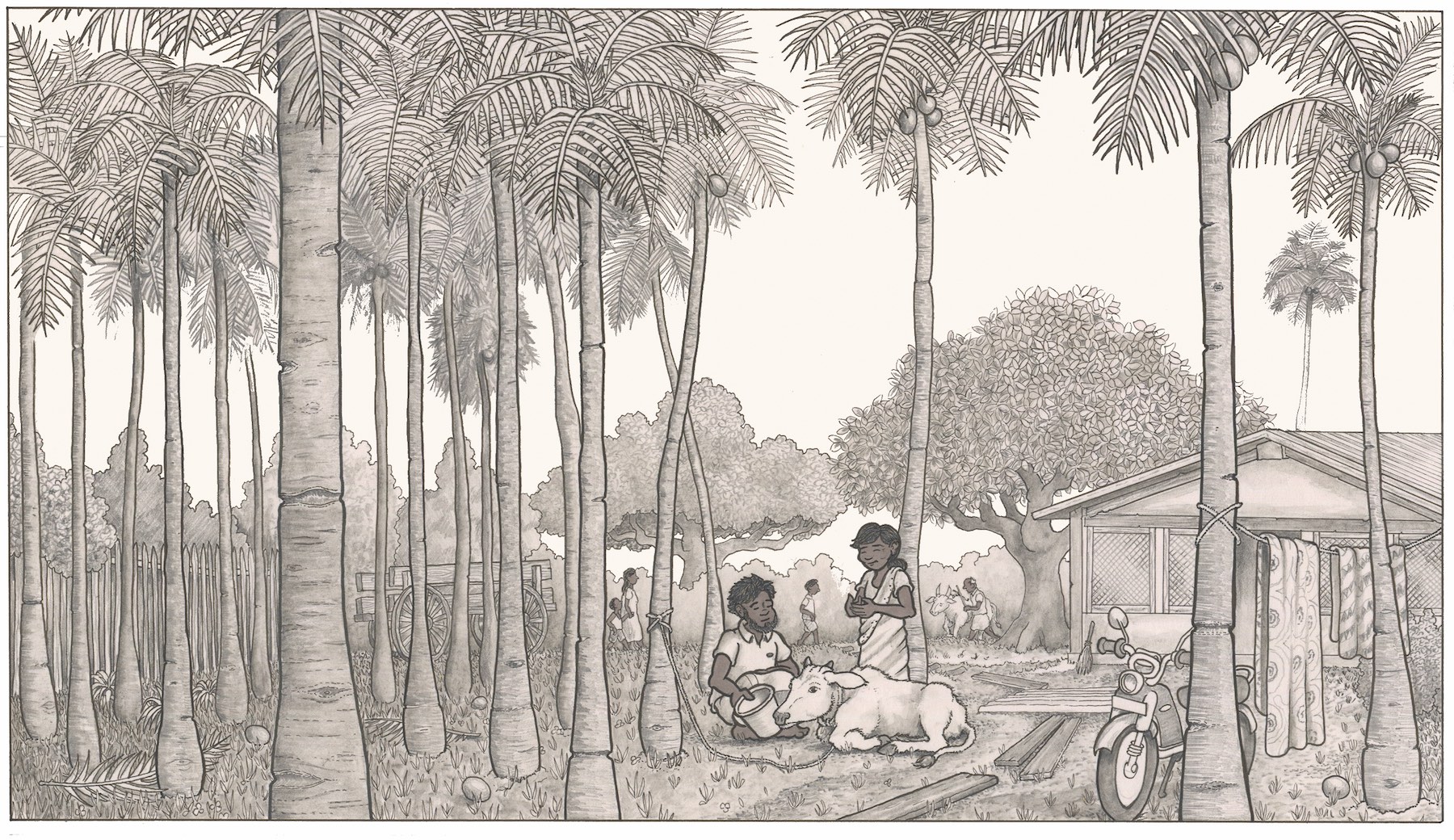


Vanni. A Family’s Struggle through the Sri Lankan Conflict is out now.
Follow Samuel Horti on Twitter.
Enjoyed this article? Like Huck on Facebook or follow us on Twitter.
You might like

The last days of St Agnes Place, London’s longest ever running squat
Off the grid — Photographer Janine Wiedel spent four years documenting the people of the Kennington squat, who for decades made a forgotten row of terraced houses a home.
Written by: Isaac Muk

As salmon farming booms, Icelanders size up an existential threat
Seyðisfjörður — The industry has seen huge growth in recent years, with millions of fish being farmed in the Atlantic Ocean. But who benefits from its commercial success, and what does it mean for the ocean? Phil Young ventures to the remote country to find out.
Written by: Phil Young

How Japan revolutionised art & photography in the ’60s and ’70s
From Angura to Provoke — A new photobook chronicles the radical avant-garde scene of the postwar period, whose subversion of the medium of image making remains shocking and groundbreaking to this day.
Written by: Miss Rosen

The lacerating catharsis of body suspension in Hong Kong
Self-Ferrying — In one of the world’s most densely packed cities, an underground group of young people are piercing their skin and hanging their bodies with hooks in a shocking exploration of pain and pleasure. Sophie Liu goes to a session to understand why they partake in the extreme underground practice.
Written by: Sophie Liu

Activists hack London billboards to call out big tech harm
Tax Big Tech: With UK youth mental health services under strain, guerrilla billboards across the capital accuse social media companies of profiting from a growing crisis.
Written by: Ella Glossop

In photos: The boys of the Bibby Stockholm
Bibby Boys — A new exhibition by Theo McInnes and Thomas Ralph documents the men who lived on the three-story barge in Dorset, giving them the chance to control their own narrative.
Written by: Thomas Ralph


