
Ming Smith’s lyrical portrait of Black America

Throughout her five-decade career, Ming Smith has broken through boundaries she has faced as a Black American artist coming of age during the Civil Rights Movement. Born in Detroit, raised in Columbus, Ohio, and educated at Howard University in Washington D.C., Smith moved to New York in the 1970s to work as a model alongside pioneers including Grace Jones, Toukie Smith, and Bethann Hardison.
“I didn’t call myself a photographer, but I was constantly shooting,” the artist said in Ming Smith: An Aperture Monograph. “I was just a young person in New York trying to find my way, and I had to support myself, so I took a job as a model.”
While on a go-see, Smith heard Kamoinge members Louis Draper and Anthony Barboza discussing photography. She showed Draper her work and he invited Smith to become the first woman to join the legendary photography collective. “That was a major awakening,” Smith said.

Grace Jones, Studio 54 (New York), 1970s

Star of Hope, 1978
Smith used the camera the way a musician plays their instrument, using photography to express the deepest reaches of her inner self. Never one to seek status, Smith simply followed her instincts and in doing so, became the first Black woman to have her work in the permanent collection of the Museum of Modern Art.
Half a century later, Smith is receiving her proper due, most recently with Evidence, the inaugural exhibition at Nicola Vassell Gallery in New York. “Ming and I discovered there are several parallels in our path,” says Vassell, who also got her start moving to New York to work as a model, albeit it in the ‘90s.
“We had similar experiences and discovered that we both look at the world without restriction – the open road is part of the creative process and all encounters are welcome. It’s a very unique perspective for a woman artist of a certain age. You’ve had to challenge so much that it’s like a walking revolution.”

Dakar Roadside with Figures (Senegal), 1972

Amen Corner Sisters (Harlem, New York), 1976
Indeed, Smith is the quiet storm, always grounded where she stands, refusing to give in to prevailing notions or trends. “Ming pushed back against the domain of the male perspective and the comfort of what people had grown accustomed to and found a new territory all her own,” says Vassell.
Whether photographing scenes of daily life on the streets of Harlem or Dakar, or making timeless portraits of luminaries including Sun Ra and Brassaï, Evidence is proof of Smith’s unerring ability to reinvent the language of photography. It is only in recent years that her contributions are being recognised, in no small part due to the work Vassell has done to bring the work of Black artists to the forefront of the contemporary art world over the past two decades.
“Whether it’s where she positions herself or her connectivity to the universe, Ming can locate, capture, and articulate all this nuanced complexity in her work,” says Vassell. “She is emblematic of life’s possibilities. One can always create and try to cut a path that is meaningful to the individual rather than accepting the status quo.”
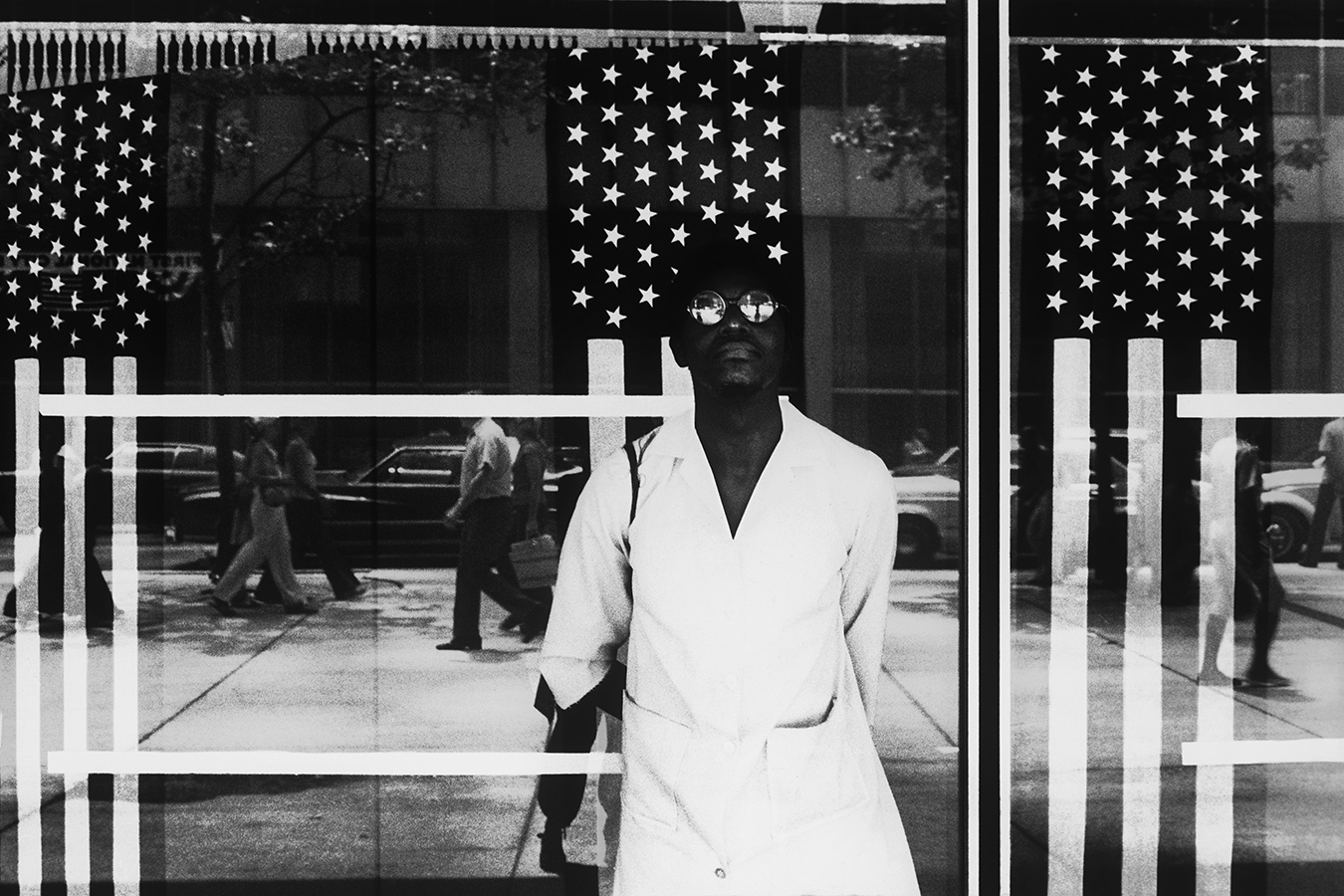
America Seen Through Stars and Stripes (New York), 1976

Sun Ra Space II (New York), 1978

Self-Portrait as Josephine (New York), 1986

Man Strolling (Coney Island), 1976
Ming Smith: Evidence is on view at Nicola Vassell Gallery in New York through July 3, 2021.
Follow Miss Rosen on Twitter.
Enjoyed this article? Like Huck on Facebook or follow us on Twitter.
You might like

The sharp rise of video game photography
Point, shoot — As the entertainment medium’s fidelity levels increase and developers build more powerful tools, a growing community of gamers are pushing the boundaries of image making in virtual worlds. Vicky Jessop meets people at the forefront of the emerging artform.

Joyous photos from the heart of the UK’s radical free festival movement
Common Grounds — The photographer has been capturing British counterculture for the past half century. A new exhibition looks at his archive sitting at the intersection of music, community and grassroots protest.

The lasting community legacy of a legendary Californian boxing gym
Moretón — Since opening in the ’80s, the Coachella Valley Boxing Club has trained multiple world champions, while providing a vital hub for local youth. In his new photobook, Darren Vargas documents its tight-knit, Chicano-led community, while also weaving a deeply personal story.

Introducing ‘The Chaos Isles’, a new photozine by Huck and Yushy
Normal Island — From unlicensed raves to the solstice at Stonehenge, furries to giant vegetable growers, Yushy is one of the UK’s best lensmen of its wild side. ‘The Chaos Isles’ will be sent out exclusively to Club Huck+ members.

Join Club Huck+ to get the most from Huck
Dispatches from the sharp edge of culture — Members get our print magazine, special photozines, The Huck Long Read newsletter, discounts from our friends and partners, digital versions of back issues and priority access to events.

Landmark new exhibition is celebrating 50 years of female punk
God Save the Queens — The Museum of Youth Culture is bringing together rare photography, archive material and a one-night-only supergroup featuring members of X-Ray Spex, The Slits and The Raincoats.


