‘Black people think that mental health care is a white thing’
- Text by Tara Joshi
- Photography by Jinni J

When Christelle Bofale answers FaceTime in Austin, Texas, she’s been having a sitting-in-bed-watching-Netflix kind of day. She seems a little abashed about it, but it’s the kind of rest that feels necessary – taking things slow feels like an increasingly rare antidote to the pressures of capitalism and social media alike. More than that, when you’re an independent artist about to put out your debut EP and dealing with endless promo as a result (the night before we talk she was up late, performing and shooting a video), taking some time for yourself is kind of crucial.
To a point, that’s the kind of the message that shines through on said EP. Titled Swim Team, it brims with immersive, lo-fi guitars (the name references these submerged, watery sonics, as well as Christelle’s regret at not showing up to swim meets, in spite of being on the high school team). But what’s most striking is Christelle’s voice: one that speaks back against the concept that, in her own words, “As a black person in America, you’re kind of taught that seeking out mental health care is a white thing, and that you as a black person should just be strong enough without professional help.” Looking after yourself can come in many forms, but recognising that you’re allowed to look after your mind is still something that feels quite rooted in privilege.
Born to Congolese parents, Christelle was exposed to music and storytelling from an early age. Her dad is a soukous guitar player as well as the musical director for the Congregation at his church, and Christelle was given a keyboard when she was four. As well as that, though – and perhaps most tellingly – Christelle always liked taking care of people. “I would take care of my dolls”, she says, laughing. “So I went through a bit of a phase where I thought I wanted to be a vet, but… I didn’t feel that for very long.” On Swim Team that compassion is obvious: be it in the luxurious melodies, or her tender lyrics about heartbreak and moving on.
You taught yourself guitar in high school – how did you go from there to where you are now?
Once I got to college, I was in a relationship with somebody, and we had been writing music together – he would play the guitar, I would write the melodies and lyrics. So I kind of stopped writing my own stuff. And then once that relationship was over, fall of 2016, that was when I was like, ‘Okay, wait, I gave that person a lot of power, but I can completely do this on my own.’
So I slowly started playing solo shows, and it was really insane how things started to slowly build. Up until very recently I haven’t had any music online, so it was very much creating this community in-person.
It’s crazy even asking, because obviously some of the pioneering guitar players were black women – but what’s it like basically being an indie guitar artist, when I imagine people look at you and assume you make R&B?
There is definitely a stigma, or a predetermined idea. I didn’t really notice or become aware of it until a couple years ago. In middle school and high school, me learning the guitar and practicing guitar was such an internal thing. I had idols that I looked up to but, looking back, a lot of them were white. But I remember when I discovered Lianne La Havas, I connected with her so deeply, and I just realised I hadn’t really had a black female guitarist close to my age to really look up to and see myself in.
Once I started playing shows, sometimes I would send bookers or bars a clip a friend had filmed of me playing because, again, I didn’t have anything out. And I would get messages back like, ‘Thank you so much for reaching out, we’ll have to consider putting you on an R&B showcase sometime.’ Like, ‘Oh my gosh, did you even listen to what I sent you?’ That’s not to knock those genres: R&B is so important, jazz is so important, and they need to exist, and I love them. But, you know, we don’t have to be confined to spaces. We can be just as powerful moving in other worlds.
You’ve spoken about this EP being a snapshot of black mental health, I was wondering if you could unpack that a bit. I feel like mental health issues are often coded through a white lens.
I wasn’t necessarily thinking, ‘Oh, this will be such a good way to start a conversation about mental health.’ But once I started thinking about writing an artist bio, I asked myself, ‘What do I want to talk about, if I’m being given a platform?’
Going through my own experiences, a lot of resources did come from white people or white organisations. My therapist was white, when I was checked into hospital most of the staff I worked with there were white people. Most of my friends who would have open conversations about mental health were white, and when I was having suicidal thoughts in high school and I would talk to my parents about it, they would be like, ‘That’s white people issues.’ Or, ‘Just learn how to handle it.’
So how does that manifest in the EP for you?
The EP was born from a place – with the exception of one song, one song was from high school – that was really, really dark for me. But now, even though [these songs] can sometimes be hard to perform, I still love listening to them – they bring joy. I guess it’s just a testament to being able to take these dark moments, as cliché as it is, and turn them into something positive. 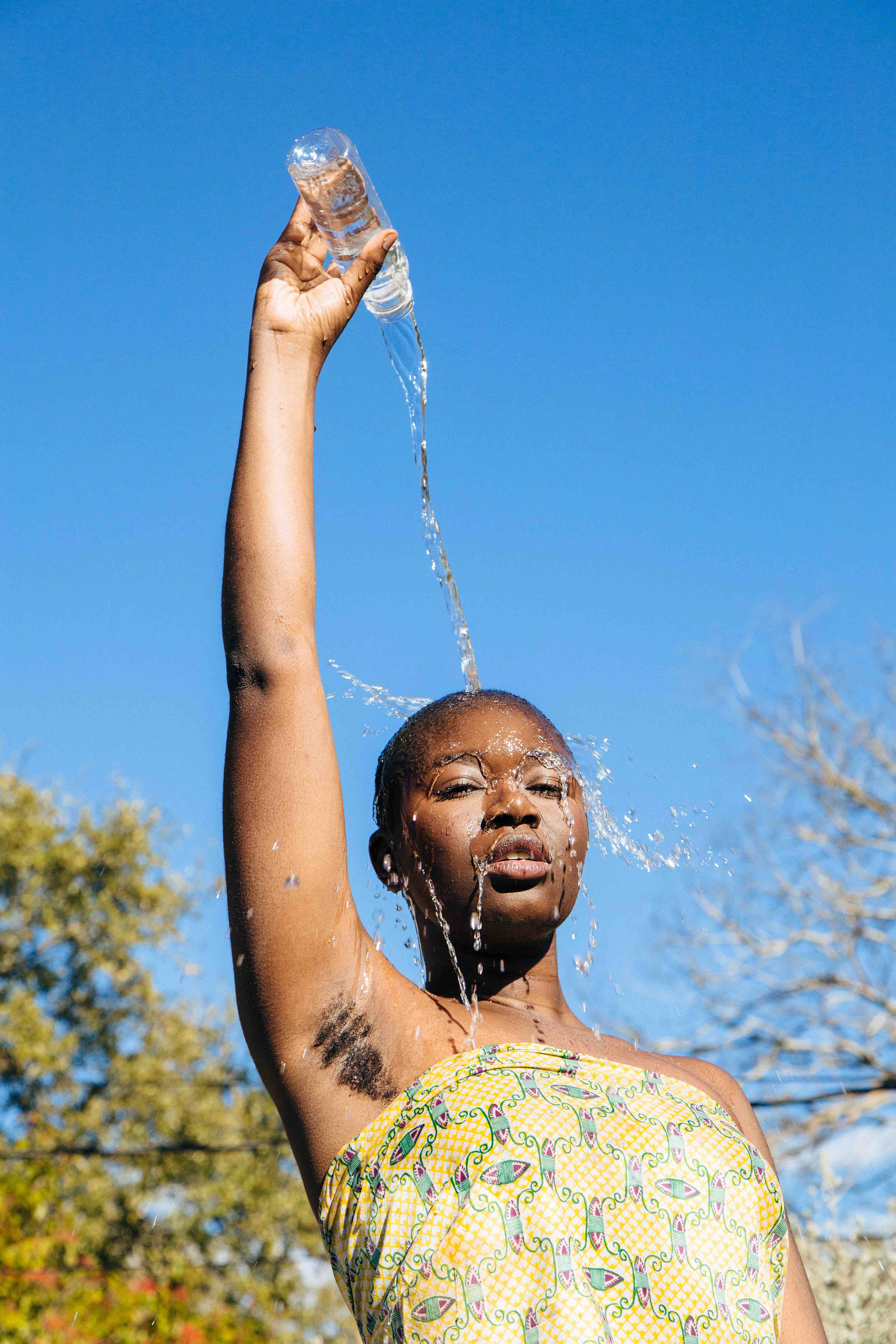 Swim Team is out now on Father/Daughter Records.
Follow Tara Joshi on Twitter.
Enjoyed this article? Like Huck on Facebook or follow us on Twitter.
You might like

Julian Cashwan Pratt: “We fought security until the cops showed up”
Hard Feelings — The lead singer of Show Me the Body joins Rob Kazandjian’s column on fatherhood and masculinity to talk about mentors, scrapping Zionists at shows, and finally making his father proud.
Written by: Robert Kazandjian

Lost photos from the heyday of punk and new wave
Crash Bang — DB Burkeman’s latest photobook unearths photographs from his younger years as an aspiring music photographer, which sat undeveloped in his family home for decades.
Written by: Miss Rosen

Analogue Appreciation: Xmunashe
Make Yourself At Home — In an ever more digital, online world, we ask our favourite artists about their most cherished pieces of physical culture. Today, it’s elusive freeform explorer Xmunashe.
Written by: xmunashe

Grainy, yearning memories of Europe’s ’90s free rave heyday
Never Alone — A new photobook from Cheyenne Clementi and Valentina Morandi presents pictures they made over seven years while touring the continent as part of the Tekno Mobil Squad soundsystem crew. It archives parties, people and a lifestyle largely consigned to the past.
Written by: Isaac Muk

As Hanoi’s nightlife faces raids & repression, its underground scene modulates
Spaces Between the Beats — Tensions between nightlife and authorities have grown in recent times, as police target venues and their patrons with increasingly frequent drug testing and searches. With clubs becoming hostile spaces as a result, Hanoi’s electronic music community is finding new spaces and forms of expression, reports Martin Guttridge-Hewitt.
Written by: Martin Guttridge-Hewitt

American Football: The One With The Feelings
Many moons — The Midwest emo architects transformed a college experiment into a coming-of-age soundtrack. 25 years on, their latest iteration sees them bottle the same magic for the ups and downs of middle life.
Written by: Tracy Kawalik


