Photos that capture the real Brooklyn kids of the ’60s
- Text by Miss Rosen
- Photography by Constance Hansen / Guzman

In the wake of riots that began after the United States government ordered the assassination of Dr. Martin Luther King, Jr., Daniel Patrick Moynihan, an urban affairs adviser to President Nixon, introduced a policy called “benign neglect” that would change the course of American history. The policy proposed systemic denial of basic government services to African-American and Latinx neighbourhoods across the nation, resulting in a massive collapse that decimated the people for well over a decade.
The Clinton Hill section of Brooklyn, home to the Pratt Institute, was one such neighbourhood to fall into disrepair. Yet from the destruction, a new culture was coming to bear.
Constance Hansen, one half the husband-and-wife team of Guzman, has just unearthed photographs of this pivotal era taken while she was a student at the Pratt Institute from 1969- 1971. “There was a whole other thing going on then,” she remembers.
“The 60s vibe, the music, the Vietnam War, Civil Rights – everything was exploding. It was anarchistic. You just did your thing. There were a lot of artists, writers, poets, and people creating, very free and they were all deep in their work. I would be floating through and taking pictures.”

Artists at work, Fort Greene Brooklyn

Feral cats, my place. Late 60’s Fort Greene Brooklyn
Hansen had initially enrolled in Pratt as a sculpture major, but immediately fell in love with photography. “I knew this was my form and this is what I wanted to do forever. Photography became a diary and a visual way of describing my world. I wasn’t looking in – I was just in it,” she recalls.
Living in a $35-a-month apartment on Clermont Avenue, Hansen began to find her way. “We were all scraping by. The door had a padlock. There was no gas in the stove and we didn’t always have heat. We had a darkroom in the attic that didn’t have running water. We didn’t have phones – no one could afford them.”

Cutty Sark
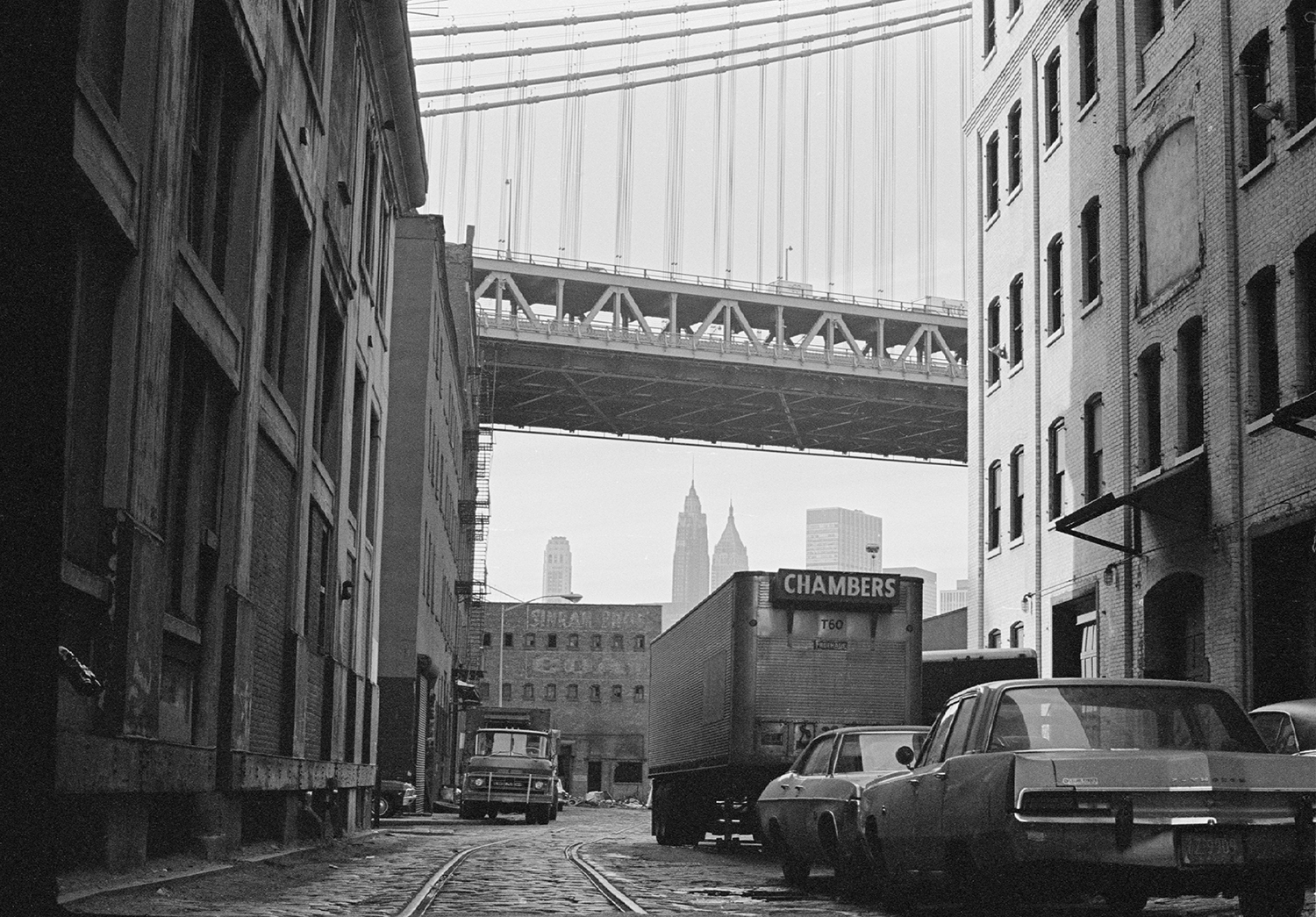
Dumbo, late 60’s
“We were making do and wandering around. There were a lot of artists in the building: a filmmaker, an architecture student who was taking the walls apart. Everyone was sharing what they were doing.”
The photographs Hansen took capture the spirit of the times, when students felt completely free to experiment and liberate themselves from all constructs. At the same time, things were rough: people turned up murdered, went underground, overdosed, or went to jail. “It was rough around the edges and some people didn’t make it out,” Hansen reveals. “I feel like I was very lucky and blessed to have that experience and time in my life when it was just so free.”

Crochet girl’s bedroom, late 60’s

Police activity, brooklyn late 60’s

Female gaze, late 60’s

Missing teeth trouble. My place, Fort Greene Brooklyn, late 60’s

Landlord, Clermont Ave, Brooklyn 60’s

Artists life, Fort Greene brooklyn

Kids watching building burn, late 60’s
Follow Miss Rosen on Twitter.
Enjoyed this article? Like Huck on Facebook or follow us on Twitter.
You might like

How Japan revolutionised art & photography in the ’60s and ’70s
From Angura to Provoke — A new photobook chronicles the radical avant-garde scene of the postwar period, whose subversion of the medium of image making remains shocking and groundbreaking to this day.
Written by: Miss Rosen

Artifaxing: “We’ve become so addicted to these supercomputers in our hands”
Framing the future — Predominantly publishing on Instagram and X, the account is one of social media’s most prominent archiving pages. We caught up with the mysterious figure behind it to chat about the internet’s past, present and future, finding inspiration and art in the age of AI.
Written by: Isaac Muk

The lacerating catharsis of body suspension in Hong Kong
Self-Ferrying — In one of the world’s most densely packed cities, an underground group of young people are piercing their skin and hanging their bodies with hooks in a shocking exploration of pain and pleasure. Sophie Liu goes to a session to understand why they partake in the extreme underground practice.
Written by: Sophie Liu

What we’re excited for at SXSW 2026
Austin 40 — For the festival’s 40th anniversary edition, we are heading to Texas to join one of the biggest global meetups of the year. We’ve selected a few things to highlight on your schedules.
Written by: Huck

Wu-Tang Clan forever, and ever
The Final Chamber — RZA, the spiritual leader of one of the most important hip hop groups of all time explains why they won’t rest until their legacy is secured.
Written by: Yoh Phillips

In photos: The boys of the Bibby Stockholm
Bibby Boys — A new exhibition by Theo McInnes and Thomas Ralph documents the men who lived on the three-story barge in Dorset, giving them the chance to control their own narrative.
Written by: Thomas Ralph


