Inside the most intimate spaces in America
- Text by Lois Bielefeld
- Photography by Lois Bielefeld

I’ll admit it: I’m nosy. I’ve always been fascinated by what people’s habits and personal spaces reveal about them. I think growing up with a mother who was legally blind made me more aware and empathetic, not just of how she interacted with the world, but of how the world interacted with her in comparison to me.
Growing up in Milwaukee, I often assumed that I had been adopted. I was the creative outlier of the family, safely tucked away in my fantastical make-believe world. My dad would watch TV while my mom tended to the household chores, my older brother busying himself with his collection of baseball cards. Peter, Eliza, Eula and Abigail, 2018, from New Domesticity


Scott and James, Manhattan, 2009, from The Bedroom
But as different as I seemed, my parents willingly indulged that creative side: pushing me to take extra classes at the local art school and helping me construct a darkroom in our basement. As a teen, photography gave me a voice and means to explore the outside world. But I never had any idea where that could lead.
At 18, I moved out of my parents’ home and tried to figure out my next move, puttering about with my camera in between working dual jobs at a sandwich shop and a movie theatre. Having been raised in a strictly Evangelical Christian environment, this marked a significant transition.

Alden, Baton Rouge, 2012, from The Bedroom

Thursday: Lon and Todd, 2017, from Weeknight Dinners
It took a fair amount of time to shed my parents’ outlook while developing my own ideas and beliefs – both about the world and my role within it. My early twenties would be filled with growth, uncertainty and countless turns in the road, but it all furthered that same sense of empathy and appreciation of diversity I’d had as a child.
By the time I graduated from photography school at Rochester Institute of Technology, I was married with a three-year-old and living in NYC. Navigating young motherhood and trying to make ends meet, I went through a long period of wanting to photograph but not knowing what to photograph.

Serra family Sunday pasta lunch, 2018, from Celebration

Joe, Milwaukee, 2012, from The Bedroom
Then, in 2006, Rineke Dijkstra randomly took a picture of my daughter in Prospect Park for her Park Portraits series. At the time this just seemed like a cool thing that happened but, looking back, it monumentally impacted my career.
Up until that point I had been doing one-off shoots and portraits, never expanding into anything bigger. Seeing her work exposed me not only to series-based photography but also a different context for it to be seen: on the walls of a gallery rather than the pages of a magazine or website.

Emry’s Tea Party, 2018, from Celebration

Poker Night, 2018

Solomon, Rowan, Sanjiv, and Amaya- Murray Hill, 2017, from Neighborhood
I started to hunger for a consistent project I could hone and nurture over time. I was also grappling with my identity and the dawning realisation that I was gay. Gradually I came out and started to come into my own. Photography gave me space for that.
In 2008, I began making lit portraits of people in their bedrooms, seeing how these intimate spaces reflected their lives. Then, two years later, I moved back to Milwaukee for an in-house photography job, which gave me the financial stability to develop more series-based portraits, like focusing on corporate workers and their lunches in a small, closed-off set that I made at work. In 2012, I received my first fellowship and soon began a new series about people’s typical weeknight meals.

Wednesday: Melissa and Ava, 2017, from Weeknight Dinners
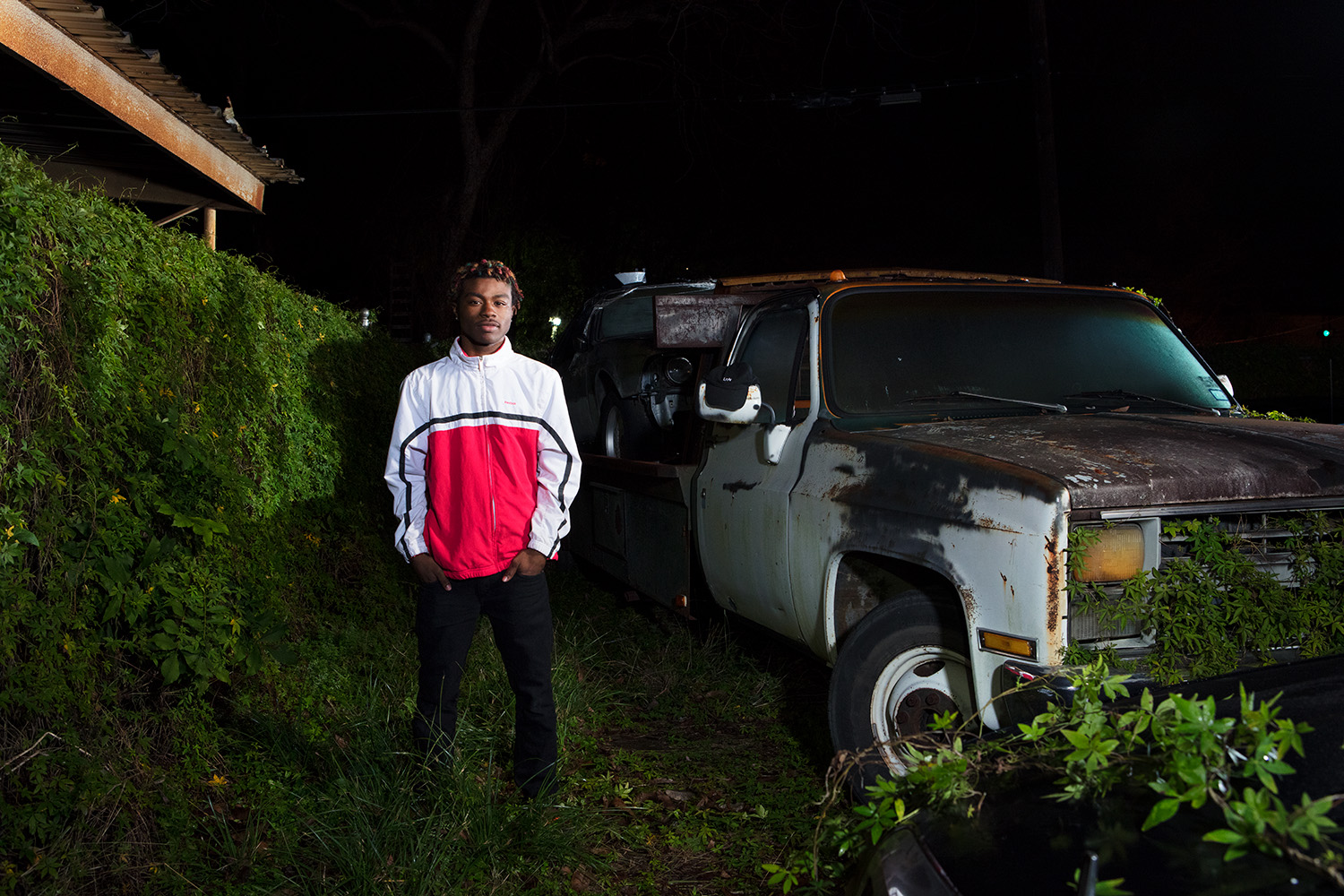
Zacorian – Old Town, 2017, from Neighborhood

Scout’s third birthday party, 2018, from Celebration
The thread that connects all these situational portraits is a desire to look at the who, what, when, where, and why of humanity. How I live today represents a 180-degree turn from my upbringing, which has made me recognise just how complex people are. Our journeys through life – shaped by family, environment, culture, peers, genetics, interpretations and memories of key events – are what I’m interested in.
When I was young, I thought photography was visual truth or evidence; today I toy with the fallacy of the photographic image. My pictures have an ethnographic bent to them yet they are staged and theatrically lit affairs.

Willie Mae, Manhattan, 2011, from The Bedroom

Monday: Dennis & Denise, 2015, from Weeknight Dinners
But context and time often have just as much impact on the work too. Ultimately it’s what each viewer brings to the photograph – their personal experiences, ideas, and judgements – that allows the work to form its own legs.
That openness is important. I allow each project to lead me wherever it will, adapting to whatever medium feels right for the series. It’s something I think about as I enter a new phase of my life.

Scout’s third birthday party, 2018, from Celebration

Monday: Ryan, 2017, from Weeknight Dinners
My daughter is off to university and my wife and I have moved to San Francisco’s Bay Area so that she can start a new job. I am curious to see how the West Coast will seep into my exploration of what domesticity looks like today. But much like the stories themselves, I’m ready to let life take me along for the ride.
This article appears in Huck 67 – The Documentary Photography Special VI. Buy it in the Huck Shop or subscribe now to never miss another issue.
Find out more about Lois Bielefeld or follow her on Instagram.
Enjoyed this article? Like Huck on Facebook or follow us on Twitter.
You might like

The last days of St Agnes Place, London’s longest ever running squat
Off the grid — Photographer Janine Wiedel spent four years documenting the people of the Kennington squat, who for decades made a forgotten row of terraced houses a home.
Written by: Isaac Muk

How Japan revolutionised art & photography in the ’60s and ’70s
From Angura to Provoke — A new photobook chronicles the radical avant-garde scene of the postwar period, whose subversion of the medium of image making remains shocking and groundbreaking to this day.
Written by: Miss Rosen

Artifaxing: “We’ve become so addicted to these supercomputers in our hands”
Framing the future — Predominantly publishing on Instagram and X, the account is one of social media’s most prominent archiving pages. We caught up with the mysterious figure behind it to chat about the internet’s past, present and future, finding inspiration and art in the age of AI.
Written by: Isaac Muk

The lacerating catharsis of body suspension in Hong Kong
Self-Ferrying — In one of the world’s most densely packed cities, an underground group of young people are piercing their skin and hanging their bodies with hooks in a shocking exploration of pain and pleasure. Sophie Liu goes to a session to understand why they partake in the extreme underground practice.
Written by: Sophie Liu

What we’re excited for at SXSW 2026
Austin 40 — For the festival’s 40th anniversary edition, we are heading to Texas to join one of the biggest global meetups of the year. We’ve selected a few things to highlight on your schedules.
Written by: Huck

In photos: The boys of the Bibby Stockholm
Bibby Boys — A new exhibition by Theo McInnes and Thomas Ralph documents the men who lived on the three-story barge in Dorset, giving them the chance to control their own narrative.
Written by: Thomas Ralph


