These timeless photos prove that youth never changes
- Text by Mark Steinmetz
- Photography by Mark Steinmetz

My parents gave me my first camera around the age of six.
Although I have many clear memories of framing scenes, and even set up my own darkroom at 12, I saw myself going into the sciences.
But early on in college, I took a course on the films of Michelangelo Antonioni before leaving science behind.

I left for Yale School of Art, thinking I’d go into film, but that route began to seem impractical and I was impatient.
That’s when I realised that with photography, you don’t need to have a crew or command a lot of money. It’s more like being a poet, where you just have your piece of paper.
In 1983, when I was 22, I decided to drop out after a semester and head for Los Angeles to find the photographer Garry Winogrand who, I believe, had a history of hanging out with other photographers.
It seems awfully bold, looking back, but I really don’t have an explanation other than it felt natural.
He had a Leica, I had a Leica; he needed someone to drive around so he could take pictures out the window, and I guess I said things that made him think I was okay.
It turned out to be the last year of his life and I absorbed a great deal from him, like going out in the world and making yourself available to what it offers – not feeling that you’re too busy or that time is money.

When it came to shaping my own body of work, I wanted pictures that could tell a story together.
That way, the meaning would be cumulative and you wouldn’t need so much weight on a single image.
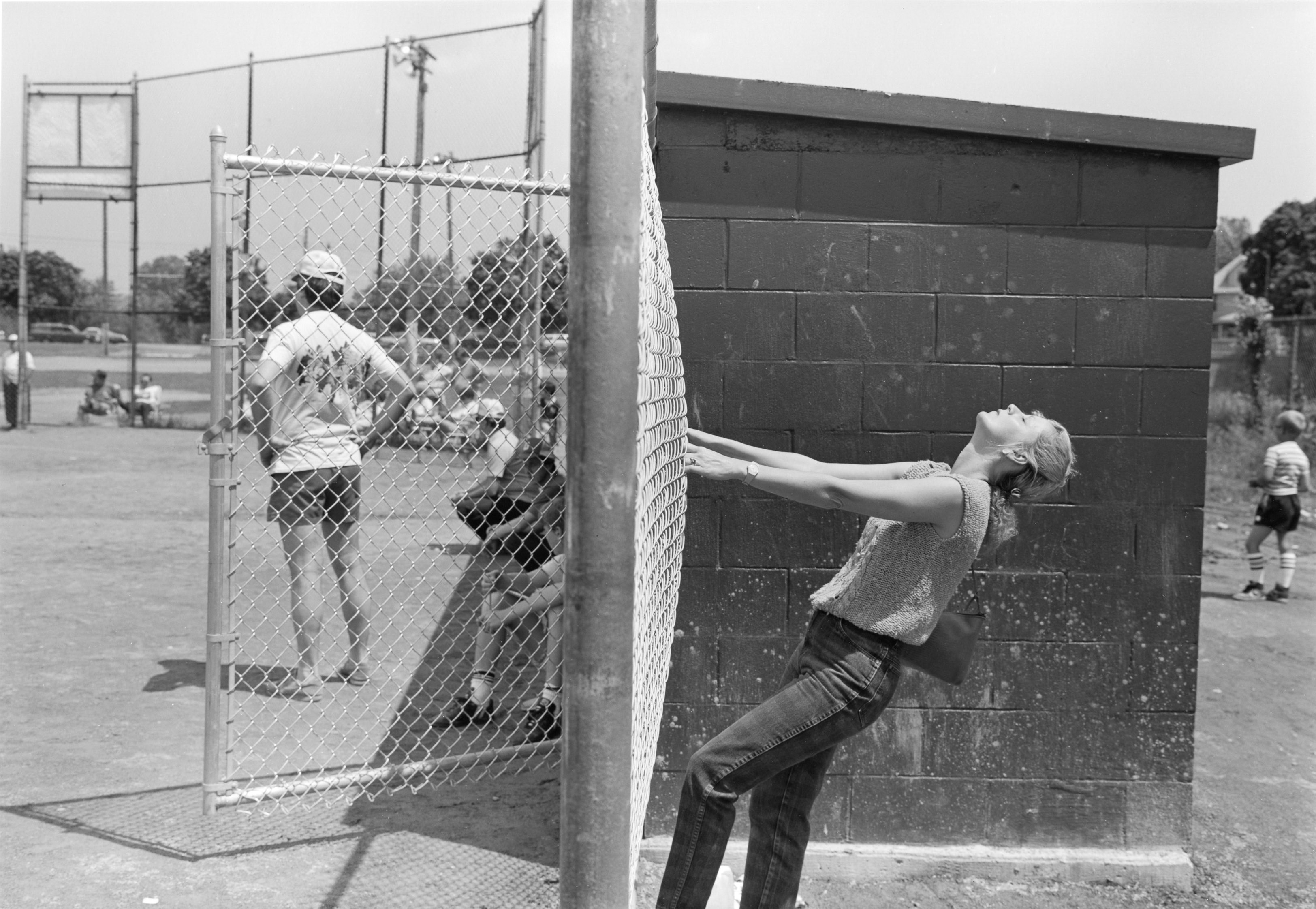
Two projects I focused on were little league baseball and summer camps. Every year, from spring into summer, one would lead into another and certain things never changed.
In baseball, you’ve got uniforms, chain-link fences and dug-outs. At summer camp, you have sleeping bags, cabins and camp res. There isn’t much difference between them in 1990 or 1965.

I like that time of age, too. There’s a kind of grave maturity developing at around 11 years old.
When a little kid laughs or cries, it doesn’t have real resonance, whereas if someone has these emotions between eight and 12, there’s a poignancy to it.

When they become adults, it’s just not the same. Many of these photos are about the predicament of being a kid put into a certain situation.
In one picture, these girls who have been so horrible to each other all summer are now parting – and the depth of their love just gushes out. It’s almost excruciating.

I think there’s a lot of growing and learning in photography. To make good pictures is a sort of demonstration of how you are as a person and as a photographer.
That process reinforces your growth and your growth reinforces your photography, so you’re always deciding who you are through your photos.
It’s this constant looking at self, navigating your feelings.
The larger patterns only come out after the fact. I’ve taken a lot of pictures where I felt kind of depressed because I can’t imagine what they’re good for.

But when I started making books, I found that one page is a wonderful service to the one that came before. Everything starts to fit together nicely; the meanings grow and change.
Those initial projects – The Players, Summer Camp and Kids & Teens – took many years and that approach has transferred to all the work I’ve been doing ever since.
I don’t really believe in short-term projects and I’ve always had a distaste for the topical.

I hope to be relevant and contemporary but at the same time I don’t want anything to be too ‘now’ as, in a few years, it just won’t have the urgency.
I prefer focusing on everyday things because they tend to stand the test of time.
I think I’m unusual in that my process feels like playing chess over a long time frame.

At various stages, you’ll think there’s a dead end only to find a new opening and discover more possibilities.
It’s sort of like The Old Man and the Sea: sometimes you just have to persevere.
This article appears in Huck 57 – The Documentary Photo Special IV. Subscribe today so you never miss another issue.
Check out the portfolio of photographer Mark Steinmetz.
Enjoyed this article? Like Huck on Facebook or follow us on Twitter.
You might like

The last days of St Agnes Place, London’s longest ever running squat
Off the grid — Photographer Janine Wiedel spent four years documenting the people of the Kennington squat, who for decades made a forgotten row of terraced houses a home.
Written by: Isaac Muk

How Japan revolutionised art & photography in the ’60s and ’70s
From Angura to Provoke — A new photobook chronicles the radical avant-garde scene of the postwar period, whose subversion of the medium of image making remains shocking and groundbreaking to this day.
Written by: Miss Rosen

Artifaxing: “We’ve become so addicted to these supercomputers in our hands”
Framing the future — Predominantly publishing on Instagram and X, the account is one of social media’s most prominent archiving pages. We caught up with the mysterious figure behind it to chat about the internet’s past, present and future, finding inspiration and art in the age of AI.
Written by: Isaac Muk

The lacerating catharsis of body suspension in Hong Kong
Self-Ferrying — In one of the world’s most densely packed cities, an underground group of young people are piercing their skin and hanging their bodies with hooks in a shocking exploration of pain and pleasure. Sophie Liu goes to a session to understand why they partake in the extreme underground practice.
Written by: Sophie Liu

What we’re excited for at SXSW 2026
Austin 40 — For the festival’s 40th anniversary edition, we are heading to Texas to join one of the biggest global meetups of the year. We’ve selected a few things to highlight on your schedules.
Written by: Huck

In photos: The boys of the Bibby Stockholm
Bibby Boys — A new exhibition by Theo McInnes and Thomas Ralph documents the men who lived on the three-story barge in Dorset, giving them the chance to control their own narrative.
Written by: Thomas Ralph


