The changing face of British culture, in photos
- Text by Daniel Dylan Wray
- Photography by British Culture Archive

Paul Wright was sat at his office desk in Manchester, his 40th birthday creeping ever closer on the horizon, feeling trapped by the banality of his working life. “I’ve had a lot of mundane jobs,” he says. “A lot of office work and jobs that would be easy enough to see me through to the weekend. Before I had kids, life was all about DJing or putting on nights – living for that buzz of the weekend.”
However, as he began to settle down he noticed something of a void beginning to form: “I was just sat at my desk at work thinking, ‘I can’t do this much longer’. Because I wasn’t going out as often, I needed to get my kicks elsewhere. I knew there was more to what I wanted to do in life. I probably had a bit of a midlife crisis.”
Thankfully, that midlife crisis didn’t result in a gauche sports car, a golfing habit or a ponytail. Instead, it led to a blog – now more commonly known as the ‘British Culture Archive’.
Wright set up the site in 2017 to “document, highlight and preserve the changes in British society and culture through social and documentary photography”. Three years later, the mundane office job is firmly behind him, and he finds himself running the site – along with an adjoining publication that welcomes public submissions, The People’s Archive – as a full-time job, as he bounces from London to Berlin setting up exhibitions. Next up is Manchester, where he will exhibit The People’s City, a selection of photography focusing on the North West at The Refuge.
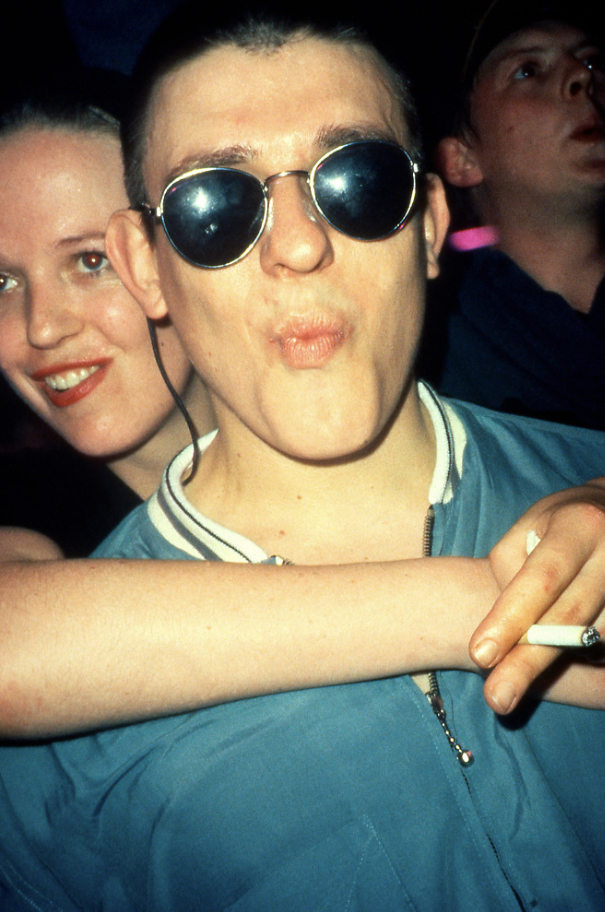
Photo Peter J Walsh

Photo Richard Davis
For Wright, it was a case of reigniting a lifelong love. “I grew up in the ’80s and remember the poll tax protests and the miners’ strikes,” he recalls. “Those images always seemed to strike a real chord. I’m from a working class background and it was a politically-charged decade and my parents were divorced – it was a tough time for a lot of people. The images that captured a lot of these moments really stuck with me. It’s something I became a bit obsessed with; that gritty, realist photography.”
A successful crowdfunding campaign, along with some sponsors getting involved, has allowed Wright to pursue this passion as a profession. “My long term goal is to create a permanent gallery space in Manchester,” he says. “I want to create a space that is very accessible and welcoming to all people from all backgrounds. Creating a run of exhibitions at places like the Social in London and Refuge in Manchester – they are the kind of places I want to tour. Just everyday spaces and bars where people can come in out of the street and have a drink and feel relaxed around the artwork. I don’t want it to be at a high-end gallery, because that’s not what I’m about. It’s about making great art accessible to the everyday person.”
Luke Cowdrey, one of the founders of The Refuge, views the show as an opportunity to delve deeper into the untold history of the city and surrounding areas. “British Culture Archive accurately portrays the other history of Manchester, the one you don’t really read about,” he says. “When I first came across their Instagram, it was love at first sight – every picture is from that really interesting era before the narcissism of social media… There is a real naivety and magic to the work, which people warm to as it gives them an alternative view of the city.”

Photo Rob Bremner

Photo Rob Bremner
Cowdrey singles out some of Peter Walsh’s work (a prominent club photographer during the acid house boom) as something that offers a unique insight into the era. “Some of his club shots in Manchester are much more than Madchester,” he says. “They are more of a moment of history where things were so unified and people came together: class, colour and sexuality didn’t mean anything. It was just people getting together to music they love.”
Wright remembers travelling through some areas of Manchester as a child, like Moss Side and Hulme, and being fascinated by them – from seeing Alsatian dogs on pub roofs, to the towering monolithic slab of brutalism that was Hulme Crescents. Alongside Walsh, works by Richard Davis and Rob Bremner will feature, along with contributions from the People’s Archive.
But while the project focuses on historical perspectives, Wright is shooting for more than just retrospective exploration. “It’s not an out and out nostalgia site,” he says. “There’s more to it than that. This is world class British photography and I want to make that work accessible.”
It’s also something of a tribute to the beauty and purity of communities that he sees as often being overlooked or misunderstood. “There’s quite a strong working class ethos to what I’m doing,” he offers. “There is a message behind it. A lot of the tabloids focus on exploiting the working classes in a nasty way, so it’s a bit of a counteractive voice to that. I want to show the working classes in a positive light.”

Photo Richard Davis

Photo Rob Bremner

Photo Rob Bremner

Photo Rob Bremner

Photo Rob Bremner
The People’s City Exhibition runs at The Refuge from January 30.
Follow Daniel Dylan Wray on Twitter.
Enjoyed this article? Like Huck on Facebook or follow us on Twitter.
You might like

How Japan revolutionised art & photography in the ’60s and ’70s
From Angura to Provoke — A new photobook chronicles the radical avant-garde scene of the postwar period, whose subversion of the medium of image making remains shocking and groundbreaking to this day.
Written by: Miss Rosen

Artifaxing: “We’ve become so addicted to these supercomputers in our hands”
Framing the future — Predominantly publishing on Instagram and X, the account is one of social media’s most prominent archiving pages. We caught up with the mysterious figure behind it to chat about the internet’s past, present and future, finding inspiration and art in the age of AI.
Written by: Isaac Muk

The lacerating catharsis of body suspension in Hong Kong
Self-Ferrying — In one of the world’s most densely packed cities, an underground group of young people are piercing their skin and hanging their bodies with hooks in a shocking exploration of pain and pleasure. Sophie Liu goes to a session to understand why they partake in the extreme underground practice.
Written by: Sophie Liu

What we’re excited for at SXSW 2026
Austin 40 — For the festival’s 40th anniversary edition, we are heading to Texas to join one of the biggest global meetups of the year. We’ve selected a few things to highlight on your schedules.
Written by: Huck

In photos: The boys of the Bibby Stockholm
Bibby Boys — A new exhibition by Theo McInnes and Thomas Ralph documents the men who lived on the three-story barge in Dorset, giving them the chance to control their own narrative.
Written by: Thomas Ralph

Huck’s 20th Anniversary Issue, Wu-Tang Clan is here
Life is a Journey — Fronted by the legendary Wu-Tang Clan’s spiritual leader RZA, we explore the space in between beginnings and endings, and the things we learn along the way.
Written by: Huck


