The radical history of ’80s San Francisco, in photos
- Text by Miss Rosen
- Photography by Janet Delaney

San Francisco in the ’80s was a study in contrasts. As the shadows of gentrification began to creep over the heart of the city, just South of Market, the people of the Mission took to the streets to protest the policies coming out of the Reagan White House.
During this time, American photographer Janet Delaney was at the centre of it all, capturing the spirit of public life in parades and protests, performances and beauty pageants. In her new book, Public Matters (MACK Books), Delaney delves deep into her archive to reflect upon the incredible impact of mass gatherings organised to serve the greater good.
At the time, the Mission was a predominantly Latinx neighborhood, made up of recent immigrants from El Salvador, Nicaragua, and Honduras who were fleeing wars and conflicts that had come about as a result of U.S. involvement. “In the 1980s, San Francisco was exploding with immigrants, not just from Central America but from Russia and Asia as well,” Delaney remembers.

Janet Delaney, ‘Three Young Women, 1985’ in Public Matters (2018). Courtesy of the artist and MACK.
“What I am trying to do in this book is acknowledge and celebrate the importance and presence of people from all the world in our communities and how being on the street is made all the richer by diversity. The Mission was a mix of all these different countries and creating a new way of being. The Day of the Dead Festival not only honoured your ancestors but protesting the wars of the Reagan administration.”
In Delaney’s photographs, we return to a San Francisco that once was: a people politicised against the establishment in a fight for survival. “The thing about Reagan was that he had a velvet glove,” she says. “He had a smooth way of being. The basis in where we are now is founded in what happened under Reagan.”

Janet Delaney, ‘Three Contestants, 1988’ in Public Matters (2018). Courtesy of the artist and MACK.
“Jimmy Carter had solar panels on the White House, and then Reagan took them off. If we had been able to follow some basic future that was being laid out in the ’70s, we would be in much better condition right now. But the corporate-lead that Reagan ushered in, and solidified by joining forces with the religious right, took the country in a different direction.”
The people of San Francisco chose to respond the best way they knew how, gathering together on the streets to amplify their voices and draw attention to the cause. “San Francisco was very savvy in responding. The protest against Nicaragua was constant and persistent, and the protests for women’s rights were a regular event.”
“I still go to marches – I am still out there. There is a sense of support, of knowing you are not alone, of trying to make a big enough noise so that you will be heard outside of your immediate community. I think change happens in so many ways. It doesn’t just happen in the legislature, it happens in the hearts and minds one by one where it becomes a gathering, a stream, a river of cultural change. It is possible: I saw it with the Vietnam War.”

Janet Delaney, ‘Dexter King, Martin Luther King’s Son, at First Martin Luther King Day Parade, January 26, 1986’ in Public Matters (2018). Courtesy of the artist and MACK.

Janet Delaney, ‘Dominque diPrima, on Stage, 1985’ in Public Matters (2018). Courtesy of the artist and MACK.

Janet Delaney, ‘Pawnshop, Mission St, 1984’ in Public Matters (2018). Courtesy of the artist and MACK.

anet Delaney, ‘Two Young Teens, 1985’ in Public Matters (2018). Courtesy of the artist and MACK.

Janet Delaney, ‘Mother and Daughters Behind Barricade, 1986’ in Public Matters (2018). Courtesy of the artist and MACK.

Janet Delaney, ‘“I May Not Get There . . .” First Martin Luther King Day Parade, 1986’ in Public Matters (2018). Courtesy of the artist and MACK.

Janet Delaney, ‘“Repeal Public Law 93-531”, (Forced Removal of Navaho from Native Lands), 1986’ in Public Matters (2018). Courtesy of the artist and MACK.
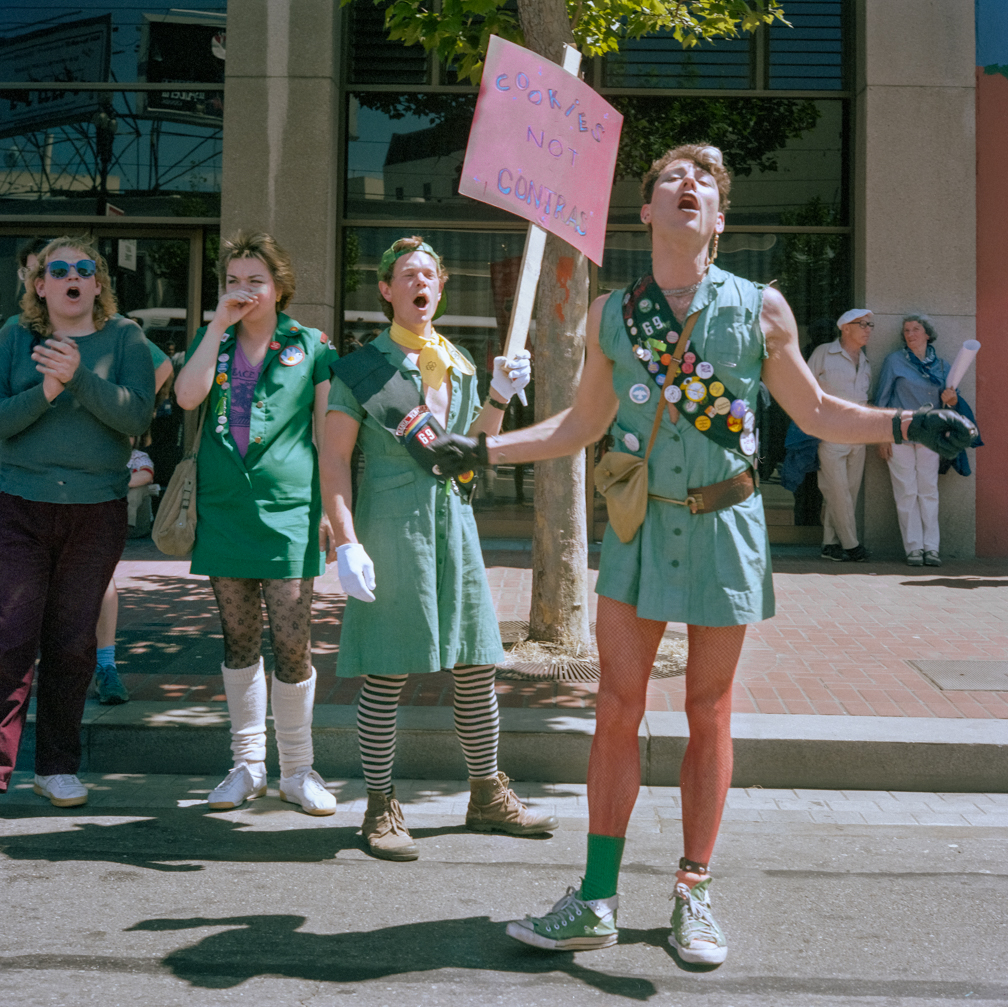
Janet Delaney, ‘“Cookies not Contras”, Peace, Jobs and Justice Parade, 1986’ in Public Matters (2018). Courtesy of the artist and MACK.
Public Matters is available on MACK Books.
Follow Miss Rosen on Twitter.
Enjoyed this article? Like Huck on Facebook or follow us on Twitter.
You might like

The last days of St Agnes Place, London’s longest ever running squat
Off the grid — Photographer Janine Wiedel spent four years documenting the people of the Kennington squat, who for decades made a forgotten row of terraced houses a home.
Written by: Isaac Muk

How Japan revolutionised art & photography in the ’60s and ’70s
From Angura to Provoke — A new photobook chronicles the radical avant-garde scene of the postwar period, whose subversion of the medium of image making remains shocking and groundbreaking to this day.
Written by: Miss Rosen

Artifaxing: “We’ve become so addicted to these supercomputers in our hands”
Framing the future — Predominantly publishing on Instagram and X, the account is one of social media’s most prominent archiving pages. We caught up with the mysterious figure behind it to chat about the internet’s past, present and future, finding inspiration and art in the age of AI.
Written by: Isaac Muk

The lacerating catharsis of body suspension in Hong Kong
Self-Ferrying — In one of the world’s most densely packed cities, an underground group of young people are piercing their skin and hanging their bodies with hooks in a shocking exploration of pain and pleasure. Sophie Liu goes to a session to understand why they partake in the extreme underground practice.
Written by: Sophie Liu

What we’re excited for at SXSW 2026
Austin 40 — For the festival’s 40th anniversary edition, we are heading to Texas to join one of the biggest global meetups of the year. We’ve selected a few things to highlight on your schedules.
Written by: Huck

In photos: The boys of the Bibby Stockholm
Bibby Boys — A new exhibition by Theo McInnes and Thomas Ralph documents the men who lived on the three-story barge in Dorset, giving them the chance to control their own narrative.
Written by: Thomas Ralph


