How to leave your job and team up with a creative partner
- Text by Michael Segalov
- Photography by Kamil Kustosz (main image)

Gideon Berger had just put on a homemade mix CD when he first got talking to fellow prop-builder Stephen Gallagher. It was 2004 and the pair were working on the same crappy design job in a Southwest London warehouse – their mutual hatred of nine-to-five tedium sparking a close friendship.
“We did a few jobs together and decided we couldn’t be fucked working for other people anymore,” explains Gid. “We wanted to just do our own thing, to find a way of not having to do so much soulless corporate stuff – a way of not having to work with cunts.”

Stephen and Gideon, Glastonbury 2017. Photo by Bekky Lonsdale.
Gid’s real passion was rooted in the free-party scene, while Steve’s lay in sculpture and design. So, after Gideon came back from Burning Man feeling inspired the following summer, the pair realised the potential in combining their interests.
Together, as Block9, they would specialise in set designs that can transport audiences to another world.
They still work out of a London warehouse, this time based in Tottenham, but it’s for a labour of love that has paid off.
Block9’s knack for creating subversive spaces has led to a steady stream of high-profile collaborations, from building Banksy’s Dismaland Castle to designing stage productions for the likes of Skrillex, Gorillaz and Lana Del Ray.

Genosys, Glastonbury. Photo by Kamil Kustosz.
Today Gid and Steve, 39 and 45 respectively, are giving a tour of Glastonbury in the sweltering sun. It was here, in the festival’s hedonistic southeast corner (also called Block9), that the pair first put their installations into action 10 years ago with the NYC Downlow: Glastonbury’s first queer venue.
What was a small, sweaty celebration of LGBT culture organised by 15 people now spans multiple venues, requiring a team of around 700 to construct it over four weeks. Gid has personally programmed a line-up of 200 DJs across five different venues over the long weekend.

NYC Downlow, Glastonbury. Photo by Martin Perry.
The Block9 team is big on attention to detail: scouring everything from engineering archives to old porn magazines just to give their sets an added flourish.
As they take a seat in the backstage area, ready to discuss their path to independence, it becomes clear that they enjoy overseeing the minutia. Every few minutes they’ll interrupt themselves to hop behind the bar and serve drinks to the crew.
“We are not interested in corporate brand partnerships or any of that crap,” says Steve, when asked about their core values. “We want to explore realms where musical experience meets art meets politics meets installation – and we want to continue outdoing ourselves.”
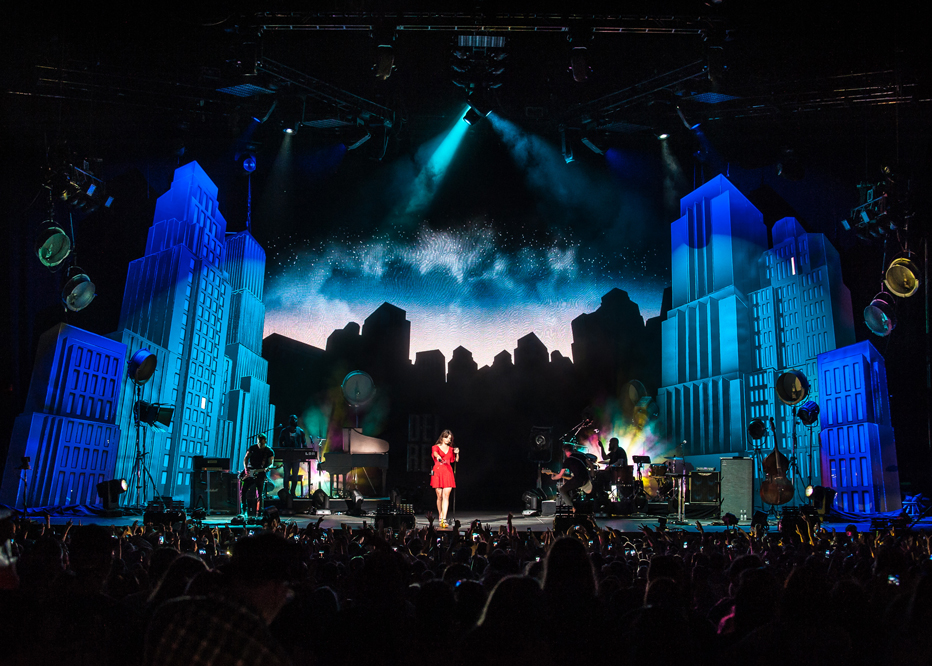
Lana Del Rey. Photo by Tim Prendergast.
“People want realness, they want personality,” adds Gid. “We’re not good at editing who we are. We’re open, blunt and honest. I think in this day and age, when everything is so homogenised and formulaic, it’s easy to identify Block9 as something different.”
In person, the guys communicate in erratic bursts – playing off each other like brothers. It can get heated at times, they admit, but it always ends in compromise and understanding.
“Gid and I will lock ourselves in a room somewhere, take off the gloves and battle it out,” jokes Steve. “That’s how the creative part works for us, however unconventional. It’s what makes Block9 what it is.”

Dismaland, 2015. Photo by David Levene.
Asked what advice they’d give to young creatives desperate to blaze their own trail, Steve smiles. “When I was 17 and going to work on building sites, my dad said to me that 80 per cent of realising your dream is getting out of bed and trying to do it,” says Steve, smiling. “Trust me: just go and fucking do it.”
How to leave your job and team up with a creative partner
There’s nothing wrong with being a control freak
“We micro-manage the living shit out of everything. Your vision is key, so finding other brilliant people who share it is vital. By channelling people’s strengths, you can conduct your own creative orchestra.”
Don’t forget how difficult partnerships can be
“We pick holes in each other’s work. It’s painful and we annoy each other, but we see what each of us brings to the table. That collaborative process can feel like a battle when you’re a team rather than a solo creative. Fortunately, our two heads make for a better product, so we grin and bear it.”
Build a community by reaching out
“There is a delicate balance to be struck between working with friends and working with those who are less fun but more valuable to your project. It’s tempting to just work with people who you’d want to spend time with socially. But often, better creative results come from picking a team from a broader pool.”
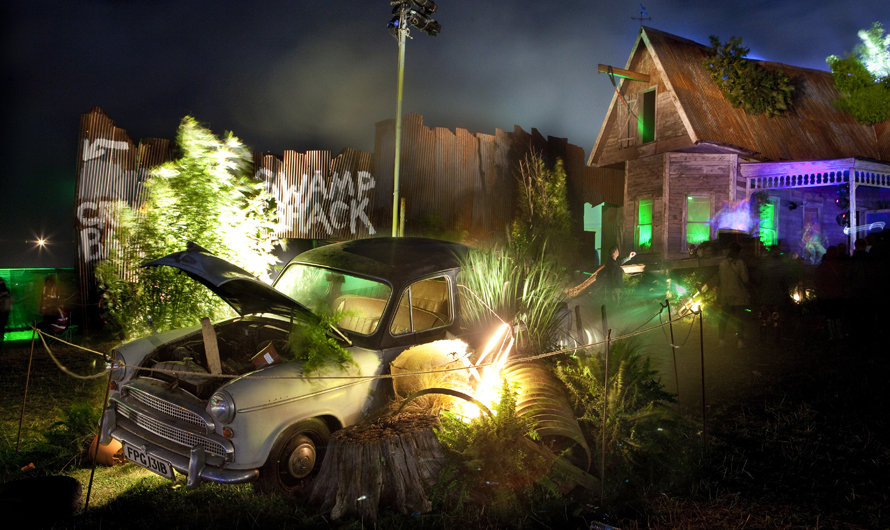
The Swamp Shack, Bestival. Photo by Nic Serpell-Rand.
Great things come from hard work
“One of Steve’s most used sayings is ‘perspiration, not inspiration’. You can’t just expect amazing ideas to drop out of the sky; you have to work towards them. That means creating time and space to facilitate the creation and development of ideas.”
Tell your boss to fuck off
“It’s the best decision we ever made. If you’re stuck in a rut, then deal with the consequences later. Make it up as you go along, if you have to. Be bold and put your neck on the line, because saying you’ll do something isn’t the same as doing it. You won’t regret it.”
This article appears in Huck 61 – The No Regrets Issue. Buy it in the Huck Shop or subscribe to make sure you never miss another issue.
Find out more about Block9.
You might like

Jesse Glazzard’s messy portrait of queer friends, lovers and chosen family
The Sound of Dirt and Beauty — The photographer’s debut monograph explores tender, unpolished moments shaped by the people who he surrounds himself with, while offering a window into the UK’s working-class LGBTQ+ community.
Written by: Sunny Sunday

Behind the curtain at Alternative Miss World 1981
Olympia glamour — Running a subversive take on the traditional beauty pageant, the Andrew Logan organised event prioritised underground creativity and invention. Photographer David Corio went behind the scenes at its biggest edition.
Written by: Miss Rosen

What life on the Strait of Hormuz is really like
Southern Winds — Bandar Abbas based photographer Morteza Niknahad has been capturing the diverse communities and stories of his local region since he first picked up a camera. His new series highlights the human impact of war.
Written by: Isaac Muk

Nick Haymes’s intimate portrait of his family’s life
Chronograph — Over 25 years, the photographer documented his son’s lives as they grew into adults. The resulting photobook is an exploration of the passage of time, as well as the optimism of youth.
Written by: Miss Rosen

Kristina Rozhkova’s scatty, confronting portrait of captivity
Gut Feeling — The Russian artist’s 2024 arrest and subsequent detention opened her eye towards the omnipresent dynamics of power and control. Her new photobook is a stark exploration of being trapped.
Written by: Isaac Muk

UK’s first ever Latino film festival is coming to London
LoLaFF — Taking place between October 2-6, it will feature 55 filmmakers from Latin America, with an opening night at the Barbican.
Written by: Isaac Muk


