Chris Killip’s timeless portrait of working class punk culture
- Text by Chris Killip
- Photography by Chris Killip

A version of this story appears in Huck 73: The Sanctuary Issue. Get your copy now, or subscribe to make sure you never miss another issue. Get your copy of Huck 73 now, or subscribe to make sure you never miss another issue.
“I first stumbled upon The Station in Newcastle in 1985. It was just after the miners’ strike and things were pretty depressed. The north-east of England became de-industrialised in a very short space of time as the coal mines, steelworks and shipbuilding all closed down. Over the course of 15 years, I documented this mammoth shift and became known eventually as ‘the photographer of the de-industrialisation revolution’ – but it was by default. I was simply photographing what I saw.
“During this period, I would also photograph things at night; venues and events. One night, somebody said I should check out The Station – an anarcho-punk venue set up in an old police social club in Gateshead – so I went along the following Saturday and was blown away by the place. It was so different to anything else because it wasn’t a commercial space. It was owned by the people who were dancing there and the bands that played there – a group called the Gateshead Music Cooperative.

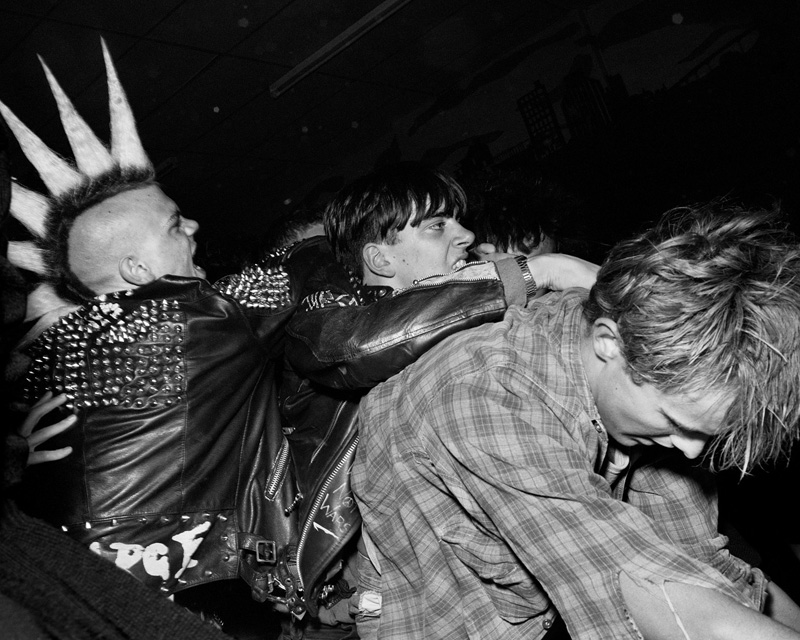
“These weren’t the punks of 1970s London; these guys were politically aware. They were very keen on animal rights and would often join the miners’ strike marches. They were unemployed and had very little money. But what they did have was cider and glue – which fortunately didn’t kill them – and they made the most of it. My problem was that they only had one outfit. They were good outfits: they worked on them until they perfected their punk look. But it meant that the nights all blended into one.
“Inside, the place was painted black. The ceiling was black, the floor was black. There were no lights. I was photographing with my big 4×5 plate camera and Norman flash. And in the end, there was a sameness about all the pictures. So after about six months I stopped because I felt I was repeating myself.
“I used one photo for my book In Flagrante and packed the rest away. I forgot I even had them. Then in 2016 my son was in my studio looking through some boxes and said, ‘Dad you should really do something with these photos.’ That’s how the book, The Station, came about. Looking back, I didn’t realise what I had. If my son hadn’t kicked me up the backside to go and look at them again, they’d still be in that box now.

“The Station closed in late 1985. I don’t like writing about it because I can’t speak for people. I never talked to anybody when I was there: I had to concentrate, because it was difficult. I just came and I photographed. Years later, I put together a list of about 100 bands that played there. It took me about two months of contacting people online. The list isn’t complete but the names are fantastic. Imagine the publicity you’d get today if you were called ‘Eat Shit’.
“Nobody ever said to me, ‘Who are you? Where are you from? What are you doing here?’ But I must have looked so odd. I was 39 with silver-grey hair and I always wore a suit, because it had these false pockets where I could stash my camera. Nobody ever questioned me. Ever. I just came and went with the understanding I could be there.
“Recently, I got an email from a guy called Malcolm who was the leader of a band called ‘Hellbastards’. He could name everybody in all the pictures, he could name all the bands, and he was just so knocked out by it – that there was now this permanent record of that time. About four years ago, I put 12 big prints in a show at the Baltic in Gateshead. People contacted my wife on Facebook with pictures of the original punks going to my show with their families. They were white-haired or bald with big beer bellies and their children and grandchildren were looking up at them as if to say, ‘Grandpa, is that really you?’
“There is a great value in capturing these cultural moments. It’s a part of somebody else’s history, and it’s a history that gets overlooked. Young people doing something – succeeding at doing something, organising this club, running it successfully – it’s all forgotten. My hope is that it can be an inspiration to young people today. As in: get your act together, don’t ask permission, get on with it and do it. Raise some money, you know. That’s what they did.”


As told to Andrea Kurland.
Get your copy of Huck 73 now, or subscribe to make sure you never miss another issue.
The Station is published by Steidl. The exhibition is showing at the Martin Parr Foundation 13 August – 11 October 2020.
Enjoyed this article? Like Huck on Facebook or follow us on Twitter.
You might like

In photos: Black Texas life since emancipation
Kinship & Community — A new photobook and exhibition showcases the rich culture, history and community of African American folks in the Lone Star State, whose existence in the region predates colonial Britain.
Written by: Miss Rosen

American Football: The One With The Feelings
Many moons — The Midwest emo architects transformed a college experiment into a coming-of-age soundtrack. 25 years on, their latest iteration sees them bottle the same magic for the ups and downs of middle life.
Written by: Tracy Kawalik

Youthful joy & end-of-era poignancy at a London school prom
Leavers — For several years, Lewis Khan documented young people as they celebrated the last of their school days and the completion of their exams. The series is now collated in a new self-published photobook and short film.
Written by: Zoe Whitfield

Harry Gruyaert’s vintage, kaleidoscopic scenes of New York
A Sense of Place — For 50 years, the Belgian photographer and Magnum Photos member has been capturing NYC’s colourful chaos. A new photobook and exhibition showcase his unique, technicolour view of the city.
Written by: Miss Rosen

In the pit at one of the UK’s last stock car & banger speedways
Stock Car Racing Isn’t Dead — Photographer Liam McCarthy spent time in and around the Arlington Raceway’s circuit, capturing the diehard community that keeps the sport alive.
Written by: Isaac Muk

Inside Lower Duck Pond, the nicest town on the internet
/r/HaveWeMet — With a population of 2,500 and no fixed location, the subreddit is a space for roleplaying citizens to solve mysteries, host fictional events and ultimately connect. In an internet that’s often divided and toxic, Vicky Jessop hangs out in one of its most wholesome corners.
Written by: Vicky Jessop


