
These designers quit their jobs to craft the perfect chair
“We often find inspiration in biological mechanisms in the ocean and on land — the structure and the connections and the overall shape,“ says Jasper Overgaard.
Jasper is one half of the Danish furniture builders Overgaard & Dyrman, who have built a worldwide reputation for combining the rustic and the urban aspects of Denmark’s design tradition.
They have produced some of the most original, most immaculately rendered furniture to come out of the Nordic nation in recent years.

“We are of course inspired by some of the most famous craftsmen and architects that have created the Danish way of design,” he says, “especially people like Finn Juhl and Poul Kjærholm — but for us it is more about our own little experiment.”
As well as the aesthetic of totemic individuals around which much of the design culture has revolved — you can see the influence of the superbly detailed drawing of evolutionary biologist Ernst Haeckel in the fruits of Jasper’s labour.
The work’s organic intricacy, often combining apparently complex patterns of metalwork interwoven with tactile elements in leather, is underpinned by a logical simplicity, one that reflects the naturally evolved complexities of biological forms.

“It’s easy to make the argument that the world doesn’t need another chair,” he says. “Therefore our products are not necessarily simply fulfilling a need — they come from a passion for purity. We want our products to become objects of conversation as much as a simple place to sit.”
Jasper is based in his central Copenhagen studio. There’s a quietly intense atmosphere. An array of immaculately rendered tools on the walls. There are beautiful steel rendered awls and groovers, racers and punches, skivers and bevelers spotlit by Denmark’s signature slanting light.
“Our aim is that our process has integrity from start to finish,” he says. “We love it when a piece of furniture is beautiful from the time you make the first sketch to the end of its lifetime.”

Each stage of the Overgaard & Dyrman process is shot through with integrity of purpose. “The tools we use are as important in term of design as the furniture itself,” he says.
“I found these incredible leather working implements. They are truly beautiful objects made to immaculate standards. It turns out the tool maker is a blind man — an absolute perfectionist in what he does. We believe that if the process of tool making itself is so precise that the things these tools make will naturally be better, more exact.”
You can’t help but notice the unhurried intensity with which Jasper works. There’s a tangible mindfulness about everything he does.
“I love working with leather because when you interact with it you become aware that it is a fundamentally natural material, and like all natural materials it can be very malleable and soft in one direction, but incredibly tough in another. It’s a wonderful challenge.”
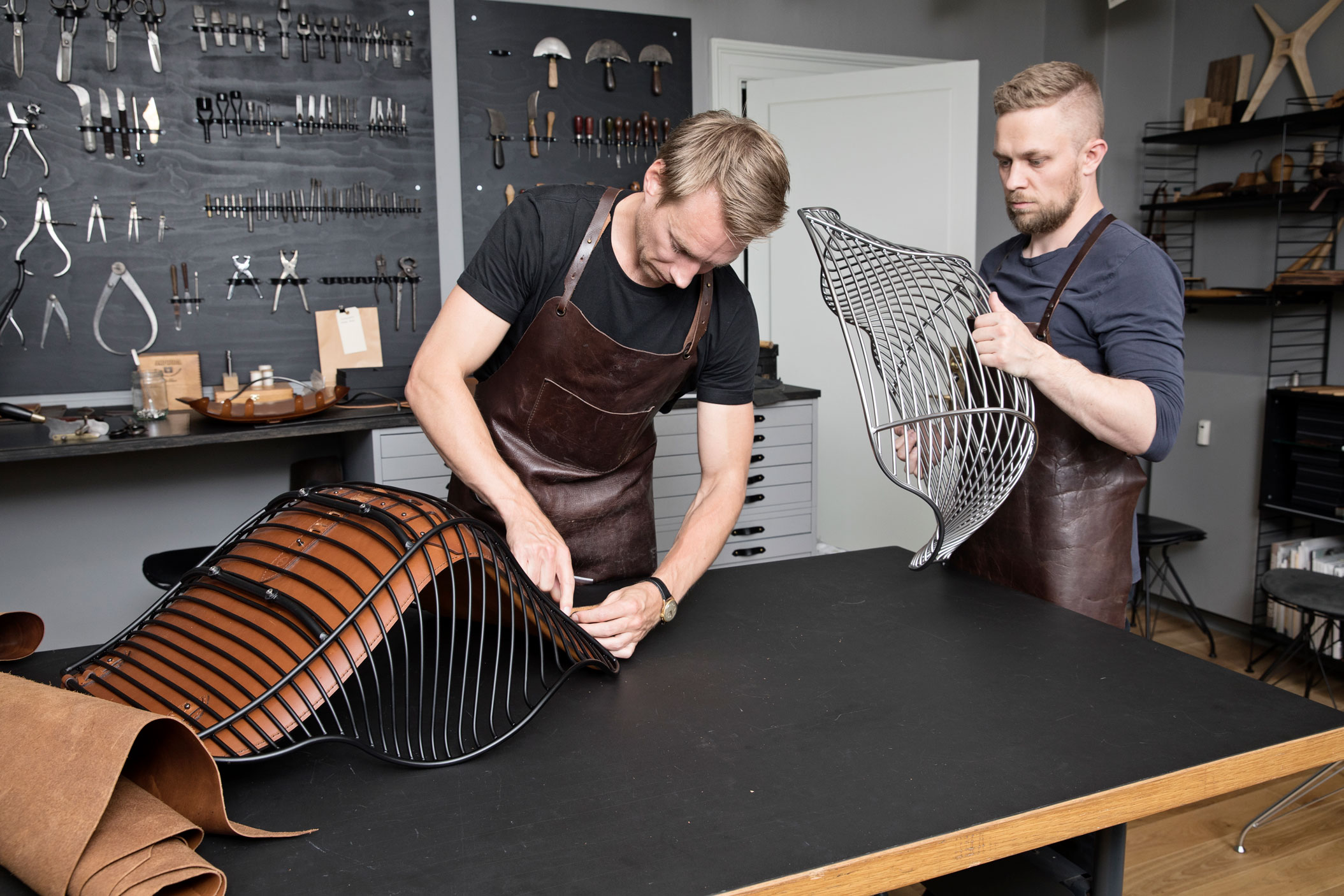
Jasper’s design partner Christian Dyrman lives and creates the metalwork elements of the Overgaard & Dyrman design in a studio in Northern Jutland — the pair coming together to research, plan and finish the products every second week or so. There’s something fundamentally and pragmatically Danish in the arrangement.
“Christian and I have known each other since we were students, and worked closely together for so many years before we finally both quit our jobs and started the company,” he says.

“This gave us a solid base upon which to build. We have been able to bring our different characters and expertise to what we do, and they complement each other. We didn’t start from a business plan,” he says.
“We simply made furniture that we loved and then people started ordering it. The business was born of simple passion for design.”
Read more about Jasper making things #TheDanishWay
Enjoyed this article? Like Huck on Facebook or follow us on Twitter.
You might like

Inside the Los Angeles scene kid revival
It Starts With Us — For the cover of Huck 84, photographer Alexis Gross and writer Anna Zanes meet the latest faces of scene, who are finding freedom to express themselves through its technicolour, unafraid aesthetic.

Introducing our new issue of Huck Magazine: It Starts With Us
Huck 84 — For our second 20th anniversary issue, we spotlight 20 people and groups providing the world with a hopeful future.

The sharp rise of video game photography
Point, shoot — As the entertainment medium’s fidelity levels increase and developers build more powerful tools, a growing community of gamers are pushing the boundaries of image making in virtual worlds. Vicky Jessop meets people at the forefront of the emerging artform.

Joyous photos from the heart of the UK’s radical free festival movement
Common Grounds — The photographer has been capturing British counterculture for the past half century. A new exhibition looks at his archive sitting at the intersection of music, community and grassroots protest.

Introducing ‘The Chaos Isles’, a new photozine by Huck and Yushy
Normal Island — From unlicensed raves to the solstice at Stonehenge, furries to giant vegetable growers, Yushy is one of the UK’s best lensmen of its wild side. ‘The Chaos Isles’ will be sent out exclusively to Club Huck+ members.

Join Club Huck+ to get the most from Huck
Dispatches from the sharp edge of culture — Members get our print magazine, special photozines, The Huck Long Read newsletter, discounts from our friends and partners, digital versions of back issues and priority access to events.


