Gender Stories: Adam Orbach is fighting for LGBTQ acceptance in Israel
- Text by Adam Orbach / Michael Segalov
- Photography by Jonas Opperskalski

“Being born in the West Bank settlement of Yakir, into a small community, it’s no surprise that everyone knows each other – we all knew each other’s business. People there are religious, it makes being different stand out. My family dress religiously, my mother only in skirts and long sleeves, hair covered. We kept Shabbat and only ate kosher food.
“When I was five, I went to a mixed-gender kindergarten, and one day we headed out for a trip to a swimming pool. Boys and girls were wearing different bathing suits, even though above our waists our bodies all looked exactly the same. I asked the teacher why, and she said that’s the way the world goes, especially in our religious community.
“These distinctions between genders are heightened in Orthodox Jewish practice. My parents tell me as a child I used to wear kippah and tzitzit, the skullcap and ritualistic vest that only men wear in Orthodox Jewish practice. This wasn’t really what people did.
“At the age of Bat Mitzvah, the coming of age of a young Jewish woman, these boundaries become further solidified. The celebration came on my twelfth birthday, and soon I was expected to dress modestly as a woman: skirts, never pants, and sleeves that covered at least two thirds of my arms.
“Until this age I engaged with Jewish practice, going to synagogue with my father who I’d be able to sit with. But at my coming of age, that was no longer possible, I’d be expected to sit with the women. Practicing Judaism, in this environment, just wasn’t possible for me.
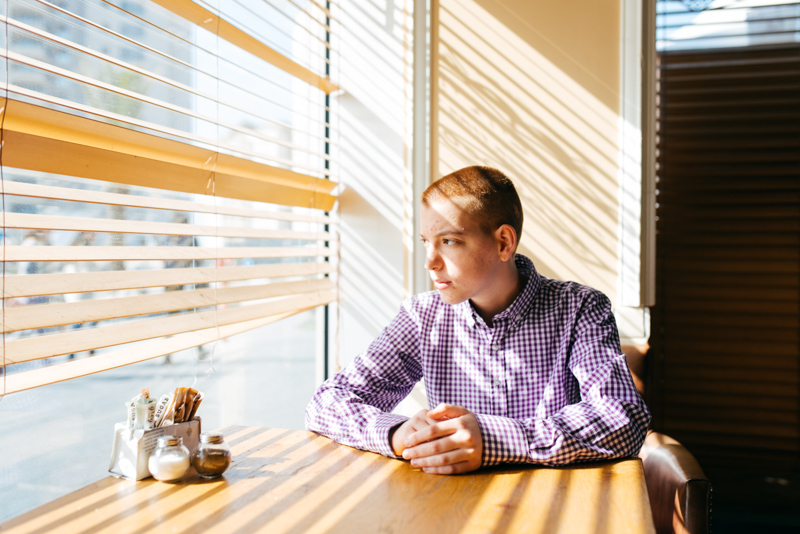
“In primary school we had a lesson on puberty. I felt nauseous. I wouldn’t know what to do about a period! One day a girl in my class got hers, and she was so excited, jumping around. I just couldn’t understand why she was happy. ‘You should be crying! You have blood!,’ I thought.
“My teacher explained it was to be celebrated, that this meant she could give birth. To me it was a disaster, a manifestation of womanhood that I didn’t want to accept.
“When I turned seventeen, I came out. We had a meeting of my year group at school. We were sitting there, and the principal was standing at the front insulting LGBT people. I stood up, I didn’t mean to, but I was just so angry. I told her about myself, in front of everyone; that I had a boyfriend and a girlfriend. It was a religious school, she was shocked, and told me about therapy that could ‘put me right’.
“The following year I started my time in national service. I was seeing more of the LGBT community now that I wasn’t living at home. I came out as genderqueer at first, not as trans, as I didn’t feel I fitted into the masculine box that was presented, of what it meant to be an Israeli man. Then a friend of mine came out as trans; he wasn’t super masculine and I realised I did want to be a man, but not all men are the same.
“I was at Jerusalem Pride this year. I went with some friends and my boyfriend, as I always do, to the parade. Unlike some parades around the world, it’s usually more of a protest than a party, as here we still need to demand our rights. There are some places in the city that we just can’t go through.
“Then the attack happened. Yishai Schlissel, who had hidden in a supermarket waiting for us to arrive, stabbed six people on the march. One of them, Shira Banki, just sixteen, was killed. It was terrifying, the panic, the screaming and the crying. We could have been murdered, simply for demanding our freedom.
“Israel is a religious state, so LGBT rights have a long way to go. Same-sex marriage is a battle that still needs winning, changing your gender on state ID won’t see you treated well. This year we lost three friends from the trans community; one of them was May Peleg. May was an activist, an amazing person who committed suicide two months ago.
“She came from a religious Charedi community, ultra-Orthodox, and her family never accepted her. May made it clear in her will that she wanted to be cremated, after she passed, at a non-religious service. Cremation is frowned upon in Orthodox Judaism. Her mother didn’t approve, so it went to court.
“Many of my friends went to court in her name, and fought until the jury finally used a female pronoun. We also won the case, and the right to spread her ashes in the sea and by a tree at our LGBT centre.
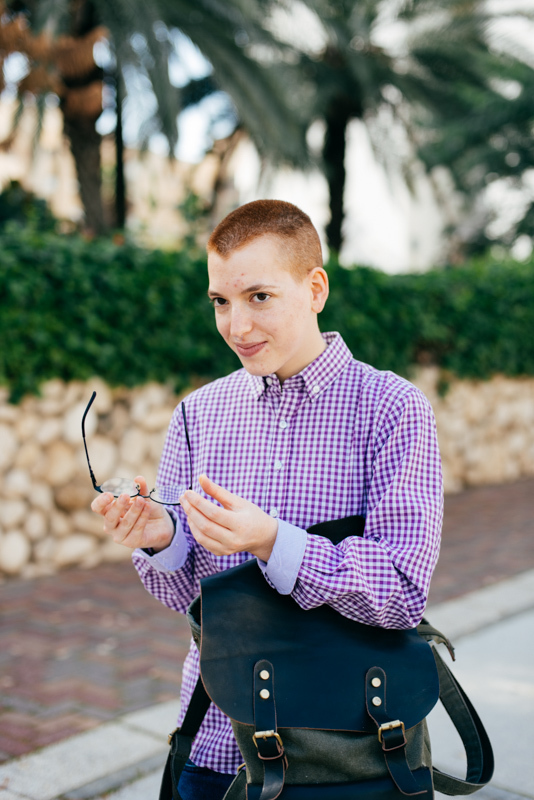
“Trans women here face violence in the streets; assault and sexual violence are all too common. As a trans man I’ve not been sexually assaulted, but people approach me, and think they can just ask any questions they want, as if because I’m trans I’m obliged to publicly answer all their invasive questions.
“In the Jewish state, religious communities continue to preach hatred; the Orthodox teachings are that to be trans, or to be queer, is fundamentally wrong. This Judaism, and our struggle, can’t go hand in hand.
“I work hard, with organisations that support young trans Israeli people, answering helplines, providing counselling and other types of care. We’ve got a long journey to go still, here in Israel, and our community needs this daily support.”
Read more Gender Stories.
This article originally appeared in Huck 54 – The Defiance Issue. Grab a copy in the Huck Shop or subscribe today to make sure you don’t miss another issue.
You might like

Palestine Action ban ruling set for Supreme Court appeal
Final stand — Founder Huda Ammori has won permission to challenge the Court of Appeal’s verdict, which upheld the group’s proscription as a ‘terror organisation’.
Written by: Ella Glossop

Queer resistance & sun-soaked solidarity at the world’s largest trans pride march
Our Future, Our Fight — Over the weekend, over 150,000 people marched at the London Trans+ Pride, with the parade ending at Trafalgar Square for the first time in history.
Written by: Ella Glossop

Inside Parkuir: the art project queering sport, space and our bodies
Lie and play — Founded by Maria Laudes and Guiu Gimeno, it provides a framework for engaging, subverting, and celebrating the small details that make people unique – and queer.
Written by: Molly Lipson

A major Nan Goldin exhibition is coming to London
You Never Did Anything Wrong — Opening at the Hayward Gallery in November, the show will debut a new film from the artist and activist, alongside a slate of recent work.
Written by: Jack Dennison-Thompson

Tender portraits of women serving life sentences in America
Looking Inside — While working as a public defender attorney in New York State, Sara Bennett found dilapidated prisons and forgotten people. Her new photobook harnesses the power of images and shines a humanising light on those imprisoned for serious crimes and their reintegration into society, while asking questions of the USA’s incarceration system.
Written by: Miss Rosen

Activists replace Union Jacks with ‘Tax The Rich’ flags in Farage’s Clacton
Take Back Power — It comes after the Reform UK leader resigned as an MP and triggered a by-election in the constituency, following scrutiny over a £5 million donation that he had not declared.
Written by: Ella Glossop


