Inside the Los Angeles scene kid revival

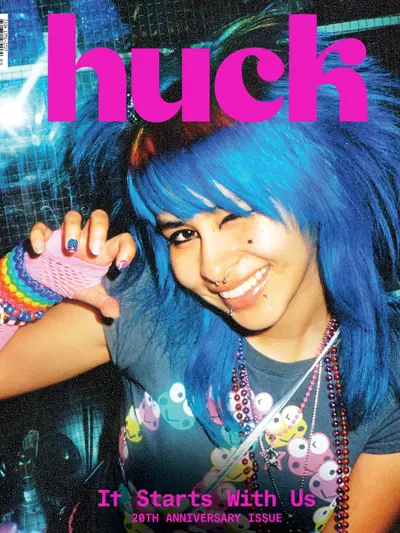
It Starts With Us — For the cover of Huck 84, photographer Alexis Gross and writer Anna Zanes meet the latest faces of scene, who are finding freedom to express themselves through its technicolour, unafraid aesthetic.
LA’s scene kids cover Huck 84: It Starts With Us – 20th Anniversary Issue. Order a copy online or sign up to Club Huck+ to make sure you never miss another issue, or grab a copy from all good newsagents.
Last week, I sat on the floor of 20-year-old Melody’s childhood bedroom with a Baja Blast in one hand, a slice of Dominoes in the other. A cosmetology student, Melody does a mean liberty spike, and hopes to specialize in alternative hair one day. Next to her vanity where a flat iron resides fully heated and resting in its cradle, ready for immediate deployment, hangs a Misfits flag. Through Oli Sykes’ screams from the boom box and his dramatic fringe, her 19-year-old Christian friend tells me he plays bass in Deadbeat Nightlife – a MySpace band formed in 2008, two years after he was born.
Pop culture runs in 20 year cycles. And truly 20 years ago, this could’ve been my bedroom, my CD collection and zebra-print bedsheets. I was making my first mohawked friends, and begging my parents for a pair of purple cheetah Tripp NYC skinny jeans. At that time, though, scene was burgeoning.

But it started when I turned 11, and a family friend handed me a mixtape. Spanning Black Flag to Butthole Surfers to Bad Brains, it featured the music that shaped his youth. And it altered my brain chemistry. – Suddenly, everything became about punk rock, from my clothes, to my hair – dyed with Kool Aid – to what, where and with whom I wanted to be. That said, it wasn’t easy finding anarchist allies or fans of ’70s rock in the fourth grade. I hadn’t quite caught up to a 20-year cycle.


By 2006, though, I found an active alternative community on a new site called MySpace. On the platform, self-expression was not only an accessible function, but rewarded. And in the unfiltered chaos, I fell into another rabbit hole, sinking my teeth into a space that had been crystallising for years, but would find its true form in this new, digital world: scene. Rather than a genre, it was a true subculture, a fusion of fashion, music, and most importantly internet culture harnessing the good, bad, and ugly parts of the new frontier. From its inception, the first influencers would emerge – Audrey Kitching, Jeffree Star – and a new age for music accessibility arrived. From MySpace alone, bands like Job For A Cowboy and Hollywood Undead blew up.
Scene was a choose-your-own-adventure situation. Between crunkcore, metalcore, deathcore, neon punk, and raver-leaning dance-pop, the sonic landscape alone contained so many idiosyncrasies. And as long as one’s hair was flat ironed with a swooping fringe, or teased out “gun shot” style with racoon tails, the style was a spectrum. Some leaned Kandi-raver, others drew from animé or Harajuku. Others veered emo or fashioncore, favouring less colour than their peers. Unfortunately for me, shortly after erecting a MySpace, I butchered my hair attempting a shag. To distract from the disastrous cut, I bleached it. It turned orange, broke off, and I had to wear a beanie for the entire year. Needless to say, I never made it as a racoon-eyed Scene Queen.
But it wasn’t all knee-high converse and tattoo chokers. There was a darkness that surrounded scene culture, beyond the “cringe” and “poser” name-calling it received from punk rockers. It was the early, rogue days of the internet, an uncensored place that gave way to things like Hunter Moore’s revenge porn site Is Anyone Up?, as well as cases of abuse, grooming, and the like. Cyberbullying became the latest, darkest medium for teenage torment, particularly targeting what would be some of the first influencers, pouting young women and girls like Kiki Kannibal, who were garnering attention at warp speed for their neon-hued selfies. It was a complicated time. Nonetheless, it’s come back around. Welcome to the “Rawring 20s”.
“At the end of the day, everything I am now I had to fight to be. My expression, my queerness, my loudness, and my inability to conform into a world that beats you into submission.” Hannah
It’s the first shoot. Using the internet, appropriately, Alexis has wrangled a group of four tried-and-true scenesters – a combination of IRL and Instagram friends. Ranging from 17 to 21, bubbly and excited, they help one another with hair, eyeliner, the right belt combinations in hyperdrive – one belt is never enough, hard and fast rule – I witness one reach into the other’s mouth to adjust a snakebite piercing. As they assemble, I walk through the holy trinity: music, hair, their stylistic entryway. Melody’s friend Bryan, a guitarist in two local deathcore bands, arrives: an emo older sibling. “She and her best friend are OG emo/scene kids,” he tells me. “I always remember hearing Bullet for My Valentine and a lot of dad rock coming from her room whenever her friend was over. From there I kinda explored some music in middle school and found Pierce the Veil. I always kept it in the back of my mind until I was finally comfortable to be who I am today and embrace all the emo culture and internet culture I grew up with.”
His younger sister, 17-year-old Tyla shows up for the brighter side of scene, heavy on the Hello Kitty, and toting a backpack full of tutus, jewellry, bows, belts and more. Ceremoniously, she pulls out a tee she made herself, which reads: “I PARTIED NAKED WITH BRING ME THE HORIZON.”
Over Crunchwraps, they gush over bands like Saosin, Suicide Silence, and offer rundown of the Pierce the Veil show at Petco Park the night before. To me, it’s true time travel – when La Dispute’s ‘Such Small Hands’ starts playing, I can’t help myself. Suddenly, we’re all screaming together, “every mangled promise that your body couldn’t keep!” It’s unexpectedly emotional. Age gaps aside, one thing that will never cycle in or out is the human need for catharsis, the pulsing heart of all things alternative. The lifeblood of sensitive, creative weirdos that keeps us going. That is, until we get an all-too familiar message from Melody’s mother downstairs: keep it down!


Obviously, over 20 years, things change. Alongside society’s political and anthropological mutations, culture shifts at a pace that’s only been expedited with the introduction of the internet. Today, young people are suffusing scene with their own lived experience. “There’s so much variety in what people call ‘scene’ in 2026,” Bryan tells me. “It’s definitely a bigger melting pot than it used to be.”
The music, the harsh culture or criteria around influencers, and the rigidity of falling under any one label, genre, or otherwise has thawed over time, it seems. With a plethora of virtual platforms, scene kids can piece together identity and find community on a roomier scale, using an expanded palate of inspirations and interests.
But it’s not all rainbows and PLUR. Bryan and Christian educate me on “SoCal deathcore revival” – a popular meme page that mocks Gen Z the MySpace-coded metalcore scene for being “posers”, “cringe” or worse. However, I see it as part of the cycle. We’ve all paid our dues emulating older kids, obsessing over the look and feel of generations past. And as time passes, each phase, each reference, becomes a brick laid in the foundation of who we become. “If you’re afraid of someone stealing your ideas,” I heard writer Lena Waithe say in an interview, “Have more.” It’s not even about the idea – it’s about perspective and voice.


Days later, I’m in a dusty playground in Highland Park with Monica and her 20-year-old sibling Ethan – a fashion student who goes by the pseudonym domo homo. In their family, alt fashion has been passed down generationally, literally handed down from their blue-haired mother. In recent years, Ethan has entertained a few phases in the pursuit of their own colorful identity, and I can immediately see it all mapped out walking into their bedroom. Skelanimal and Sanrio plushies, hot pink studded belts, sparkling platforms, fuzzy leg warmers. There are mannequin heads wearing striped “peacock” hair styled wigs and razor cut bangs. Every surface is covered with ephemera. But when it comes to music, Ethan considers fashion separately, and listens to mostly nightcore and heavy electronica. When I ask about shows, stores, bands that I consider scene or emo, they almost recoil. For them, the space is just a jumping off point – animal print and jelly bracelets are as much a motif as they are a metaphor for life. Scene in 2026 is about being loud and different, and lauded for it. “In the beginning,” Monica explains, “I really wanted to fit into this one category. Now I love to mix and match all of my favourites. I’ve made a lot of friends by not being afraid to express myself unapologetically and I feel that we all encourage each other to push fashion boundaries.”
The five young women we meet later that day understand the Scene Queen assignment. From blocks away I clock fishnet stockings, teased hair, and a colour palate that speaks volumes to how well researched they are, though they feel just as adverse to being boxed in. While gluing on a long, polkadot nail, Hannah reveals, “I don’t personally consider myself ‘scene,’ but because I’m a hairstylist, I enjoy the fashion and hair. Maybe I’m a poser,” she jokes, reiterating that for her and her friends, it’s just about freedom and eccentricity. “At the end of the day, everything I am now I had to fight to be. My expression, my queerness, my loudness, and my inability to conform into a world that beats you into submission. I didn’t want to be the only crayon in the pencil box, and it turns out I don’t have to be. Shows, music, popup events, surrounding myself with people who uplift me are all part of it.”
I get a message from Christian a few days after our shoot. He invites me to see his band open for OG scene band, Alesana – it’s a show many of the kids we’d shot would be gathering, as well. Along with the ticket link, he shares a few last thoughts. “I find a lot of peace in the extreme expressions that a lot of people in the scene have and do. I like having bright red hair. I like when it’s spiky, I like having piercings and like customising my character. It’s really nice to be able to be around people who understand that part of me. And to be around people who generally share similar views as me. People who, you know, stand up for what’s right. People who care about music. To be able to make music like this, and talk about it with people who understand has been the best thing for my life. Having my eyes opened, and being able to join this community has entirely changed its course. If I hadn’t joined my band, I would be doing something very, very different. I don’t even know who I would be today. This all made me, as a person. I just feel so at home the way that I am now. And it sounds and feels crazy to imagine a world where it never happened.”


Huck 84: It Starts With Us is out now. Sign up to Club Huck+ to make sure you never miss another issue.
Alexis Gross is a photographer based in Los Angeles. Follow her on Instagram.
Anna Zanes is a writer and editor. Follow her on Instagram.
You might like

‘Did it ever go away?’ – Emos at 2000trees on the subculture’s revival
Photographer Jak Hutchcraft attended the legendary music festival to find out what attendees make of emo’s comeback.

Photos celebrating the unsung women of indie sleaze
Almost 20 years after the indie youthquake first struck, photographer Rebecca Thomas recalls documenting the women at the epicentre.

The cathartic roar of Vietnam’s hardcore punk scene
Going hardcore in Saigon — In a country that has gradually opened up in recent decades, a burgeoning youth movement is creating an outlet for youth frustration and anxiety. Frank L’Opez reports from the country’s biggest city’s underground.

In photos: Bin jousting, happiness and wholesome humour at Bloodstock 2025
Derbyshire doom — At first glance, the UK’s heaviest metal festival may not seem like a particularly warm affair. But metalheads are some of the nicest music fans in the country, and Chris Bethell was there to capture the fun and funnies of the weekend.

How skateboarding and punk combined to create a radical, rebellious movement
Don’t forget the streets — The sport’s intersectional romance with subcultures and their music can be a complicated maze. The deeper into the labyrinth, the more inextricable the two forces appear to be.

Introducing our new issue of Huck Magazine: It Starts With Us
Huck 84 — For our second 20th anniversary issue, we spotlight 20 people and groups providing the world with a hopeful future.


