Life inside an isolated Russian mining town
- Text by India Lawrence
- Photography by Hanne Van Assche

Dubbed ‘Russia’s treasury’, the district of Yakutia sits atop a vast pile of wealth in the form of a giant diamond reserve. It’s here that Belgian photographer Hanne Van Assche discovered Udachny, a mining town frozen in time.
In her new book Udachny / Lucky, Van Assche explores the inhabitants’ deep connection to their landscape, and how the diamond industry has kept this small community tethered to the hinterlands of coldest Siberia.
Shooting as part of her master’s degree at Ghent Royal Academy of Fine Arts, Van Assche wanted to document abandoned towns and isolated communities. When she stumbled across Yakutia, a monotown with connections to her home in Belgium (Antwerp is one of the diamond capitals of the world), she had to see it for herself.

“The camera is a way into communities and people you don’t easily get access to,” she says. “I learned through research that they export diamonds to Antwerp [from Udachy], a big ‘diamond city’ as we call it in Belgium. I always see the end products, the diamonds, and I was really interested [to find out] who these people are that live in those towns, and how life is there.”
The name Udachny, translating to ‘lucky, or ‘happy’, is a direct response to the happy accident that allowed the town to form, after the discovery of the first diamond there in 1949. Now workers from across Russia and neighbouring countries come to Yakutia looking for work on the reserves.
Udachny’s 12,000 inhabitants live compacted into just 38 apartment blocks. In her almost four months there, Van Assche learned to live just like them. “I got to know really great people and I lived together with them. It was the goal to get to know most of these people and to portray them in their own environment,” she says.

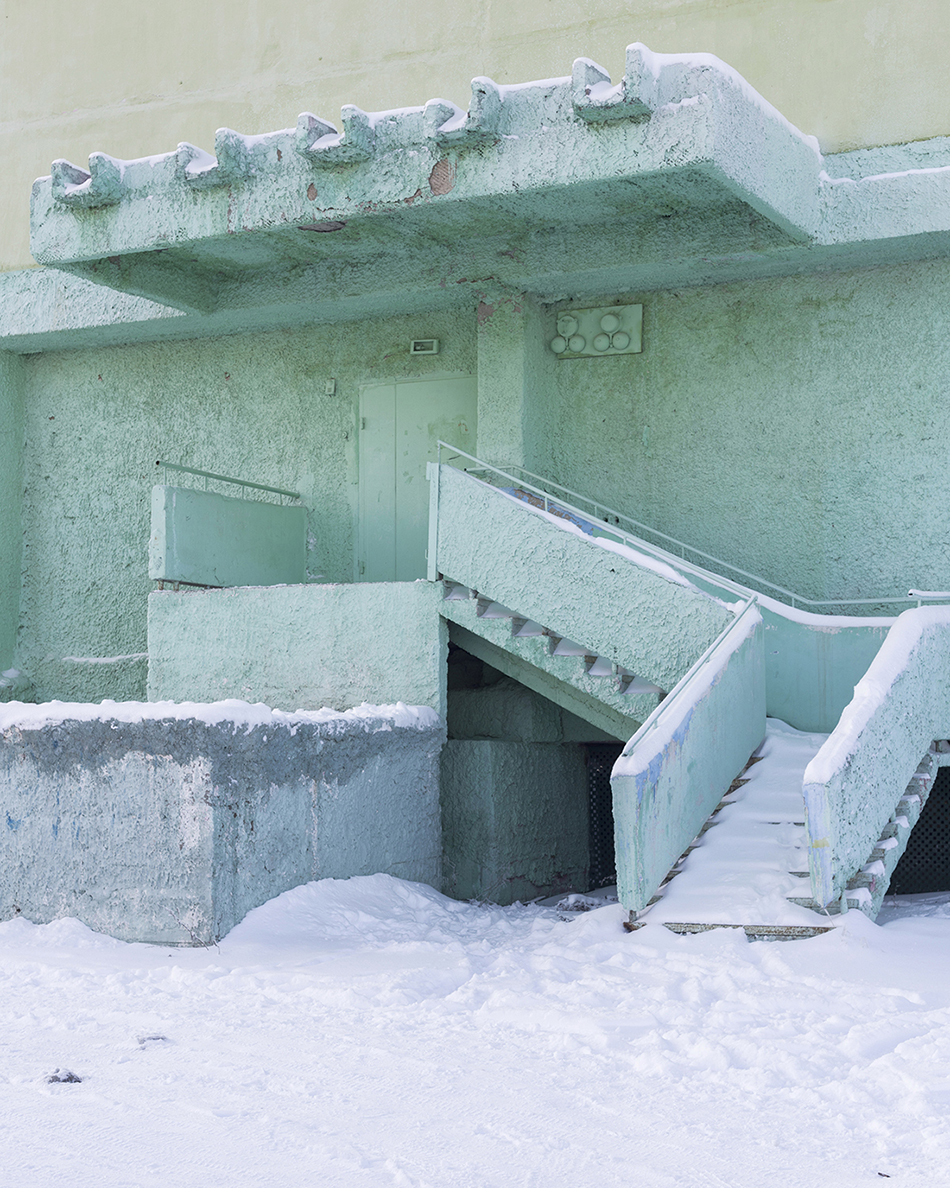
 Van Assche’s photographs seem more like a scene from the ‘80s than the 2020s. “I was blown away by the architecture, there are a lot of pastels. It’s like time stood still. But at the same time, people also have a phone and that connects them to the world.”
On the edge of the Arctic Circle, a landscape of tundra zones, taigas and dense pine forests cuts Udachny off from the rest of Russia. “It’s so far away from everything and so isolated. It feels like a world on its own,” Van Ascche notes. She understands why the people of Udachny have such a “strong connection with nature”.
“It’s really industrial but also a rural landscape,” she adds. “It’s nothing like we have here – so I was overwhelmed by it, but it was incredible. There were times when we would go into nature on a hike and you could only hear your own footsteps in the snow. It’s an amazing feeling when you don’t hear anything.”
 In its own microclimate, life in Udachny is unlike anywhere else. The town spends eight to nine months in the harshest of winters, with temperatures as low as minus 40C.
Although life in Udachny appears small and closed off from the rest of the world, Van Assche paints a portrait of resilience, pride and a community’s deep affection for their town. “The people in the Udachny are very proud people because they’re contributing to their fatherland – to Russia. I have a lot of respect for the people who live there.”



Udachny / Lucky will be published in March 2022 by Stockman’s Art Books.
Enjoyed this article? Like Huck on Facebook or follow us on Twitter and Instagram.
You might like

Jesse Glazzard’s messy portrait of queer friends, lovers and chosen family
The Sound of Dirt and Beauty — The photographer’s debut monograph explores tender, unpolished moments shaped by the people who he surrounds himself with, while offering a window into the UK’s working-class LGBTQ+ community.
Written by: Sunny Sunday

Behind the curtain at Alternative Miss World 1981
Olympia glamour — Running a subversive take on the traditional beauty pageant, the Andrew Logan organised event prioritised underground creativity and invention. Photographer David Corio went behind the scenes at its biggest edition.
Written by: Miss Rosen

New exhibition highlights British radical living over 200 years
Earthly Paradise — Taking place at the William Morris Gallery, it explores the homes and lives of artists, writers, musicians and more, as well as the conditions that allowed them to thrive.
Written by: Isaac Muk

What life on the Strait of Hormuz is really like
Southern Winds — Bandar Abbas based photographer Morteza Niknahad has been capturing the diverse communities and stories of his local region since he first picked up a camera. His new series highlights the human impact of war.
Written by: Isaac Muk

Nick Haymes’s intimate portrait of his family’s life
Chronograph — Over 25 years, the photographer documented his son’s lives as they grew into adults. The resulting photobook is an exploration of the passage of time, as well as the optimism of youth.
Written by: Miss Rosen

Kristina Rozhkova’s scatty, confronting portrait of captivity
Gut Feeling — The Russian artist’s 2024 arrest and subsequent detention opened her eye towards the omnipresent dynamics of power and control. Her new photobook is a stark exploration of being trapped.
Written by: Isaac Muk


