The long history of slop in music
- Text by Ian McQuaid
- Illustrations by Alex Holmes
Top of the Slops — The term might be everywhere now, but the act of copying and enshittifying has been around for decades, explains Ian McQuaid.
This column first featured in Club Huck’s culture newsletter. Sign up for free here to make sure it lands in your inbox every month.
2026 was the year of slop.
March 2026 saw the term “AI Slop” spike to its highest ever ranking in Google search results, an indicator that it’s a topic everyone has an opinion on. There have been debates raging over AI use across the arts – perhaps most virulently in music, where we’ve seen everything from a glut of ageing producers (Timbaland, Diplo, Dr Dre) coming out to insist that AI music is absolutely definitely the future, to Jorja Smith having to sue a songwriter for clearly prompting AI to rip off her vocals, to Tyga releasing an album he proudly declared was made with AI, only for Pitchfork to award it a remarkable (if generous) 0 out of 10. At times it’s seemed out of control, but in all the heat and noise there’s a reality that’s been missed.
There’s always been slop.
Case in point.
In July 1971 this got to #1 in the UK album charts.
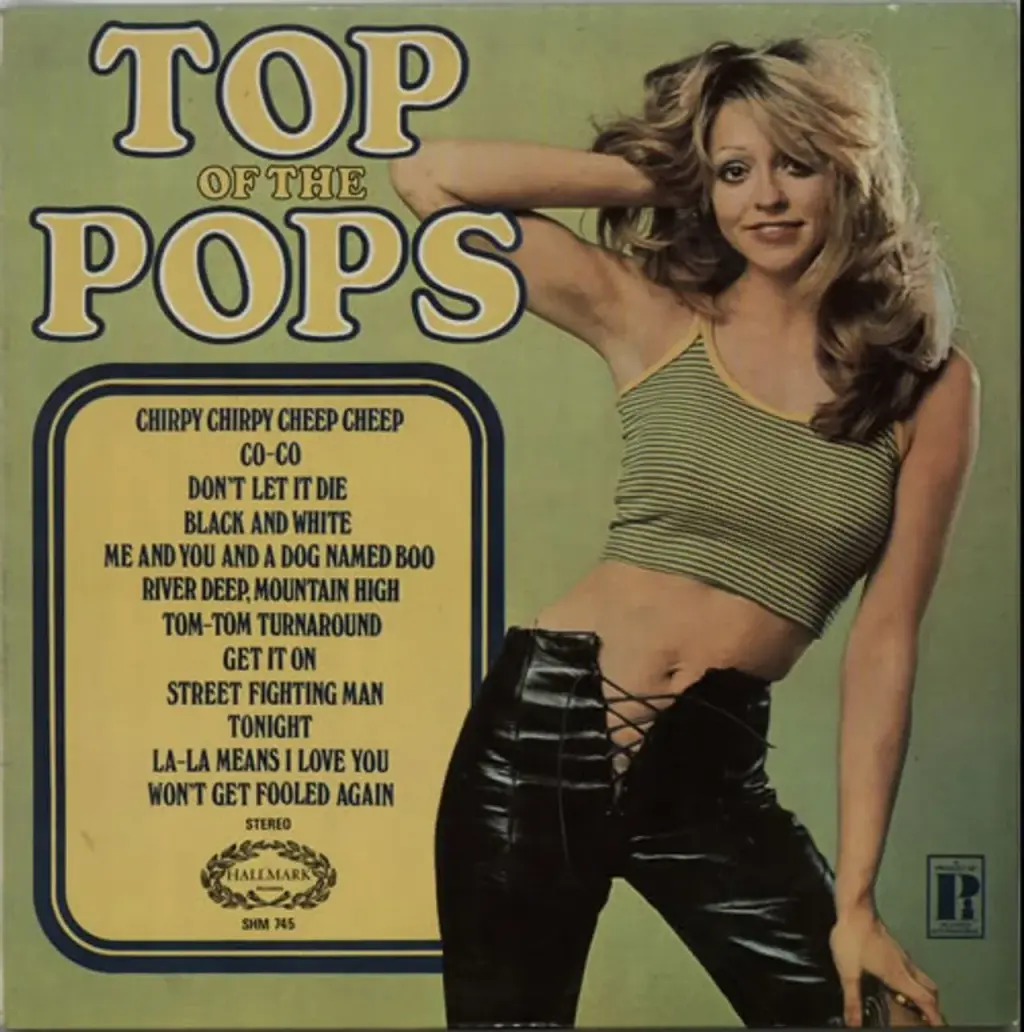
It was part of the incredibly successful Top of the Pops compilation series, a series that not only stole its name from the then wildly popular pop TV show, but stole all of its contents from the charts. The formula was simple; get a load of session musicians and lock them in a studio until they’d banged out cover versions of everything currently shifting units. Three songs in three hours? Not a bother. To anyone with any sense of discernment the songs sounded atrocious – disgraceful bowdlerisations of pop masterpieces, Marc Bolan’s fey snarl rendered as an arthritic wheeze. ‘Won’t Get Fooled Again’ sounding less like The Who and more like the why?
And yet, the British public did love it. They lapped it up. They bought Top of the Pops albums by the barrel load, enough to propel at least four of these albums into the Top 40, and enough for series owner Hallmark to bang out over 90 editions. No genre would prove too innovative, too sublime, for Hallmark not to slap it into the grinder. Not disco, with every one from Stevie Wonder to Boney M getting knocked off. Not electro – Kraftwerk got butchered on versions of ‘Autobahn’ and ‘The Model’. Not the punk-ska fusion of 2Tone, with a particularly egregious, borderline racist rendition of ‘Ghost Town’ making the grade. Even punk, that most anti-establishment of genres, was, in the end, pop music, so in it went. Hallmark delivered covers of The Sex Pistols, and later, possibly a nadir for the series, a version of Public Image’s ‘Death Disco’. A post punk lament written by John Lydon for his dying mother, ‘Death Disco’ contains the lines:
“Watch her slowly die / Saw it in her eyes / Choking on a bed / Flowers rotting dead”. There’s something truly bizarre listening to these lines whimpered out on the Top of the Pops album by a bored, jobbing musician trying to earn money to slap on the electric meter. Who would want this? But as has been proven time and again, and as we are learning at an accelerated pace in our final years on a burning planet, the public at large really, really love slop. Always have, always will.
Read next: Art Made Human?
The definition of slop is currently fairly amorphous, and is often used as a proxy for “something I don’t like”, but to get specific, I would argue that slop as we understand it in a musical context, is any work that blandly, emotionlessly regurgitates other work whilst stripping out elements that might be unexpected or transgressive, leaving the thinnest gruel, whatever tiny sliver of sound that can be used to extract profit. Does it really make that much difference if the slop was made by an algorithm? AI may have democratised slop farming, it didn’t start it. And the Top of the Pops albums didn’t start it. Slop has gone hand and hand with pop since records were pressed, and we have fallen for it every single time.
Back in 1955, when rock ‘n’ roll was first rattling bones, a record label called Dot Records got hold of a pre-release version of Fats Domino’s recording of ‘Ain’t That a Shame’, a song that would go on to become one of the recognised pillars of the genre. The A&R men at Dot recognised a hit, and hustled their new squeaky clean artist – the conservative caucasian Pat Boone into a studio to lay down a version. Pat himself wanted to alter the lyrics to “Isn’t That a Shame”, but his producers dissuaded him. They cut Boone’s version of ‘Ain’t That A Shame’, “hood” lingo and all, and released it in literally the same month as the Fats Domino original. Boone’s insipid version, that is almost entirely forgotten today, shot to #1 on the American Billboard charts. Fats himself – the songwriter the originator, the man behind the version that would stand the test of time – well, he could only reach #10. The slop won.
For every Simon Cowell, gleefully crapping out another mawkishly predictable cover, there’s an Arca, a Jim Legxacy, a Björk. There’s the street kids of Rio playing distorted Baile Funk and the street kids of Lagos playing billion-beats-per-minute Cruise. Ian McQuaid

Boone repeated the trick over and over, notoriously taming Little Richard’s ‘Tutti Frutti’, turning the camp, chaotic howl of Richard’s original into a smooth croon to satisfy middle America. Richard responded by writing ‘Long Tall Sally’, a song he was sure was too fast and lyrically dexterous for Boone to slopify. The track is a classic, Richards whooping and hollering as he reinvents pop culture in two thrilling minutes. Boone, always up for a challenge, recorded a pale rendition and watched it careen up the charts. He became the biggest artist in American recorded history – bigger than Elvis, bigger than any of the artists he was extracting culture from. He was only finally dethroned by the British Invasion of the ’60s, when it turned out the same trick could be repeated by white Brits with better haircuts. But the model! The model remained and has been reaping money for music industry moguls ever since.
At its heart, slop is about the extraction and exploitation of artistic talent by capital, rendering it into a more efficient wealth creator at the expense of aesthetic considerations. It’s about maximum profit with minimum risk.
In the UK during the ’80s and ’90s, the UK slop machine was driven by Stock Aiken and Waterman, a trio who took the groove and innovation of black American R&B and turned it into a tame soundbed for swagless singers from soap operas. This trick was repeated in the States in the ’00s, with pop artists such as the Backstreet Boys and Britney Spears taking their sound from the rowdy swingbeat Teddy Riley had applied to Bobby Brown in the ’90s, with world conquering results. Bobby Brown, a chaotic, charismatic child star laid a foundation with hits such as ‘My Prerogative’ that provided a template for pretty much the entirety of Britney’s early catalogue.
Read next: The Pope has declared holy war on AI
The same imperative gave us Landfill Indie in the ’00s. Vapid, smug strumming that came in the wake of The Libertines’ chaotic, drug fuelled excess. Safe, marketable, dull, and less likely to end up in the dock seven times a year. And while slop’s primary function is the transmuting of other people’s genius into money in your pocket, as a secondary function it inevitably serves to maintain the status quo, which is quite probably why the billionaires love AI.
Sometimes slop throws up a gem. There are a couple of the Top of the Pops albums that have become grails for crate diggers, where some drummer has a flash of genius in an otherwise halfassed session and thumps out a breakbeat with real propulsion. Backstreet Boys had some bangers. That Fenix Flexin song is an improbable jam. But more importantly, alongside slop, there has always been innovation. For every Simon Cowell, gleefully crapping out another mawkishly predictable cover, there’s an Arca, a Jim Legxacy, a Björk. There’s the street kids of Rio playing distorted Baile Funk and the street kids of Lagos playing billion-beats-per-minute Cruise. Even as there have been dire predictions for the music industry muttered by the most easily gulled, invention won’t die out because greedy corporations love selling slop – they always have and they always will. It’s nothing new, nothing new at all. Leave them to get on with it, and search out the gold.
Ian McQuaid is the author of Woosh and the head of Moves Recordings. Follow him on Instagram.
Buy your copy of Huck 83 here.
Enjoyed this article? Follow Huck on Instagram and join Club Huck’s mailing list for more from the cutting edge of sport, music and counterculture.
You might like
Art Made Human? – Huck’s September Newsletter
Emma Garland kicks off a new series of monthly cultural dispatches with her reflections on artificial intelligence, human-made art and Hank Williams singing “Straight Outta Compton”.
Written by: Emma Garland
Artifaxing: “We’ve become so addicted to these supercomputers in our hands”
Framing the future — Predominantly publishing on Instagram and X, the account is one of social media’s most prominent archiving pages. We caught up with the mysterious figure behind it to chat about the internet’s past, present and future, finding inspiration and art in the age of AI.
Written by: Isaac Muk

Porthcawl’s finest: Inside the world’s biggest Elvis festival
Long live the king — Every year, the Welsh town of Porthcawl plays host to an Elvis Festival – an event that draws devoted impersonators from Wales, Europe and beyond. Photographer Andrew Hughes captures the most convincing.
Written by: Andrew Hughes

The Pope has declared holy war on AI
The New Butlerian Jihad — In his first encyclical letter, Pope Leo XIV addressed the increasing pervasiveness of artificial intelligence as a threat to the already fragile structures of society. Newsletter columnist Emma Garland makes sense of it all.
Written by: Emma Garland

Space Afrika are flying the flag for the Black avant-garde
Quiet Storm — Mancunian duo Joshua Tarelle Reid and Joshua Inyang have been soundtracking their vision of industrial decay for the best part of a decade. Their latest album sees the pair join forces with global diasporic voices to create their most personal, expansive record yet.
Written by: Jack Dennison-Thompson

Queen Millz: “Getting kicked out of school changed my life”
What Made Me — In this series, we ask artists and rebels about the forces and experiences that shaped who they are. Today, it’s leading Leicester wordsmith Queen Millz.
Written by: Queen Millz


