
The Manhood Academy where boys become men

Navigating adolescence is always tricky, but its challenges are particularly acute for young men growing up without fathers in neighbourhoods facing deprivation, violence and drugs, where positive male role models are in short supply.

The boys line up before entering the room, as the mentors encourage them to stand up straight. From left to right: Jahran Douglas-Jones, Jaheym Foster, Leon Prendergast, Amari Woodrow-Stuart, Marcus English

Aundrieux Sankofa, Davis Williams and six other men have stepped in to fill that gap, launching the Manhood Academy for boys in October 2016.
After many years working in education, in youth care homes, in prisons and on the streets with gangs, they wanted to provide an alternate model of positive masculinity, steering boys onto a path of empowerment, leadership and responsibility.

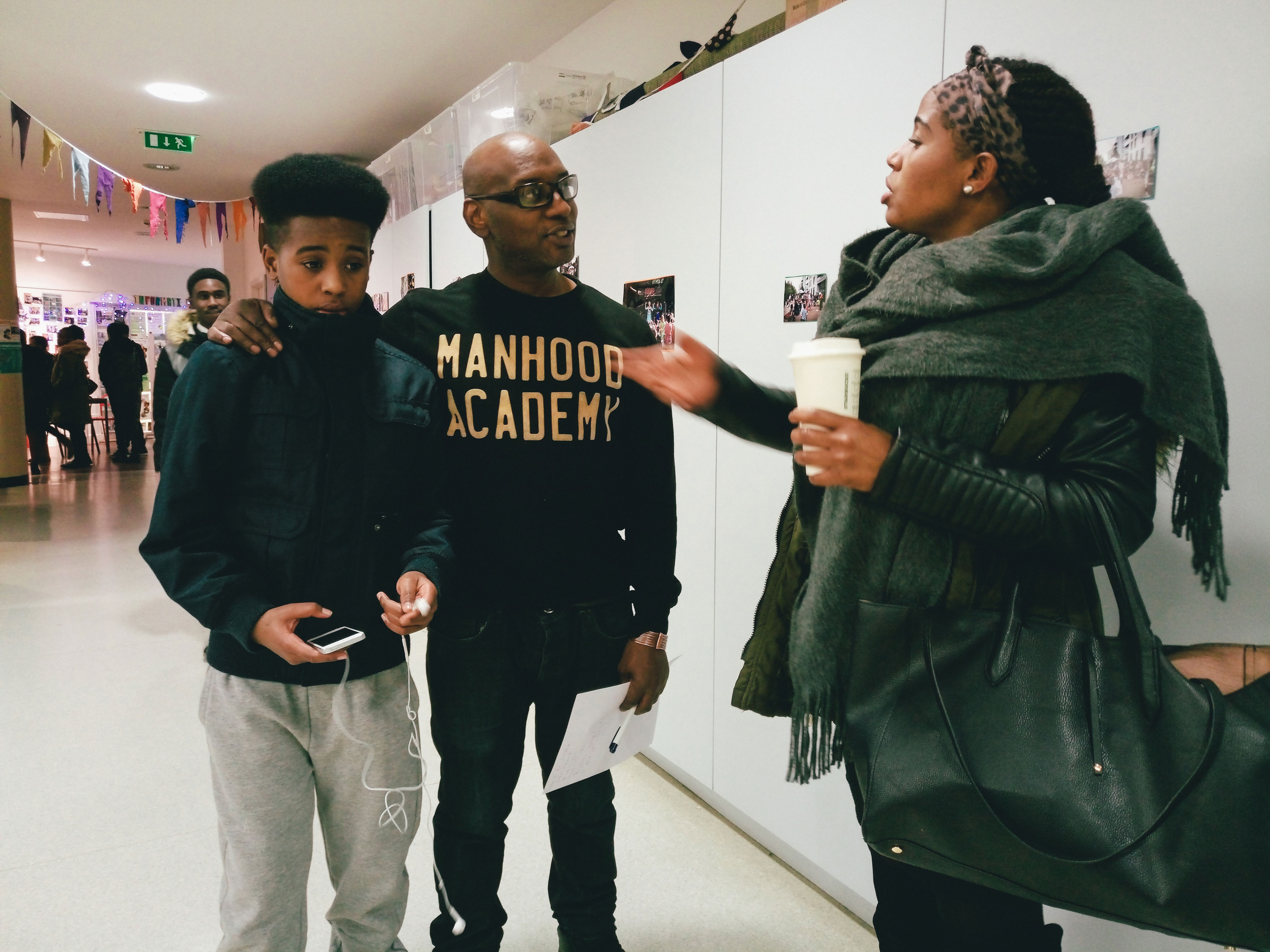
Mentors lead a conversation about anger and encourage the boys to open up about their emotions.

One of the key inspirations was a trip Williams took to the Gambia in 2015 to explore his family roots, where he witnessed a revelatory traditional rites-of-passage celebration for young men. He brought back the idea of a rites-of-passage themed program tailored to thriving in the urban environment of his London community.
The group meets weekly, with programs aimed at pre-teens and teenagers, exploring different aspects of becoming a man through modules represented by the four natural elements: earth, water, fire and air.

Co-founder Davis J. Williams (aka 5 Star) and participant Zion Jones.

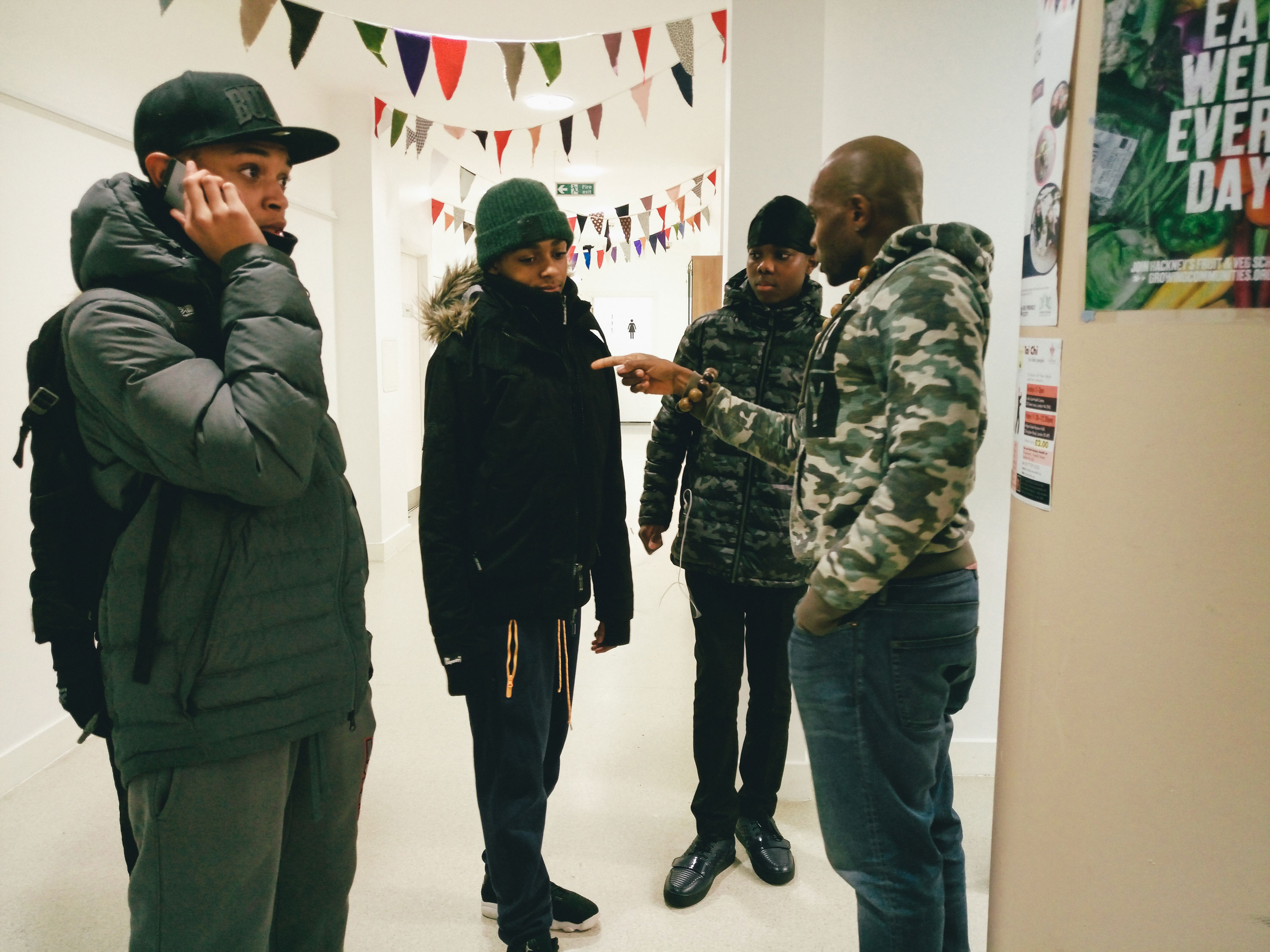
Tonight, on a rainy Wednesday night mid-December in north London, 10 teenagers gather together for the final session of the year, goofing off and commenting on one another’s sneakers before their cell phones are collected and they are hustled into the hallway, asked to stand up straight and demonstrate their seriousness of purpose.

Participants Jahran Douglas-Jones and Leon Prendergast.
The group files quietly into the room and gathers in a circle, arms interlocked, representing an unbroken chain. Each session is started this way, with a supportive pep talk and a set of affirmations, repeated as a group and as individuals.
The coaches, as the mentors are called, push the boys to stop constantly making jokes and to be authentic with themselves and each other. They check in to find out if anyone has anything in their life distracting them from their focus and gently chide a couple of latecomers.

Boys playfully tease one another before the session begins and cell phones are collected to minimise distractions.

They cite as a group, “I am my brother’s keeper. I am my sister’s protector. I am my community’s provider. We are our ancestors’ reincarnation. We are Manhood Academy.”
The mentors guide a brief discussion on responsibility and what it means to be a man. They ask the participants to reflect on those they know who have lost their way and given up on life. Nearly everyone puts a foot in the circle to denote that they know someone who fits this description.

Participant Malachi Green and co-founder/mentor Albert Mada (aka Se7en).

The circle breaks up and the boys take their seats for tonight’s discussion on anger and conflicts, part of the fire module. They speak about absent fathers and personal struggles, telling stories that can be difficult to share with others, so I leave the room and go speak to some of the mothers waiting down the hall.
“I love bringing my son here,” one tells me, “because when he gets out he actually wants to talk to his mother. He has so much to say.” Others agree. “I notice a change in how he acts,” another noted, “although it doesn’t necessarily last for the whole week…” she says with a smile.

Participants Daniel Jacob Adeloye and Jaheym Foster.
Right now, the eight co-founders are running the program on a volunteer basis on top of their day jobs, but they are already planning an expansion next year, adding groups for young women and parents.
They are currently fundraising to take teenage graduates on their own life-changing trip to the Gambia next summer, so they can experience a new environment, build confidence and self-awareness, and participate in a culminating rites-of-passage ceremony.

5 of 8 founding members. Left to right: Hughie Rose (aka The Chairman), Albert Mada (aka Se7en), Davis J. Williams (aka 5 Star), J Change, Aundrieux Sankofa (aka Prof. Khonsu).
And yet, despite having achieved so much, they’re still only scratching the surface.
The academy is inundated with calls from others around the world who are interested in bringing the model to their cities, and they have ambitions to develop programs elsewhere in the UK.
“We would all love to quit our jobs and focus on building this full time,” says Sankofa. “That’s the dream.”
Pivot Points: Stories of Change from Huck Photographers are shot entirely on the KODAK EKTRA Smartphone, a 21-megapixel camera with 4K video capability.
You might like

Inside the grunge golden age with Hole’s former bassist
My ’90s Rock Photographs — Melissa Auf der Maur’s new photobook is a sprawling visual memoir of her time at the heart of the US scene, from Tinker to The Smashing Pumpkins.

Introducing ‘The Chaos Isles’, a new photozine by Huck and Yushy
Normal Island — From unlicensed raves to the solstice at Stonehenge, furries to giant vegetable growers, Yushy is one of the UK’s best lensmen of its wild side. ‘The Chaos Isles’ will be sent out exclusively to Club Huck+ members.

Join Club Huck+ to get the most from Huck
Dispatches from the sharp edge of culture — Members get our print magazine, special photozines, The Huck Long Read newsletter, discounts from our friends and partners, digital versions of back issues and priority access to events.

Signs of solidarity as London marks three years of genocide in Palestine
Never forget — 250,000 people gathered on Saturday as Israeli attacks have continued in Gaza and the West Bank. Daisy Schofield photographed the diverse people and placards in attendance.

Landmark new exhibition is celebrating 50 years of female punk
God Save the Queens — The Museum of Youth Culture is bringing together rare photography, archive material and a one-night-only supergroup featuring members of X-Ray Spex, The Slits and The Raincoats.

Halcyon, end of summer days in ’80s Massachusetts
Bell Pond — Stephen DiRado’s new photobook is a nostalgic look at blissed out moments of young love, family and coming of age at a swimming pond in Worcester, Massachusetts.


