In Pictures: Culture, class and identity through the decades
- Text by Max Gayler
- Photography by Cover image by Peter Dench

From the mistreatment of steel workers leading to the 1926 general strike, to the eviction of council families and unresting gentrification of today’s London, the British class struggle has always been a prevalent issue. Capturing the true extent of this is difficult, but a pool of photographers, brought together for Beetles + Huxley’s new exhibition, ‘An Ideal for Living’, have tried.

Red Hijab, Red Dress and Bling, from the series ‘Honest with you’, 2013 © Mahtab Hussain

New Brighton. From ‘The Last Resort’. 1983-85 copyright Martin Parr / Magnum Photos
Exhibiting the work of a talented collection of photographers, the exhibition shows the variety and creativity with which photographers have sought to document what they consider to be a particularly British way of life. The exhibition includes Cartier-Bresson’s candid black and white images of inter-war central London, and Simon Roberts’ and James Morris’ examination of rural landscapes in modern Britain.
The project examines the ever-changing face of identity struggle across Britain. While Frank Habicht sought to depict fashions and trends during the 1960s, Charlie Phillips was documenting black communities in the city, returning time and time again to Notting Hill Carnival.

Notting Hill couple, 1967 © Charlie Phillips

May Ball, Cambridge, 1983 © Jurgen Schadeberg
Phillips claims his inspiration for this came from “ the era of cold war and American GI’s who visited the area, at the time the average family was living in one room.”
“Then I saw an illustration by Norman Rockwell, of American Life, in the Saturday Evening Post”, Phillips continues, “and I thought why not apply it to my neighbours and document our Caribbean life. It was my intention to put them into an album to take with us when I returned to live in Jamaica, which I never did.”

Mill Girls, Elland, Yorkshire, 1965 © John Bulmer

School boy with luggage, Paddington Station, London, 1933, © Emil Otto Hoppe
Charlie agreed to be part of this exhibition as he felt his photographs show a side to London’s civil history that is rarely celebrated in pictures. “Emil Otto Hoppés School Boy with Luggage, Paddington Station, London, 1933, It reminded me of my own childhood. I was twelve when we came to Britain and the memory of arriving at Paddington Station on the boat train.”
![[Photo by James Morris]](https://www.tcocdn.com/wp-content/uploads/2016/07/James-Morris.jpg)
Blaenau Ffestiniog, Gwynedd Wales, 2008 © James Morris

No loss of face, Earl’s Court, London c 1960 © Frank Habicht
The issue of race is further explored by Syd Shelton, whose photographs of the Battle of Lewisham in 1977 exhibit how punk influenced a generation to abolish racism and instead focus on a more inclusive future for London’s music scene.

Bagga (Bevin Fagan) Hackney, East London, 1979 © Syd Shelton
Showcasing other less visible cultures from around the UK, photographs from Chris Killip show the idiosyncratic appeal of rural life in England. He documents a community in Lynemouth that survived by collecting coal from the sea.

Tuinol Barry, Kings Road, London, 1983 © Derek Ridgers
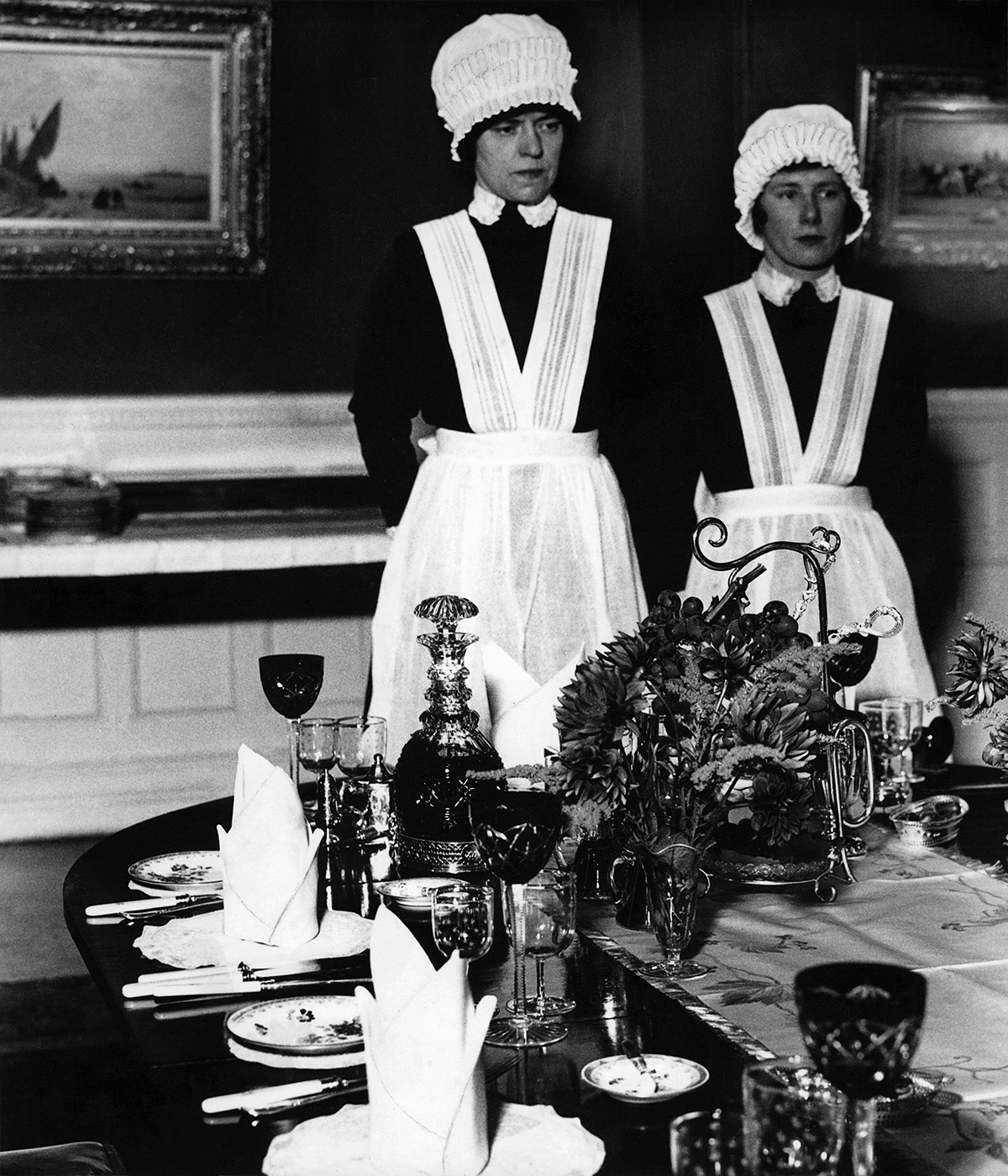
Parloumaid and under-parlourmaid ready to serve dinner, 1936 © Bill Brandt
Exploring Britain’s social identity is a subject widely studied but rarely pulled off in a way as convincing as in these photographs. From the windowless houses of miners from the 1930s to the densely populated parks of London’s chaotic summer, this collection offers a chronological look at how the dynamic of Britain’s class culture has responded to a government constantly trying to hold onto their power.
All images courtesy of Beetles + Huxley.
‘An Ideal for Living’, is open from 27 July – 17 September 2016.
Enjoyed this article? Like Huck on Facebook or follow us on Twitter.
You might like

In photos: Black Texas life since emancipation
Kinship & Community — A new photobook and exhibition showcases the rich culture, history and community of African American folks in the Lone Star State, whose existence in the region predates colonial Britain.
Written by: Miss Rosen

London’s largest indoor skatepark to be demolished for padel courts
Better Extreme — The Barking skatepark’s fate follows that of similar indoor spaces in recent years, with operators GLL citing falling visitor numbers as the reason behind the decision.
Written by: Isaac Muk

Youthful joy & end-of-era poignancy at a London school prom
Leavers — For several years, Lewis Khan documented young people as they celebrated the last of their school days and the completion of their exams. The series is now collated in a new self-published photobook and short film.
Written by: Zoe Whitfield

Harry Gruyaert’s vintage, kaleidoscopic scenes of New York
A Sense of Place — For 50 years, the Belgian photographer and Magnum Photos member has been capturing NYC’s colourful chaos. A new photobook and exhibition showcase his unique, technicolour view of the city.
Written by: Miss Rosen

In the pit at one of the UK’s last stock car & banger speedways
Stock Car Racing Isn’t Dead — Photographer Liam McCarthy spent time in and around the Arlington Raceway’s circuit, capturing the diehard community that keeps the sport alive.
Written by: Isaac Muk

Inside Lower Duck Pond, the nicest town on the internet
/r/HaveWeMet — With a population of 2,500 and no fixed location, the subreddit is a space for roleplaying citizens to solve mysteries, host fictional events and ultimately connect. In an internet that’s often divided and toxic, Vicky Jessop hangs out in one of its most wholesome corners.
Written by: Vicky Jessop


