Striking portraits of side-saddled, Mexican rodeo women in the USA
- Text by Isaac Muk
- Photography by Constance Jaeggi
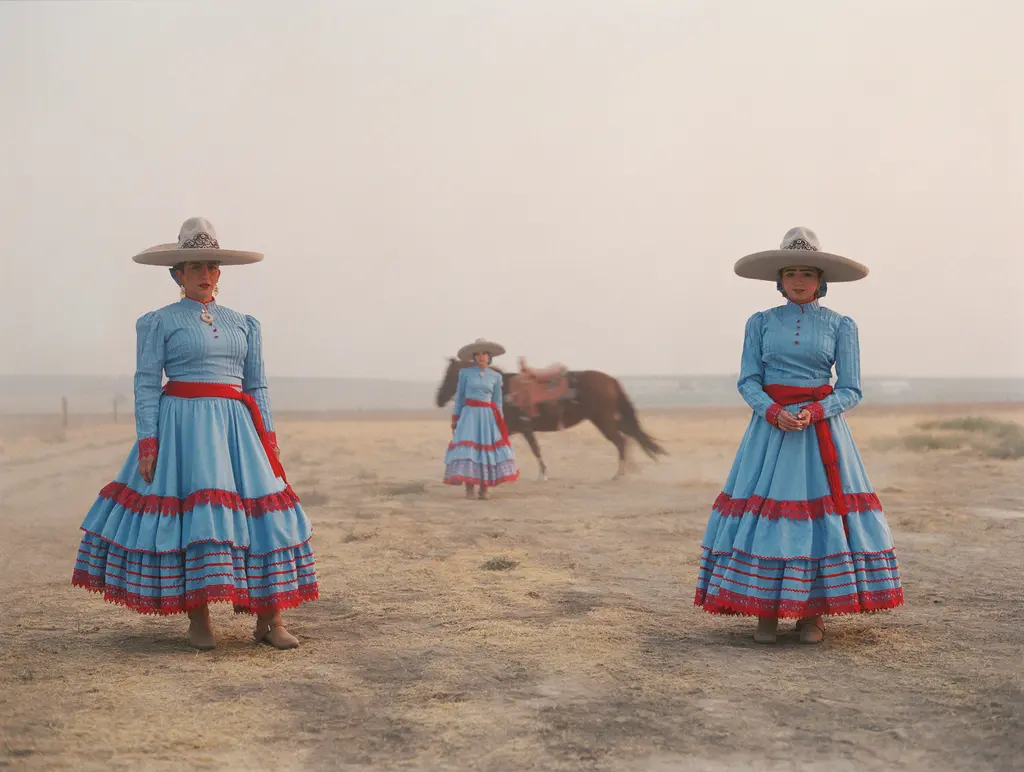
Escaramuza — Photographer and competitive horse rider Constance Jaeggi travelled across America to meet and document the women taking part in charrería – Mexico’s national sport – uncovering stories of migration, culture and identity in the process.
In Mexico, a charrería rodeo meet is a vibrant celebration of tradition and culture. Riders dressed in bold attire take on an array of challenges that include the lasso test Piales en Lienzo (Roping of the Feet) and equestrian competition Cala de Caballo (Test of the Horses). Meanwhile Mariachi and Banda music starts the party around the event’s dust ring centre, and a diverse array of local foods is cooked up for attendees.
Evolving from 16th century ranching traditions, charrería such a treasured part of national culture and identity that it lands on UNESCO’s Representative List of the Intangible Cultural Heritage of Humanity. It’s also the national sport of Mexico. But until 1953, it was a men-only sport, with women not being allowed to take part in the charrería, and even after that they only participated as half-time entertainers. They would only be recognised as proper competitors in 1992.
Yet over these years, the women, known as escaramuza, have become key parts of charrería meets. Riding side saddle and dressed in traditional outfits that include sombreros and long dresses, they perform daring, synchronised moves on the horses. It’s a display of skill and bond with horses, with riding side-ways, with both legs on a single side of the horse meaning that they only really have full control over half of the animal.


But what does escaramuza look like across the border, in the United States? It’s what Constance Jaeggi set out to find out when she began her project Escaramuza, which has now been published as a full photobook. The photographer has been a longtime lover of horses, ever since she first got into horse riding as a teenager in her native Switzerland, and even participated in equestrian sports herself.
“There just happened to be a place that did Western style riding close to where I lived,” she recalls. “I became fascinated with Western culture – I would spend all my weekends at the barn, and at lunch time we would watch Western movies and listen to country music, so I got into all these romantic notions of the American West, and started dreaming of living in the US and having a competitive riding career.”
It set her on a path that ultimately led her to Texas, where she attended college while also competing. While travelling to small towns across the USA to take part in the competitions, Jaeggi picked up a camera, and began taking pictures of horses and riding culture. “Photography became my connection with horses, which is very important and has shaped my life in a lot of ways,” she continues. “The camera was another way for me to explore my relationship with them.”

She first became truly engaged with escaramuza at the Forth Worth rodeo, where she began diving into the culture and photographing its characters and athletes, travelling across the USA to meet different escaramuzas and their communities. “I was immediately really interested, initially because of the aesthetics of it – it’s a really beautiful culture and tradition,” Jaeggi explains. “Then I started reading about it and found a few papers that talked about the gender boundaries within the sport and the connection to the soldaderas – women who fought in the Mexican Revolution – and how the image of these women changed over time to become more mythological and romanticised. I was really fascinated by all these layers.”
Much of charrería’s appeal is built on history and legend, with the sport acting as a source of national pride and identity in the wake of the Mexican Revolution. The same applies to escaramuza, with the word itself translating to “skirmish”, referencing those soldaderas. “The myth behind it was that they would be sent into battle before the men and kick up dust to distract the opposing side – I was fascinated by the historical connection, but also what it meant for women in Mexico and how in contributed to their emancipation. They were defying social norms and going into battle.”
That identity building and sense of national pride perhaps becomes even more pertinent across the border in the USA, as a means for people to engage with their national and cultural identities. A sense of pride is captured throughout Jaeggi’s photobook, from their intricately designed, well cared for outfits, to their close bonds with the horses that shine through in the photographs, while their voices are amplified through poetry by ire’né lara silva and Angelina Sáenz, who used interviews that Jaeggi recorded to bring their stories to life.
- Read next: Saddling up with Texas’ Creole trail riders


“A lot of the women I was photographing are mostly second, third, fourth generation migrants,” Jaeggi says. “One of the big things that kept coming up was that many of them didn’t feel American in the US, and when they went back to Mexico, they didn’t feel Mexican enough either. And this sport gives them a place, and a way of connecting with their home.”
With charrería still dominated by men, who also make up the majority of representatives on its sporting associations, there’s still a way to go for the escaramuza, but its rich culture and history provide a sense of place and belonging, especially in a USA that has been targeting Latine folks through targeted ICE arrests and deportations. “Several themes came out of my conversations, and immigration was definitely one of them, and a touchy subject,” she says. “You could say that charrería is the Mexican version of rodeo, but actually, it’s a precursor to American rodeo.”


Escaramuza by Constance Jaeggi is published by GOST Books.
Isaac Muk is Huck’s digital editor. Follow him on Bluesky.
Buy your copy of Huck 82 here.
Enjoyed this article? Follow Huck on Instagram and sign up to our newsletter for more from the cutting edge of sport, music and counterculture.
Support stories like this by becoming a member of Club Huck.
You might like

'Hyper-American' photos of life in rural Texas
Edward Thompson's portraits of Texas Hill Country during the George W. Bush years are both timeless and deeply personal.
Written by: Isaac Muk

The raw, fledgling intimacy of Peter Hujar’s contact sheets
Hujar:Contact — A new photobook highlights the process of the legendary queer photographer, and his process of growing into the artist he ultimately became.
Written by: Miss Rosen

Guts, glory and goat tossing at the World Nomad Games
All eyes on Bishkek — From kok boru to eagle hunting, Kyrgyzstan’s global showcase spotlights ancient sports and celebrates local traditional culture, while also stiffening the regime’s ambitions, reports Antoine Goullin.
Written by: Antoine Goullin

Jesse Glazzard’s messy portrait of queer friends, lovers and chosen family
The Sound of Dirt and Beauty — The photographer’s debut monograph explores tender, unpolished moments shaped by the people who he surrounds himself with, while offering a window into the UK’s working-class LGBTQ+ community.
Written by: Sunny Sunday

Behind the curtain at Alternative Miss World 1981
Olympia glamour — Running a subversive take on the traditional beauty pageant, the Andrew Logan organised event prioritised underground creativity and invention. Photographer David Corio went behind the scenes at its biggest edition.
Written by: Miss Rosen

Dan Lacey: “BMX is forever evolving”
Overground — Steph Pomphrey caught up with the two-wheel legend after his latest meet in east London, chatting about fatherhood, music and action sports within the outdoor industry.
Written by: Steph Pomphrey


