Help save a treasure trove of vital skate culture
- Text by Cian Traynor
- Photography by Tim Leighton-Boyce (main image)

From 1978 to 1995, Read and Destroy magazine grew to become a skateboarding bible – the foundation and inspiration of today’s UK scene.
Yet for the last quarter of a century, this groundbreaking piece of skate history has been hidden, kept in boxes and envelopes of various private collections, out of sight.

’90, ©TLB: Curti McCann, Meanwhile.

’90, ©TLB: Joe Millson’s Ramp.
But it hasn’t been forgotten. If anything, the importance of RaD among those who were influenced by it – directly or indirectly – has only grown.
“We’ve had an amazing amount of feedback from people who were avid readers as teenagers saying how transformative it had been for them,” says Dan Adams, who joined RaD as a graphic designer in 1991. For the last three years, Dan and Andy Holmes have been sorting, archiving and researching the content for the RaD book, archive and future exhibition.
“It’s impossibly difficult to understand now just how important a mag like that was as a conduit for so many ideas and information. Without an internet, where else do you go to be connected and informed about the culture you love so much?
“People regularly say how they wouldn’t now be making films, music, art or graphic design if the inclusive nature of the mag hadn’t lit the fuse for them.”

RaD, Aug ’92: Jeremy Klein, Spike Jonze, Steve Hicks.

Dan is one of those people. Having first been introduced to skating through 1970s US mag Skateboarder and, later, Trans World Skateboarding, he found the bold production values and original photography infectious. It felt like a world away from the humdrum mags being produced in the UK at that time.
Then RaD came along. Under the vision of editor Tim Leighton-Boyce (TLB), an experimental new approach came to fruition: skate’s emerging underground would be captured in the most brash, energetic light possible – a sensibility that felt closer to a fanzine than a glossy mainstream title.

’83, ©Dobie Campbell: Kev Kent.
It also brought together a stable of staff photographers that included Vernon ‘Jay Podesta’ Adams, Tony ‘Dobie’ Campbell and Wig Worland, along with original contributors like Skin Phillips, Andy Horsely, Thomas Campbell, J. Grant Brittain and Spike Jonze among others.
Tim decided to walk away from RaD in ’93, enabling Wig Worland and Andy Horsley to usher in a new phase for the mag. But due to a various differences with the publisher, they felt like they could do a better job on their own terms and started Sidewalk magazine instead.

’92, ©TLB: Simon Evans, Kennington.
Twenty years on, Dan realised that those formative times for skate culture in the UK have gone under-represented. “I felt that as a designer with that history and those connections, I could be a part of re-establishing that story and bringing it to a wider audience. This project – a two-volume book – has been a long time in the making.”
But it hasn’t been easy. The main challenge has been assembling, and then re-organising, 30 years of badly kept archives. The next undertaking is scanning old, often damaged transparencies to a standard even better than they first appeared.
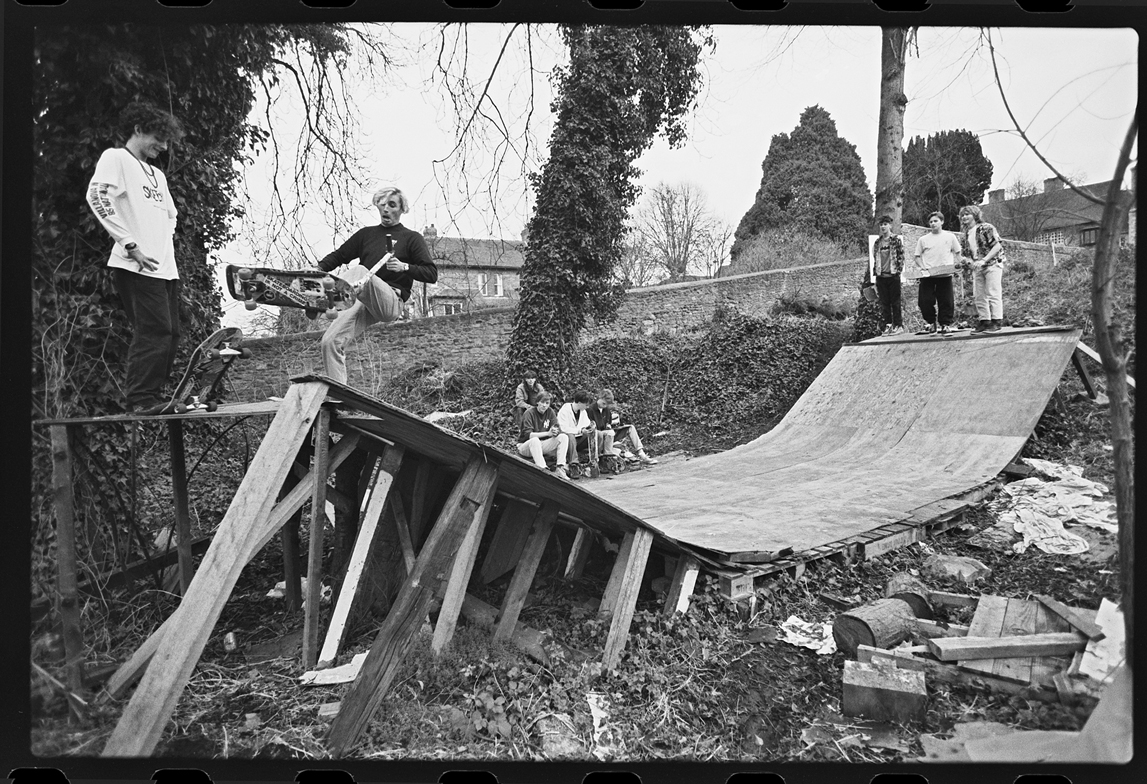
’88, ©TLB: Sean Goff goofin’ at Iffley Ramp.

’85, © TLB: Phil Burgoyne, Farnborough.
“There is no cheap way to do this,” says Dan. “We are not just pulling files off a hard drive and dropping them into a layout. The original scans made for the magazines never existed in any kind of digital memory format.
“The scans were output directly to film negatives and scrapped after one use. Every single image needs high-resolution scanning, colour correcting and proofing. It’s this necessary cost which has made it so difficult to get this project up and running in the past.”

’86, ©TLB: Swansea DIY street contest.
With just three days before the Kickstarter campaign ends, this project needs all the help it can get. What’s at stake is a collection of images, artwork and history that can’t be found anywhere else.
At a time when tricks were progressing at a rapid rate, RaD’s photographers were there to capture it all in conditions that couldn’t be further away from the sun-kissed pools of Southern California.
But that’s where the UK scene’s raw power came from, Dan says. Less access to good terrain, weather, equipment or sponsors all made the pursuit of good skateboarding harder. You had to really want it.

’85, ©Dobie Campbell: Lucian Hendricks, Crystal Palace.
“For me, [the RaD] archive still has the power to transmit all the excitement and energy that skateboarding offers. The era doesn’t matter, a good skate photo translates across the time and place that it’s made in.
“One of our more popular pictures on Instagram was a shot from 78/79 of a guy named Keith Laing. Totally in the moment – basic trick, smashed up, shitty equipment but he’s on it and living it.
“That pure skateboarding energy totally comes through to skaters of all generations.”

’79, ©TLB: Derek ‘Jingles’ Jhingoree, Rolling Thunder.
Support skateboarding history by backing The RaD Archive on Kickstarter.
Enjoyed this article? Like Huck on Facebook or follow us on Twitter.
You might like

Danny León pulls huge aerial in line with the solar eclipse
Totality — Combined with a board grab, the Spanish skateboarder performed the trick just as the moon’s path had completely covered the sun.
Written by: Isaac Muk

“Magazines are cultural artefacts”: magCulture’s Jeremy Leslie on the enduring importance of print
We love magazines — Despite the ever creeping digitalisation of the world and culture, physical objects are taking on different, yet vital, roles in culture today. Ella Glossop chats to one of London’s biggest proponents of the art about why we need to support independent publications.
Written by: Ella Glossop

The global skateboarding crew reshaping Muslim sisterhood
Skater Uktis — Founded in London in 2020, the crew has ballooned across the world, with meetups and members in Pakistan, Palestine and beyond. Zahra Onsori tracks its rise and the powerful community it has created.
Written by: Zahra Onsori

London’s largest indoor skatepark to be demolished for padel courts
Better Extreme — The Barking skatepark’s fate follows that of similar indoor spaces in recent years, with operators GLL citing falling visitor numbers as the reason behind the decision.
Written by: Isaac Muk

A decade of Palestinian skatepark graffiti gets turned into a clothing capsule
Concrete canvas — SkatePal’s new collection draws on artwork left by local skaters and visiting volunteers at the Asira Ash-Shamaliya concrete skatepark – the largest of its kind in Palestine.
Written by: Ella Glossop

Moshpits & kickflips at the Volcom Garden Experience 2026
Family affair — Last weekend, the skate, surf and snow culture brand hosted a free mini festival in its European backyard of Biarritz. We went along and chatted to legendary artist and surfer Ozzie Wright.
Written by: Isaac Muk


