10 minutes with skate legend Tony Alva
- Text by Niall Flynn

Tony Alva is on his feet, pacing.
A moment ago, he was sat on the end of a sofa after suggesting that we both take a seat. A moment before that, he was on his board, riding to a gathered crowd at the House of Vans skatepark. After stretching his legs briefly, he decides to sit again – though it’s only a perch at best. Tony Alva, it transpires, always has to be doing something. He is also 60-years-old.
With his cropped dreads, surfer’s tan and overt inability to remain even remotely still, you’d never believe it. Alva possesses the infectious charisma of somebody half his age. Off the board, it’s difficult to comprehend that you’re looking at a man who just blew out 60 candles on a birthday cake; on it, when he’s skating, it’s near impossible. He may ride a little less often nowadays, but he hasn’t lost an inch.

He’s visiting London for a belated birthday celebration, orchestrated by his Vans team. It’s not yet seven pm, but the HOV underground space is packed to the ceiling, full of friends, fans, contemporaries, partners, and press, all of whom are just as eager to get a minute with the enigmatic rebel. Luckily, I’ve managed to blag 10 – and I want to know the secret to his longevity.
“Well, lately, it’s been my sobriety more than anything,” he admits, picking up a magazine from the table opposite, just to place it back down again.
“I don’t drink alcohol, I don’t smoke dope, I don’t smoke cigarettes, I don’t use any mind-altering or mood-altering substances in my life – and I have a daily regimen of physical activity that revolves around stretching and having a good diet. It’s crazy, man.”

As one of the original members of the notorious Zephyr Competition Skateboarding Team – The Z Boys – it goes without saying that he wasn’t always so acquainted with such a sustainable way of being. He was a larger-than-life member of the crew that revolutionised skating (“we took it the sky”), who were known for their wild, no-holds-barred lifestyle just as much as their game-changing contribution. Not all of them made it, and Alva’s the first to admit that he‘s somewhat lucky to be here.
Today, though, he’s proud to announce that he’s “11 years and 62 days clean and sober”. Now, he tells me, he gets just as much of a high from guiding young skaters as he does being on the board himself. Throughout the evening, as if to emphasise his point, a never-ending wave of young disciples form an accidental entourage around him in their attempts to share a moment with the founding father.
“I just feel at this point in my life, having spirituality and sobriety involved in my experience, that I can be a true leader,” he continues. “Therefore, that makes me a part of every element of skateboarding that’s going in a positive direction.”

Alva has been skateboarding for over 50 years, 45 of them as a professional. He started surfing when he was just 10 years old. Along with the rest of the Zephyr Team, he brought both disciplines – surf and skate – together in a manner that hadn’t been conceived, nor imagined, prior to their arrival. Their aerial and sliding moves formed the basis for modern skating as we know it, while their anti-establishment fervour helped immortalise them as rowdy, rock and roll heroes in subcultural folklore. You’ve probably seen the film.
“Obviously we were revolutionary in our approach to taking surfing and putting it into our skateboarding. Our attitude, too – we were super confident, cocky, arrogant and people wanted to emulate that,” he recalls. “Kids wanted that little taste of southern Californian lifestyle. I think that’s kinda what [The Z-Boys] brought, that attitude – the rockstar attitude. Just like, ‘fuck it, this is it, it’s on.’”
Although he says that those tendencies still rear their head every now and again (“I know that I have character defects and shortcomings, but I’m gonna improve on them”), Alva much prefers the quieter life. He estimates his new regime – a blend of sobriety, faith and spirituality – has given him an extra ten years as a professional skateboarder. “Eventually, I’m gonna get to a point in my life where hopefully I won’t make those mistakes over and over again,” he says. “And then, we’re just gonna live it.”
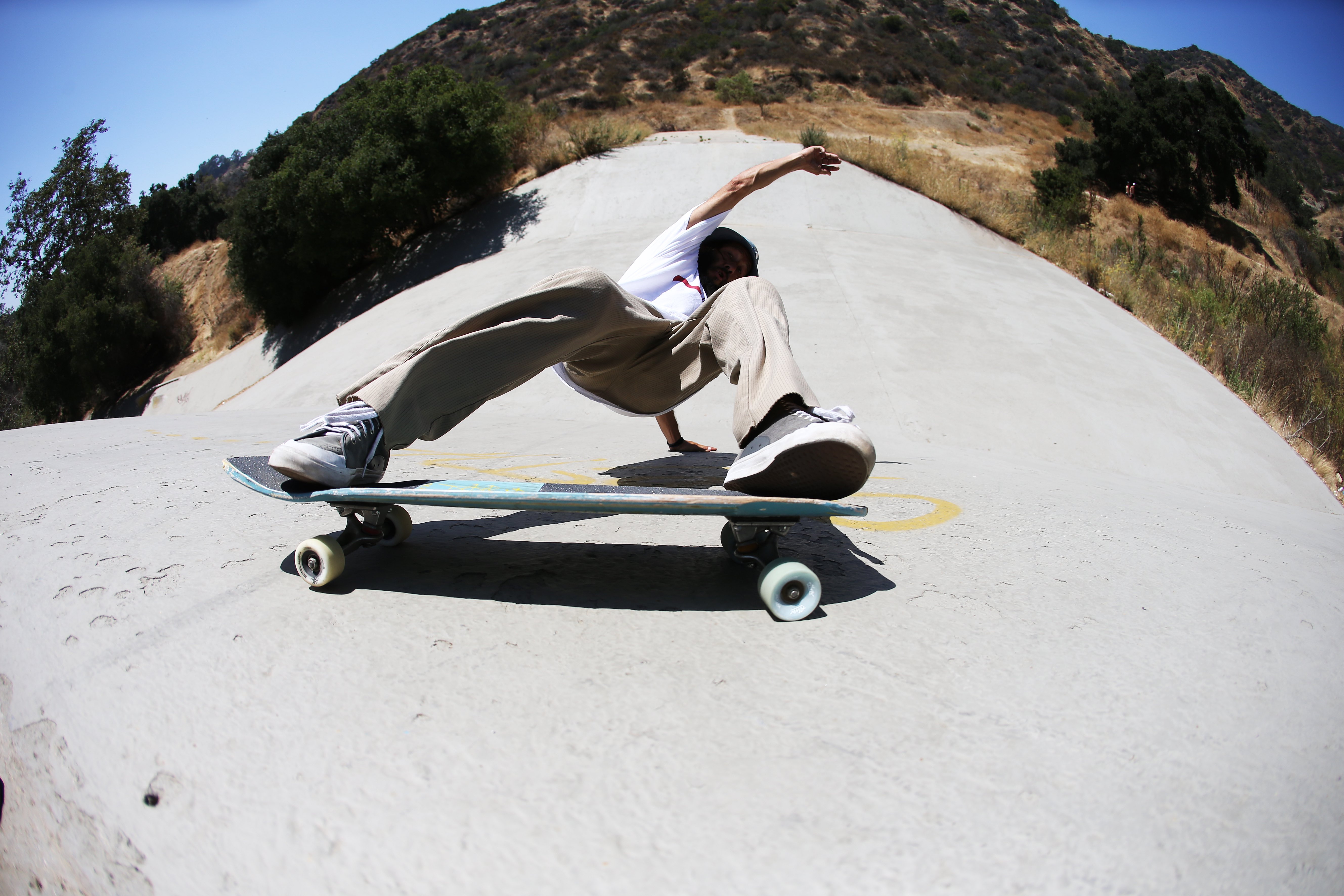
Nowadays, he divides his time equally between skate, surf and his “really good rock band”, His Eyes Have Fangs. For Alva, in whatever he’s done it’s always been about shared experiences rather than the individual pursuit. Anything that allows him to play a part in a collective creative process – be it at the park, in the ocean, or playing bass on-stage – gets his vote on the day. Though it’s skateboarding that owes him the biggest debt, the Tony Alva of now is more polymathic sensei: a guy, who likes what he does, doing a lot of things. He’s perfect for the role.
“Life in a general is not a theory really, you just go out and live it. It’s really about just going out there and learning from your mistakes and then making progress. But, at the same time, having fun, keeping it real. The moment that you’re in that space of just being able to be spontaneous and sharing it with [the people around you], that is the most rewarding experience.”
Over before it ever really started, time is called on the interview and Alva is back on his feet, grabbing his board and heading straight for the bowl. “Thanks man, pleasure to meet you,” he calls out, almost tripping as he breaks into a restless jog. Within moments, he’s back shredding again, the crowd cheering in tandem as he glides – à la Alva – effortlessly around the HOV.

Niall Flynn is an editorial assistant for Huck. You can follow him on Twitter.
Enjoyed this article? Like Huck on Facebook or follow us on Twitter.
You might like

Is Field Maneuvers the most fun time ever? Yes probably
Collective joy — Huck’s art director Samuel White went to the 2026 edition, braving a wet start and interviewing FLINTA* collective and arm wrestling legends Uhaul Dyke Rescue in the process.
Written by: Samuel White

Dan Lacey: “BMX is forever evolving”
Overground — Steph Pomphrey caught up with the two-wheel legend after his latest meet in east London, chatting about fatherhood, music and action sports within the outdoor industry.
Written by: Steph Pomphrey

Danny León pulls huge aerial in line with the solar eclipse
Totality — Combined with a board grab, the Spanish skateboarder performed the trick just as the moon’s path had completely covered the sun.
Written by: Isaac Muk

The global skateboarding crew reshaping Muslim sisterhood
Skater Uktis — Founded in London in 2020, the crew has ballooned across the world, with meetups and members in Pakistan, Palestine and beyond. Zahra Onsori tracks its rise and the powerful community it has created.
Written by: Zahra Onsori

London’s largest indoor skatepark to be demolished for padel courts
Better Extreme — The Barking skatepark’s fate follows that of similar indoor spaces in recent years, with operators GLL citing falling visitor numbers as the reason behind the decision.
Written by: Isaac Muk

A decade of Palestinian skatepark graffiti gets turned into a clothing capsule
Concrete canvas — SkatePal’s new collection draws on artwork left by local skaters and visiting volunteers at the Asira Ash-Shamaliya concrete skatepark – the largest of its kind in Palestine.
Written by: Ella Glossop


