Vintage shots of Boston’s red light district
- Text by Miss Rosen
- Photography by John Goodman

In the early 1970s, John Goodman set up his first photography studio on the edge of the ‘Combat Zone’, Boston’s official red-light district. The area got its name from the way it blended violence and vice, attracting soldiers and sailors on shore leave to its many strip clubs, brothels and porn theatres.
“The area was compressed, and the streets were full of people,” Goodman remembers. “It was edgy and unpredictable. Lit with neon, the ‘Zone’ always felt like it was night time. As a young photographer walking through the streets daily, I became part of its fabric, which gave me a certain access.”
It was the perfect training ground for Goodman, as a young photographer eager to delve into the gritty truths of the human condition.

John Goodman, Window #4, 1978.
Having studied with photographer Minor White, then a professor at MIT, Goodman learned the power of presence and awareness. “I attended classes and participated in a nine-month workshop that took place at his house every Saturday in Arlington,” he says. “Life at the house was disciplined, austere, quiet and intense. If it was your turn to wash the dishes then you were to totally focus on the task at hand; idle chatter was not part of the process; meals were silent.”
White showed Goodman how to find stillness in a chaotic world, and allow it to be his guide. “He taught me how to recognise something beyond what was just in front of my camera,” Goodman says. “Minor believed that the act of making an important photograph feels very much like an electrical impulse coursing through your body and heightening your awareness.”
As a young photographer, the street – particularly the Combat Zone –became the perfect environment for Goodman to discover his voice. “I became fascinated by the vibrancy of the city and intoxicated by a newfound freedom,” he says. “I came to understand the importance of establishing a connection with the subject while disappearing into the space.”

John Goodman, Stuart and Tremont Streets, 1974.
By the 1980s, Goodman had moved into an industrial loft where he could keep everything he produced, amassing a massive archive of his life as a photographer that sat untouched for nearly 30 years.
In 2009, he moved once more, and took this opportunity to peruse the work held in file cabinets that hadn’t been opened in decades. “I was startled and thrilled,” Goodman says of the moment he began to look at his early work. “My memory was re-awakened to the moment I made the photographs. So much came flooding back.”
Now, those long-lost photographs are on view in the John Goodman: not recent colour. “There is something in those places and faces that is relevant to today,” Goodman adds. “It is the recognition of our shared humanity. Although the look and make-up of the city has changed, people remain the same and the trials and tribulations that go along with being human remain constant.”
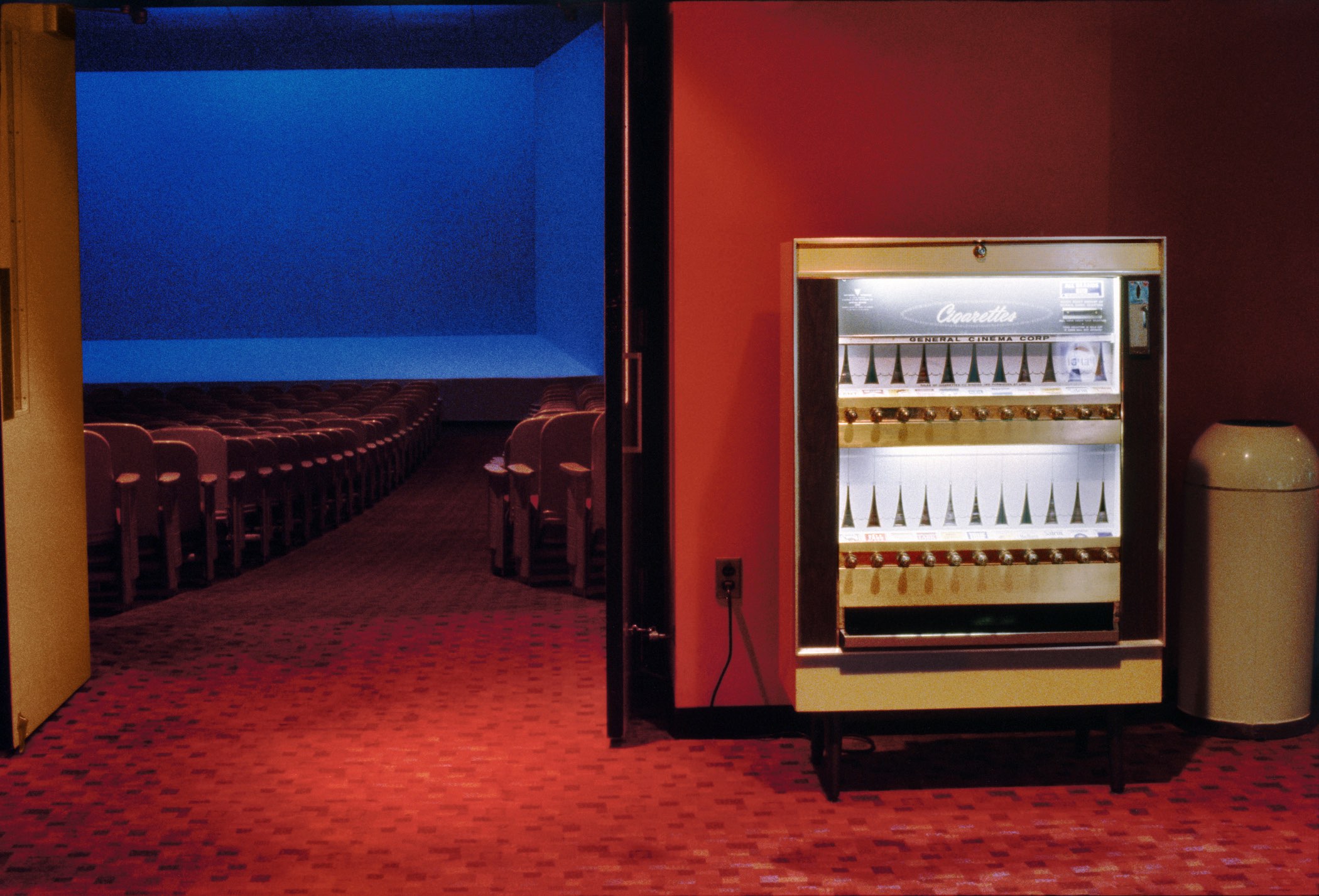
John Goodman, General Cinema, 1980.

John Goodman, Fenway Park, 1988.

John Goodman, Siegel Eggs / Haymarket, 1973.

John Goodman, Phone Booth, Truro, 1980.

John Goodman, Quincy Gas, 1973

John Goodman, Shop / Combat Zone, 1973

John Goodman, The Other Side / Bay Village, 1973.
John Goodman: not recent colour is on view at Addison Gallery of American Art in Andover, MA, through July 31, 2019.
Check out Huck 69 – The Hedonism Issue in the Huck Shop or subscribe to make sure you never miss another issue. Enjoyed this article? Like Huck on Facebook or follow us on Twitter.
You might like

Jesse Glazzard’s messy portrait of queer friends, lovers and chosen family
The Sound of Dirt and Beauty — The photographer’s debut monograph explores tender, unpolished moments shaped by the people who he surrounds himself with, while offering a window into the UK’s working-class LGBTQ+ community.
Written by: Sunny Sunday

Behind the curtain at Alternative Miss World 1981
Olympia glamour — Running a subversive take on the traditional beauty pageant, the Andrew Logan organised event prioritised underground creativity and invention. Photographer David Corio went behind the scenes at its biggest edition.
Written by: Miss Rosen

New exhibition highlights British radical living over 200 years
Earthly Paradise — Taking place at the William Morris Gallery, it explores the homes and lives of artists, writers, musicians and more, as well as the conditions that allowed them to thrive.
Written by: Isaac Muk

What life on the Strait of Hormuz is really like
Southern Winds — Bandar Abbas based photographer Morteza Niknahad has been capturing the diverse communities and stories of his local region since he first picked up a camera. His new series highlights the human impact of war.
Written by: Isaac Muk

Nick Haymes’s intimate portrait of his family’s life
Chronograph — Over 25 years, the photographer documented his son’s lives as they grew into adults. The resulting photobook is an exploration of the passage of time, as well as the optimism of youth.
Written by: Miss Rosen

Kristina Rozhkova’s scatty, confronting portrait of captivity
Gut Feeling — The Russian artist’s 2024 arrest and subsequent detention opened her eye towards the omnipresent dynamics of power and control. Her new photobook is a stark exploration of being trapped.
Written by: Isaac Muk


