The torture of Tokyo rush hour, up close and impersonal
- Text by Cian Traynor
- Photography by Michael Wolf

The Odakyu Odawara Line carries one-and-a-half million people across Tokyo every single day.
It starts in the suburbs southwest of the city and stretches 82.5 kilometres to Shinjuku, the planet’s busiest train station, which holds a Guinness World Record for the average number of daily passengers: 3.64 million.


Photographer Michael Wolf first discovered the sheer scale of that phenomenon in 1995, when he reported on the sarin gas attacks across the city’s subway system for Stern magazine, and had an inkling that it was worth exploring.
“I took six photographs which, in the end, never made it into the story but I filed them away for future reference,” he says.
“In 2010, I had some time on my hands, took out the sheet with those six images and decided to revisit the station to see if I could make a project out of it.”


All the photos in Tokyo Compression were shot at one train station along the Odakyu line and, since it had just one track, Michael easily found a prime position.
As commuters only exited from one side, he could line up his camera 100 centimetres away from the window – undisturbed – as trains arrived from either direction.
Each time, the claustrophobic scenes remained in near-silence. There were no signs of aggression. But the windows would be perpetually covered in condensation, blurring the mass of bodies crammed within.


“I like the lady looking directly at me with one eye. It works on several levels: she is looking at me with one eye; I am looking at her with one eye, i.e. my camera lens.” – Michael Wolf.
“It was always during rush hour in the morning from 7.30 until about 8.45. Every 30 seconds, a train would roll in, I would take my pictures and at 8.45 I would go back to the hotel.”
He did that once a year, for 30 days at a time, over a period of four years. When going through the images, trying to figure out a way to frame the work, he decided to zoom in even closer.
Every shot had an average of four or five faces pressing against the glass, so Michael decided to make it even more intense by focusing on one person.

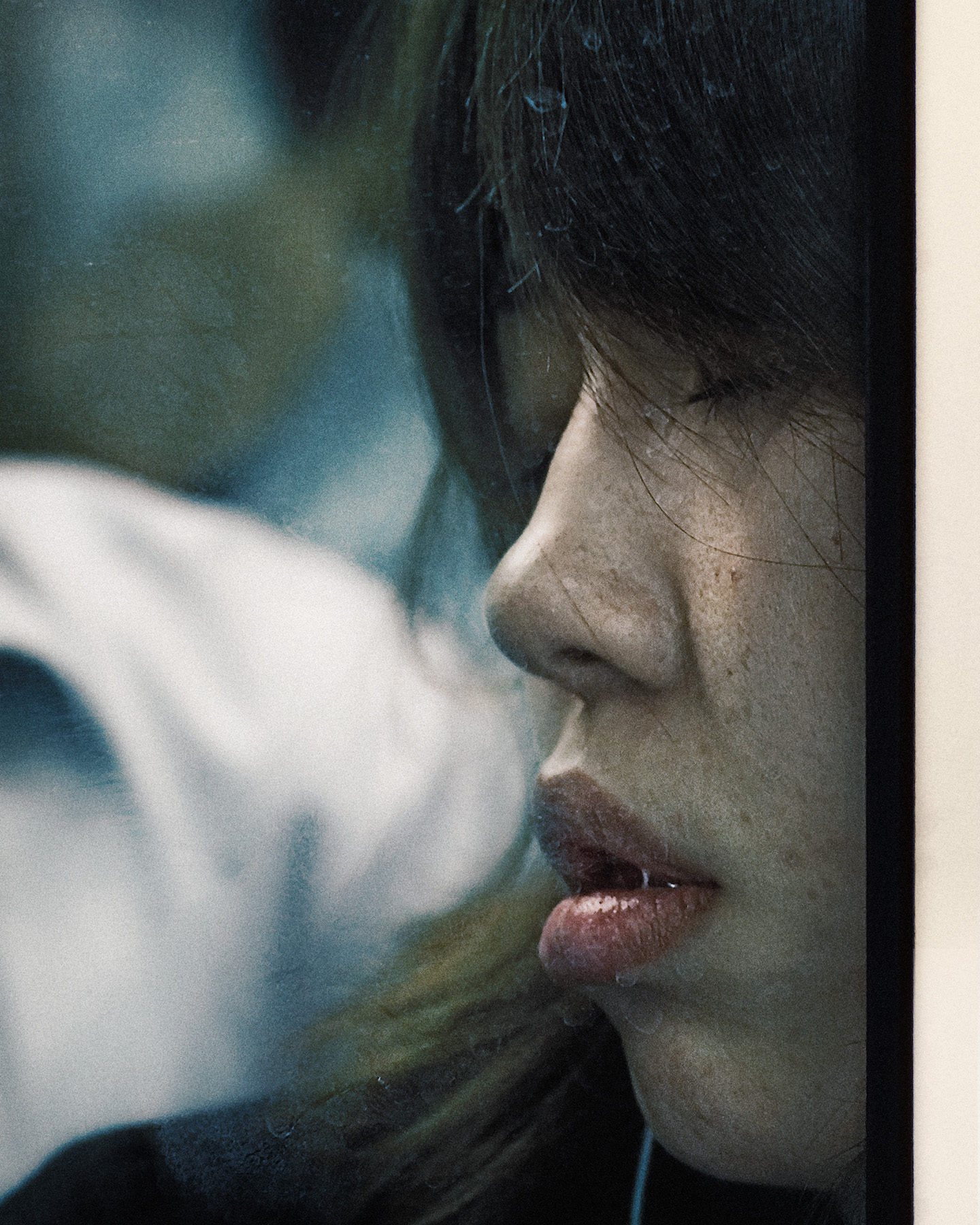
“I was interested in creating a visual metaphor,” he says. “The negative effect that life in mega cities has on its inhabitants.”
Michael was born in Germany and now lives in Hong Kong. His parents gave him a camera at the age of 13 and he quickly fell in love with the process of editing in the darkroom.
One day, a friend of his father’s came to visit and complimented his work, suggesting he apply to study photography at the Folkwang School in Essen, Germany, with the renowned photographer Otto Steinert, who was a professor there. And so he did, kickstarting a remarkable journey in photography.


In the decades since, Michael’s work has been exhibited around the world and he has won first prize in the World Press Photo of the Year competition twice.
The only constants, the 63-year-old says, are the need to follow his instinct and the challenge of not getting enough sleep.
When it comes to advice for young photographers just starting out, he prefers to keep things as direct and understated as his imagery: “Inform yourself, work hard, be obsessive.”

New works from this series will also be on exhibition at London’s Flowers Gallery, E2 from 26 May – 1 July.
Enjoyed this article? Like Huck on Facebook or follow us on Twitter.
You might like

The last days of St Agnes Place, London’s longest ever running squat
Off the grid — Photographer Janine Wiedel spent four years documenting the people of the Kennington squat, who for decades made a forgotten row of terraced houses a home.
Written by: Isaac Muk

How Japan revolutionised art & photography in the ’60s and ’70s
From Angura to Provoke — A new photobook chronicles the radical avant-garde scene of the postwar period, whose subversion of the medium of image making remains shocking and groundbreaking to this day.
Written by: Miss Rosen

Artifaxing: “We’ve become so addicted to these supercomputers in our hands”
Framing the future — Predominantly publishing on Instagram and X, the account is one of social media’s most prominent archiving pages. We caught up with the mysterious figure behind it to chat about the internet’s past, present and future, finding inspiration and art in the age of AI.
Written by: Isaac Muk

The lacerating catharsis of body suspension in Hong Kong
Self-Ferrying — In one of the world’s most densely packed cities, an underground group of young people are piercing their skin and hanging their bodies with hooks in a shocking exploration of pain and pleasure. Sophie Liu goes to a session to understand why they partake in the extreme underground practice.
Written by: Sophie Liu

What we’re excited for at SXSW 2026
Austin 40 — For the festival’s 40th anniversary edition, we are heading to Texas to join one of the biggest global meetups of the year. We’ve selected a few things to highlight on your schedules.
Written by: Huck

In photos: The boys of the Bibby Stockholm
Bibby Boys — A new exhibition by Theo McInnes and Thomas Ralph documents the men who lived on the three-story barge in Dorset, giving them the chance to control their own narrative.
Written by: Thomas Ralph


