The student debt crisis is real: but artists are fighting back
- Text by Joshua Gabert-Doyon
- Photography by Goshka Macuga, In Debt View, 2015. Photo © Jonte Wilde Photography 2015

Since 1998, when tuition fees were introduced in the UK at a modest £1000 a year, fees have grown astronomically. The rising fees have created a serious crisis of student debt. The abolition of maintenance grants earlier this week could be seen as another form of privatisation: now the most vulnerable students have to take out more loans to replace the living grants.
How can art respond to the student debt crisis? Ahmet Öğüt is the artist behind Day After Debt a long-term conceptual sculpture project that deals with that question. He’s not just concerned with how we make sense of the crushing debt, but how to actually fight back against that debt: a counter-finance strategy to buy debt and cancel it.
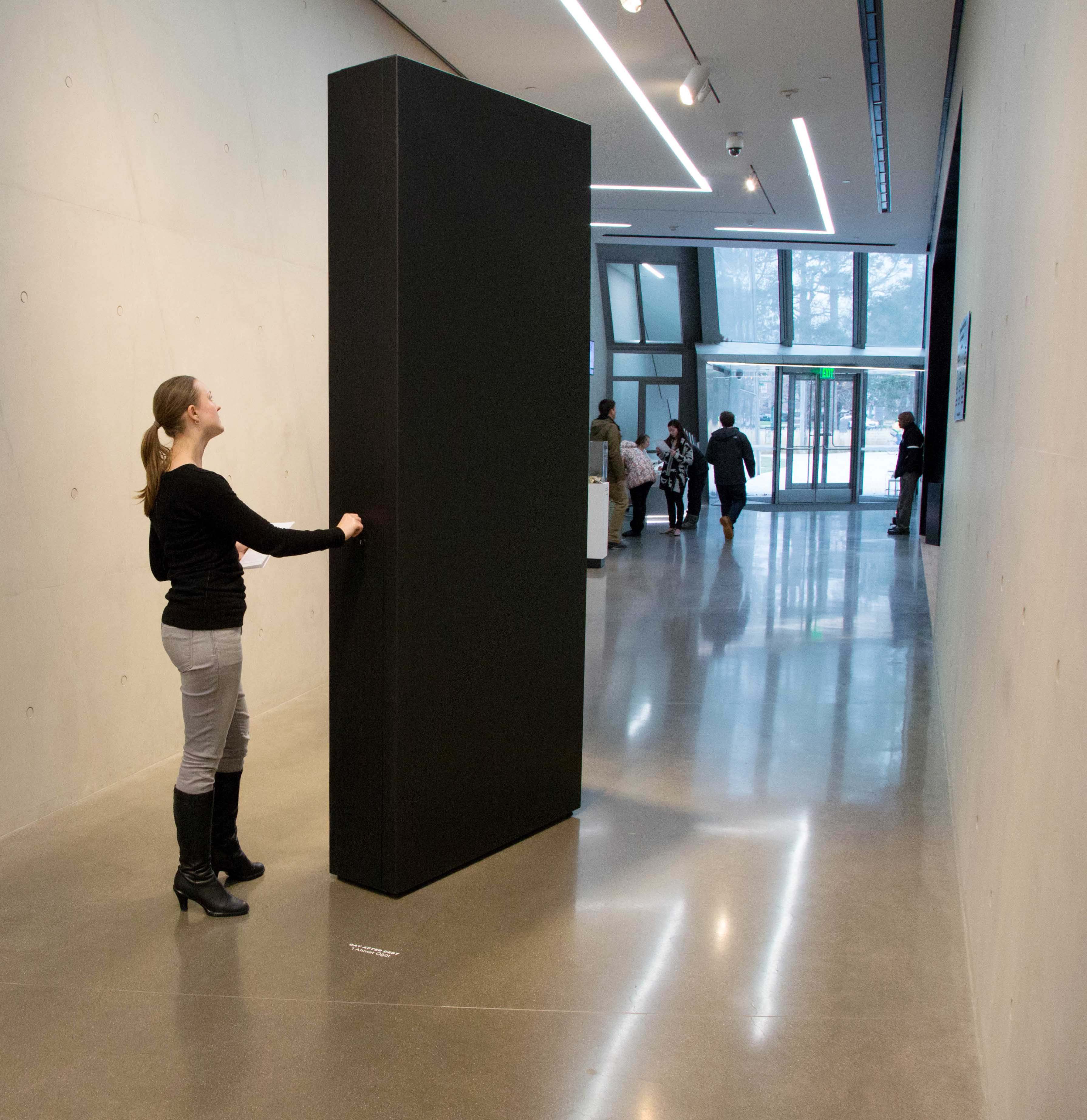
Ahmet Öğüt, Anti-Debt Monolith, 2014. Part of Day After Debt (US), 2015 In collaboration with Debt Collective/Strike Debt/Rolling Jubilee. Commissioned by the Eli and Edythe Broad Art Museum at Michigan State University and Protocinema. © Ahmet Öğüt 2015, © Aaron Word Photography 2014
“What I did is still a very small contribution, but it’s a long-term idea to control over surplus.” says Öğüt. “There were two ways of fundraising through actual artworks. You can use the artworks as money-collection points, but they could also be circulated in the art market as sculptures. By working with a lawyer it was possible to get involved with that speculative process. Whenever these sculptures are sold in the future, they will fundraise for the same cause – the money will go to the Debt Collective in the US and Jubilee Debt Campaign in the UK.”
Roger Malbert, “Cover Collaboration”, British Art Studies, Issue 1
The project started in the US, where he was working with the Debt Collective, a group which emerged out of the Occupy Wall Street movement. In the UK, the project is associated with the Jubilee Debt Campaign (a UK charity working to end the poverty and inequality caused by debt) and Day After Debt is currently touring as part of the British Art Show 8. Öğüt collaborated with three other artists, Liam Gillick, Susan Hiller, Goshka Macuga, who made pieces to be exhibited at various civic venues around the UK – the works are meant to be in the public eye, and to involve the public in ending student debt.
Huck spoke to Öğüt about Day After Debt.
How do you think art can address the student debt crisis?
As artists we are also citizens. We can take different positions and act from those positions. Every position has different possibilities and functions. For most people art may stay only in the symbolic realm, and does only metaphorical things. With this kind of approach we might be in the danger of already underestimating what could be done through art, with the tools of art, tools that we have access to, tools that give us the chance to transform, communicate, and talk about the cultural production: it has a lot of potential and power to transform things and change the system.
Part of this project is about the status of the art object – can you talk a bit about the connection you’ve drawn between the art market, debt and, financial capitalism?
Usually the involvement of the artists with the artwork ends once the artwork is done, or once it’s sold for the first time. When the ownership is transferred and the work is sold, often the author, the artist, loses control of any possible speculation that could be done around that artwork, unless there is a very specific certificate and contract that is prepared. And there are artists, such as Hans Haacke, who do think about the future of the artwork and for me that is very important conceptually. Every artwork I have produced, whether they become a part of a private or an institutional collection, I find it interesting how the life of that artwork continues. The goal is not to control every financial outcome of the artwork, but to have a say, and to use it towards a counter-financial ideal.
There’s a lot of potential if you start thinking about this conceptually – Day After Debt is an attempt to do that. It’s very hard to make it work in the short term, but if you imagine these artworks will exist for quite a long time, you can also think about how the politics will evolve. In general, it doesn’t look like it’s going in a good direction with students and education – even if it goes in a worse direction it’s quite paradoxical because artworks themselves have value that grows. If we’re able to connect these two, there’s at least a long-term connection to be made.
It’s constant fundraising as well. Often artists do support special causes, donating their works to benefit auctions to support urgencies, to create solidarity during those experiences. They do give their artworks away, but it’s usually a one-time contribution. I’m interested in the artworks when they circulate and change hands. How can you reinvent this process and turn it into a productive contribution?
Our lawyer was Daniel McClean. It was interesting to work with a lawyer like him, who works with other artists as well. It was quite a nicely challenging process to think of these questions conceptually through all these possibilities of what might happen to those sculptures: the idea of speculating the future. You suddenly start speaking a different language. It’s not the language of art world. You kind of have to make sense of the laws and rights that we don’t know we even have – in terms of ownership, in terms of inheritance, authorship – these kind of questions came up a lot when preparing the contract.
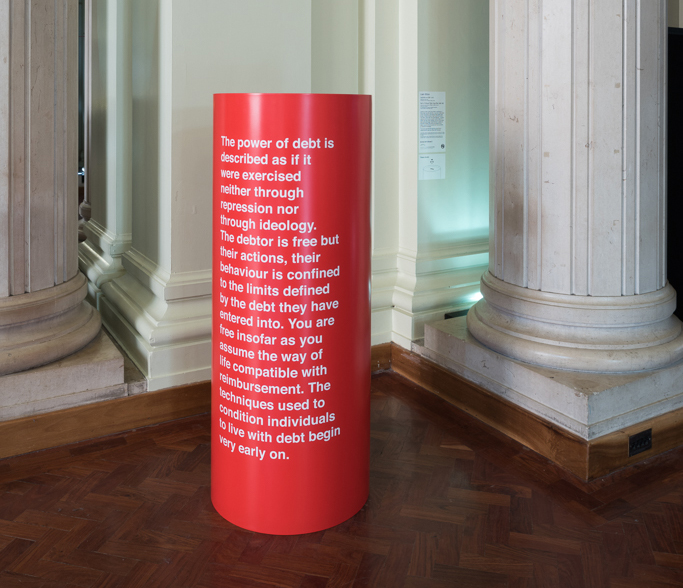
Liam Gillick, Lazzarato on Debt, 2015. Courtesy the artist and Maureen Paley, London ©
You’re coming from an art school background as well – you studied at an art school, you lecture at art schools, what can you say about the art school context, or the way that they figure into this?
I believe in progressive polytechnic education; combining learning with productive work. Art schools should be a good example of that method. Students should not study to become an artist, they should decide to be an artist.
I think one of the dangers is making competition priority: Students are often asked to learn how to compete with their colleagues in order to become an artist. Learning how to be better than them – how to write better applications – that’s not the right idea. I think the idea of doing things together, working together, already gaining a strong a collective conscious while still studying, is much more important. For instance if you look at the debt problem, that’s also how it’s given – as an individual problem. All together we should demand to repurposing higher education and imagine a solidarity-based school culture independently from oppressing financial structures.
Enjoyed this article? Like Huck on Facebook or follow us on Twitter.
You might like

In photos: Euphoric joy at the UK’s biggest ever anti-racism march
Together — 500,000 people marched through central London on Saturday to protest the far right and racism, followed by a packed House Against Hate rave taking place in Trafalgar Square.
Written by: Isaac Muk

The last days of St Agnes Place, London’s longest ever running squat
Off the grid — Photographer Janine Wiedel spent four years documenting the people of the Kennington squat, who for decades made a forgotten row of terraced houses a home.
Written by: Isaac Muk

As salmon farming booms, Icelanders size up an existential threat
Seyðisfjörður — The industry has seen huge growth in recent years, with millions of fish being farmed in the Atlantic Ocean. But who benefits from its commercial success, and what does it mean for the ocean? Phil Young ventures to the remote country to find out.
Written by: Phil Young

Activists hack London billboards to call out big tech harm
Tax Big Tech: With UK youth mental health services under strain, guerrilla billboards across the capital accuse social media companies of profiting from a growing crisis.
Written by: Ella Glossop

In photos: The boys of the Bibby Stockholm
Bibby Boys — A new exhibition by Theo McInnes and Thomas Ralph documents the men who lived on the three-story barge in Dorset, giving them the chance to control their own narrative.
Written by: Thomas Ralph

‘We’re going to stop you’: House Against Hate tap Ben UFO, Greentea Peng and Shygirl for anti-far right protest
R3 Soundsystem — It takes place on March 28 in London’s Trafalgar Square, with a huge line-up of DJs, artists and crews named on the line-up.
Written by: Ella Glossop


