The police have banned Huck's News Editor from doing his job
- Text by Michael Segalov
- Photography by Theo McInnes

This Sunday, one of the most important events in the British political calendar will kick off in Brighton.
With Parliament taking a break from sitting for party conference season, all eyes are on the cities across the UK playing host to annual party conferences.
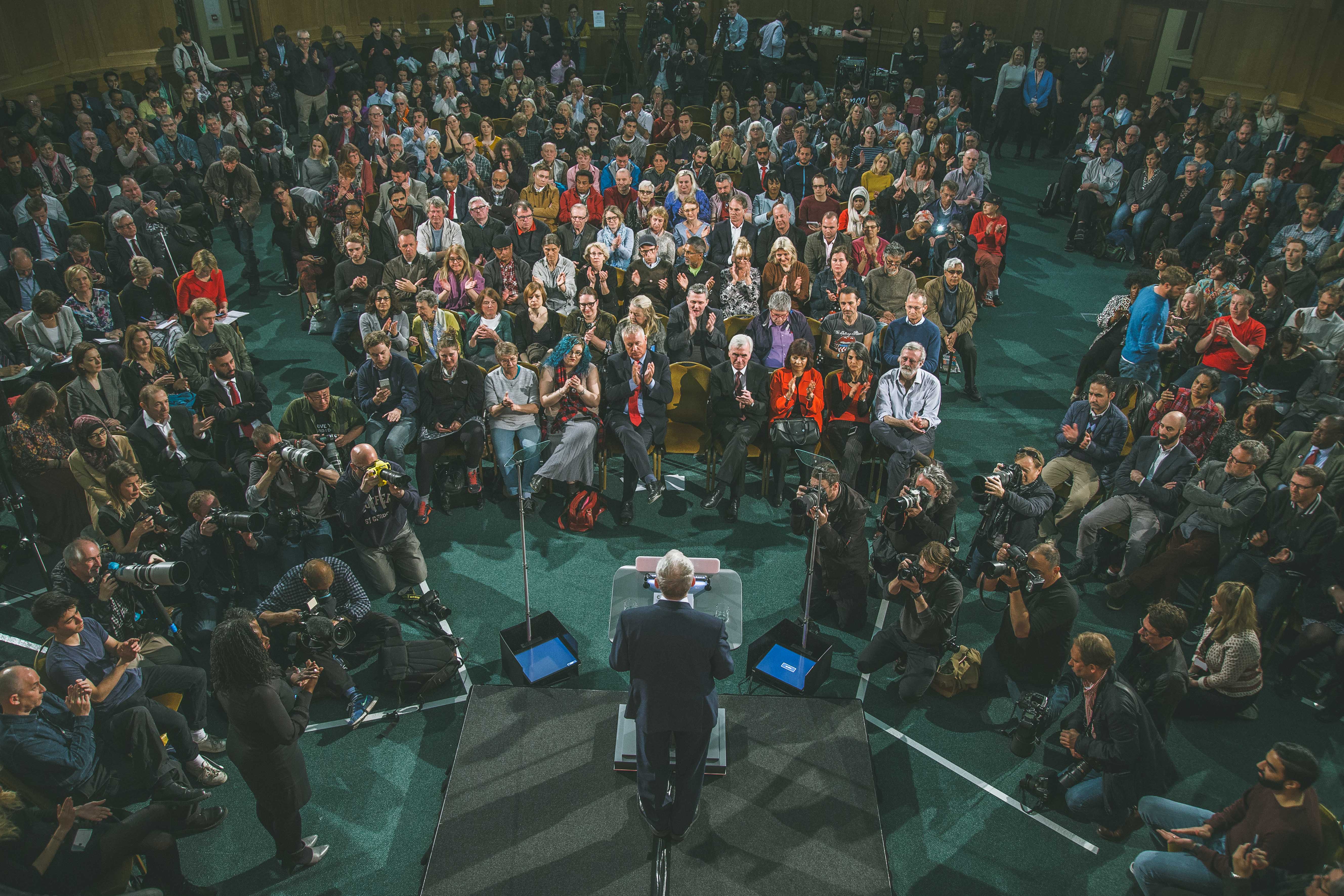
This weekend the Labour Party’s conference – the supreme decision-making event in its calendar – will take place in Brighton.
MPs, members, guests and interested parties will descend on the seaside town – to vote on policy and governance, to meet and debate, to set the direction of the official opposition party in the United Kingdom for the important year ahead.
Surrounding the conference will be fringe events, talks and discussions, and opportunities to make contacts and connect with grassroots activists.
In short, it’s a seriously significant political event. For journalists who work in the field it’s a must to be there: for interviews, for analysis, for reporting, to find story leads and to listen and to learn. Most of the nation’s press will be in attendance, and Huck had every intention of being there, too.
It’s why three months ago I, as Huck’s News Editor, applied for press accreditation to attend the conference.
We lined up interviews and picked out the fringe events I’d attend to report on. We firmed up travel plans and lined up accommodation. We formulated our plans to cover this integral political event as we do on a daily basis. We set out to continue with the journalistic work we’re so proud to do. As far as the Labour Party were concerned, everything too was set.
That was, until we were informed that our press accreditation to attend the event had been declined. Not because the Labour Party didn’t want us in attendance, but because the police refused to grant me security clearance to enter the conference site.
It’s safe to say this wasn’t something we were expecting. In fact, quite the opposite: it was a massive shock.
 Instead of being given time to consider and appeal the decision, I was informed that my clearance had been refused this Tuesday night – three months after my application was submitted. I contacted the relevant police officers immediately, but have only received a single, two-sentence email in return.
My attempts to call and email the police have almost exclusively been ignored.
Rather than provide reasons and rationale for our journalistic freedom being curtailed, the police said they would not divulge why they made their call. It’s left us confused, frustrated and at a loss.
For context, because context is important, my name is Michael Segalov and I work for Huck. As the News Editor it’s my job to ensure we cover news, politics, activism and current affairs. This includes reporting on breaking news as it happens, and interviewing politicians, activists and campaigners as much as we can.
I’m also regularly invited onto broadcast media to discuss politics, the Labour Party and other issues. Over the past few years I’ve conducted interviews with Jeremy Corbyn, John McDonnell, and plenty of other members of the Parliamentary Labour Party. I’ve attended countless events held by various political parties – including party conferences – during my career.
I’m a journalist, but I don’t exist in a vacuum, so a little more context here, too. I enjoy cycling, watching shitty television with my teddy bear, and a drink or two at the pub.
Before I joined Huck I worked regularly for other national publications, and I’m a member of the National Union of Journalists, too. As a university student I also wrote about politics and activism, and am proud to have taken part in lawful and peaceful protest both then and now – not that it should make any difference.
In short: I’ve never been arrested, charged or convicted by the police or courts of any crime, and I take my journalistic work incredibly seriously.
It’s why the police’s decision to ban me from Labour Conference feels so unfair, irrational and bizarre. As far as I see it, Huck’s ability to conduct journalism freely is being attacked, as too are my personal freedoms of expression and association as enshrined in the law.
The precedent here is worrying, alarming even, and it’s a decision that seems without doubt unjust. A free press is vital to the workings of a democracy: it allows us to scrutinise power, to share knowledge and to openly report. The principle of journalistic freedom underpins so many of the rights we hold dear, and it doesn’t take much searching to see it coming under attack right now – from Turkey to Trump’s America the free press is at risk.
This might be a single incident, but the repercussions should it go unchallenged are worrying. The police restricting the rights of a journalist from attending a political event without giving any rationale, basis or reason puts our civil liberties on the line. This isn’t about me – this is about the rights of young journalists in Britain to speak and act freely. How do we ensure those in power aren’t the ones dictating which voices and platforms are heard? Is this what an open, plural and democratic society in the United Kingdom looks like?
Democracy, if it means something, must allow for self-governance based on information from a multitude of voices; only then can we actually decide how we want our society to run. As we know, that’s not the kind of media system we have – instead in Britain so much of the press is owned by wealthy and powerful elites. It’s why spaces that champion alternative voices and narratives matter so much, and their right to do so must be protected.
On Sunday afternoon I’ll be heading down to Brighton, to try and conduct Huck’s journalistic work as best I can. But I have no doubt my inability to enter the conference will have a profound impact on our ability to do this. For now though, we just don’t understand.
Michael Segalov is News Editor at Huck Magazine. Follow him in Twitter.
Enjoyed this article? Like Huck on Facebook or follow us on Twitter.
You might like

As salmon farming booms, Icelanders size up an existential threat
Seyðisfjörður — The industry has seen huge growth in recent years, with millions of fish being farmed in the Atlantic Ocean. But who benefits from its commercial success, and what does it mean for the ocean? Phil Young ventures to the remote country to find out.
Written by: Phil Young

Activists hack London billboards to call out big tech harm
Tax Big Tech: With UK youth mental health services under strain, guerrilla billboards across the capital accuse social media companies of profiting from a growing crisis.
Written by: Ella Glossop

In photos: The boys of the Bibby Stockholm
Bibby Boys — A new exhibition by Theo McInnes and Thomas Ralph documents the men who lived on the three-story barge in Dorset, giving them the chance to control their own narrative.
Written by: Thomas Ralph

‘We’re going to stop you’: House Against Hate tap Ben UFO, Greentea Peng and Shygirl for anti-far right protest
R3 Soundsystem — It takes place on March 28 in London’s Trafalgar Square, with a huge line-up of DJs, artists and crews named on the line-up.
Written by: Ella Glossop

In photos: Lebanon’s women against a backdrop of war
Where Do I Go? لوين روح — As war breaks out in the Middle East once again, we spotlight Rania Matar’s powerful new photobook, which empowers women of her home country through portraiture.
Written by: Miss Rosen

Riding out with Mac & Matteo
Warm shoulder — Cycling around London with his cat on his shoulder, balaclava-donning youth worker Mac is challenging society’s perceptions of people who look and dress like him. Molly Lipson chats to him about trauma, fatherhood and using his platform as a feline influencer for good.
Written by: Molly Lipson


