A photographer’s road trip through the heart of America
- Text by Sandy Carson
- Photography by Sandy Carson

This story appears in The Documentary Photography Special VII. Get your copy now, or subscribe to make sure you never miss another issue.
I got my first BMX when I was 10. Nowadays, BMXing and skateboarding is cool, but back then we were outcasts – you’d get beat up just for being different.
When I was a kid, home was Newmains, a working-class, ex-mining town about 20 miles southeast of Glasgow. It was pretty run down. I just wanted to be on my BMX all the time. There were a few of us who were into it, we had a wee gang and as we got older, we would enter small competitions, get drunk, have a riot… I loved the freedom.
But when I was about 19, I got in some trouble. Because we were the only BMXers in town – because we stuck out – these thugs came after us one night. One of them ended up breaking a glass bottle over my head. With the criminal compensation money, me and my mate came over to the States, where the BMX scene was much bigger and we could make a go of things. But after three months there, I broke my leg and had to go home to Scotland.


Within a couple of months, I was in trouble again. I was chased by another group of thugs who saw me as an easy target – I was trying to run with a limp from the broken leg. We made it back to my mate’s house, but when we got there I realised that I’d actually been stabbed. I didn’t feel it at the time because of the adrenaline, but my lung got punctured. It was that moment when I said, ‘I need to get out. If I stay here, I’m gonna die.’ So as soon as I was able, I went back to America.
I lived in Pennsylvania for three years, where I was on a BMX team, before moving to Texas. By this stage, the sport had grown, and I was able to go full-time. I travelled everywhere, riding for different sponsors and companies, and it was on these trips that I really started taking photos. My mum got me an SLR when I was about 17, so I knew the basics, but it was then that I really figured out how to work a camera – taking pictures of my mates and their bikes and the punk scene in Glasgow.


We’d make zines, document our journeys, take photos behind the scenes with the riders. I was young, and looked up to the likes of Spike Jonze, so I started shooting for BMX magazines on the side – quirky culture stuff in the places we visited. It was a lot of trial and error, but I eventually got into a groove. I remember the first photo I was really proud of: it was during a trip to London, and I photographed a wee guy in Brixton helping to fix a flat tyre. I guess it was my first real documentary photo, the kind I’d wanted to start taking. I remember thinking, ‘If I can keep doing this, then I will be able to start telling some real stories.’
I carried on getting work with BMX mags and began to settle on a style. As I did more, I started knocking on the doors of other magazines and papers – you know, ‘Here you go, this is what I do, what do you think?’ They’d say, ‘Okay, this is interesting, here’s an assignment, off you go.’ It was going well. But at the same time, my BMX sponsors were starting to die. It was like, ‘Fuck, what am I going to do here? Well, I already know I can shoot photos. I might as well see where that takes me.’


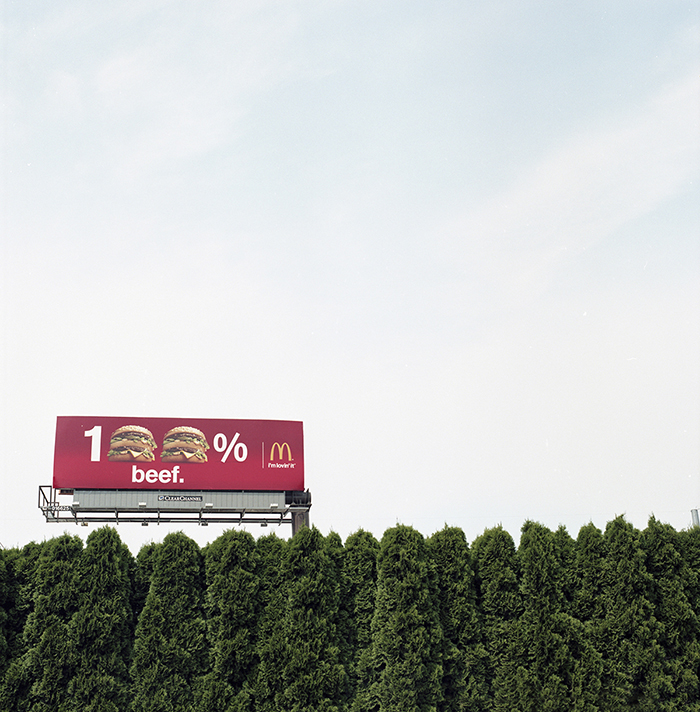
Since then, word of mouth has helped me make a career. I’ve gone on to shoot for the likes of The New York Times, The Guardian, Rolling Stone. My first book was published in 2010; my second in 2018. Now, my third book just came out on Yoffy Press – I’ve Always Been a Cowboy in My Heart. It’s a 12-year project, my own take on the American road trip, made up of photos I took during my time travelling the States. But it’s also a personal journey too – of me as a photographer: learning, evolving. There’s quite a bit of growing up in there.
I’ve been lucky; I’ve been able to do my thing. I’m not a textbook guy, I just like to chuck myself in and learn the hard way. I discovered later on about the greats like Stephen Shore, David Graham, Garry Winogrand and Martin Parr – it has inspired me even more to keep going. I want to make photos that are open-ended and ask a question: photos that have humour. I’ve Always Been a Cowboy in My Heart is basically all of that. Me, out on wee road trips, using my camera to ask what it is exactly that I’m looking at. I used to feel like a bit of an outsider looking at American life in that way, but Texas is home now. I have an anchor here.
For me, photography has always been a case of: make a lot of work, make a lot of mistakes, and then honour those mistakes. In BMX, you’re gonna have to fall down a lot to pull a trick. It’s the same with photos – you’re gonna make a lot of crap work, but keep doing it. You’ll find your voice.




This story appears in The Documentary Photography Special VII. Get your copy now, or subscribe to make sure you never miss another issue.
Enjoyed this article? Like Huck on Facebook or follow us on Twitter.
You might like

Jesse Glazzard’s messy portrait of queer friends, lovers and chosen family
The Sound of Dirt and Beauty — The photographer’s debut monograph explores tender, unpolished moments shaped by the people who he surrounds himself with, while offering a window into the UK’s working-class LGBTQ+ community.
Written by: Sunny Sunday

Behind the curtain at Alternative Miss World 1981
Olympia glamour — Running a subversive take on the traditional beauty pageant, the Andrew Logan organised event prioritised underground creativity and invention. Photographer David Corio went behind the scenes at its biggest edition.
Written by: Miss Rosen

Dan Lacey: “BMX is forever evolving”
Overground — Steph Pomphrey caught up with the two-wheel legend after his latest meet in east London, chatting about fatherhood, music and action sports within the outdoor industry.
Written by: Steph Pomphrey

New exhibition highlights British radical living over 200 years
Earthly Paradise — Taking place at the William Morris Gallery, it explores the homes and lives of artists, writers, musicians and more, as well as the conditions that allowed them to thrive.
Written by: Isaac Muk

What life on the Strait of Hormuz is really like
Southern Winds — Bandar Abbas based photographer Morteza Niknahad has been capturing the diverse communities and stories of his local region since he first picked up a camera. His new series highlights the human impact of war.
Written by: Isaac Muk

Nick Haymes’s intimate portrait of his family’s life
Chronograph — Over 25 years, the photographer documented his son’s lives as they grew into adults. The resulting photobook is an exploration of the passage of time, as well as the optimism of youth.
Written by: Miss Rosen


