Inside New York’s famed high school for the creative arts
- Text by Miss Rosen
- Photography by Flint Gennari

In 1936, four art teachers banded together to create what would become New York’s High School of Art & Design inside a former WPA Federal Theatre Project. Although the walls were ripped apart and there was no school furniture, a little ingenuity transformed orange crates and plywood into student desks and cupboards.
Over the past century, Art & Design has become one of the most pre-eminent public schools in New York, with a list of distinguished alumni that includes fashion designers Marc Jacobs and Calvin Klein, photographers Peter Hujar, Steven Meisel, and Sheila Metzner, artist Lorna Simpson, supermodel Pat Cleveland, Andy Warhol Factory denizens Jackie Curtis and Gerard Malanga, downtown icon Fab 5 Freddy, and a host of graffiti legends including Lee Quiñones, Lady Pink, and Roberto “FLINT” Gennari.
Gennari began writing graffiti in 1965, after his social studies teacher introduced him to the famed World War II doodle “Kilroy Was Here” in class one day. Inspired in equal parts by advertising slogans, psychedelic artist Peter Max, and the ability to be famous yet anonymous at the same time, Gennari began tagging “FLINT” on walls and trains around his native Brooklyn. He added pithy phrases like “For Those Who Dare” and “For Ladies Only” to let the public know just what was on the menu.

As a young child Gennari took up photography and by 1970, he was documenting New York burgeoning graffiti scene as it came into being. A year later, he applied to Art & Design. “You felt like celebrating when you learned that you made it,” he remembers.
When Gennari arrived at Art & Design as a freshman, he recalls: “The school was painted fresh for the new term. I was the first writer to tag the school. I did that so I could see what other writers were there: a lot of people tagged and I found out TRACY 168, FUZZ, SHADOW, and BOMB 1 were there at the time. A few years later, I met younger writers like Al Diaz [one half of SAMO© with Jean-Michel Basquiat], TRIP 3, DELTA 2000.”
Gennari was planning to major in photography until he realised that he would spend his freshman year learning the basics of the medium, which he already knew. “When I was nine years old, I used to take my father’s camera to photograph a band across the street,” he says. “Some of the band members came to the house and wanted pictures. I didn’t have the photos ready yet, so while they were there, I started reading about how to develop the film and made a contact print.”


“Back then was that you had to print in a darkroom and when you see the image come up, it was totally amazing. It’s something that you capture and give to the world.”
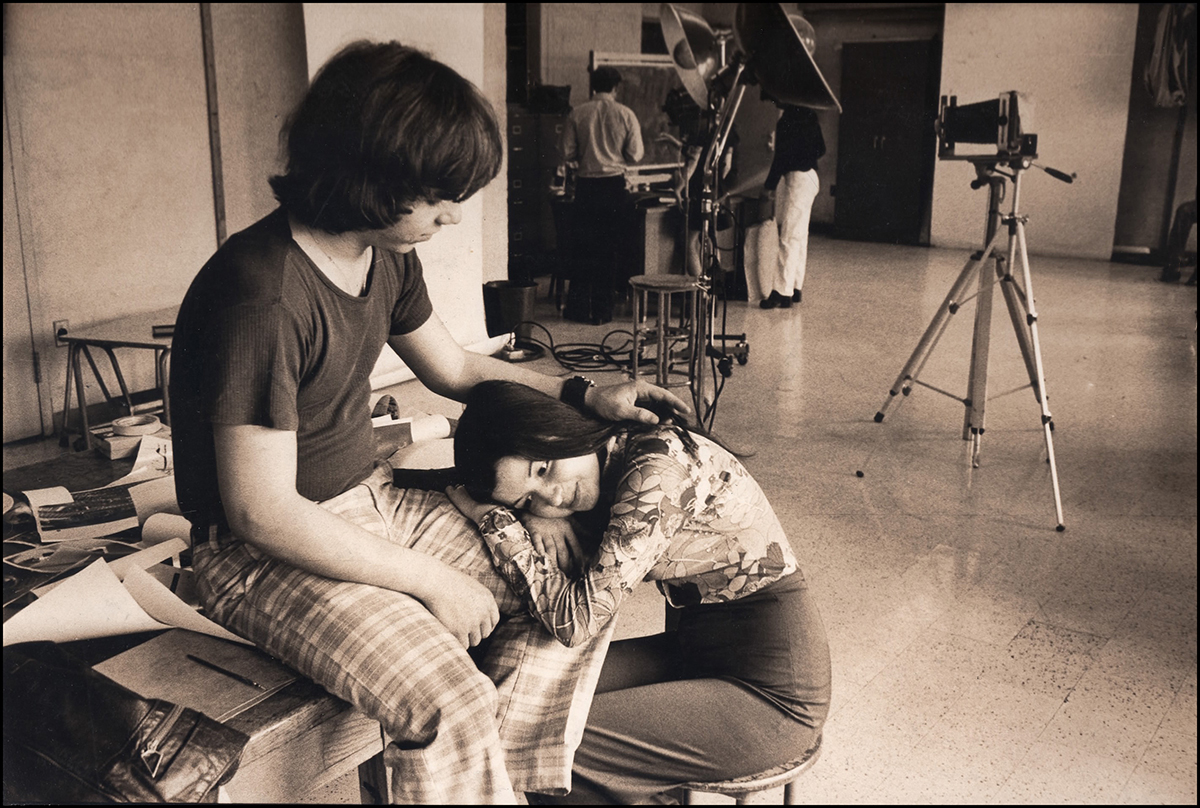
Gennari switched his major to filmmaking, but continued to take photographs throughout his years at Art & Design, amassing a collection of black and white photographs that perfectly describe the times. In his photographs, there is a sense of independence, creativity, and self-expression that evokes the D.I.Y. ethos of New York in the 1970s.
“Growing up in the 1960s, my elementary school was all white, and my junior high school was all Black,” Gennari remembers. “But at Art & Design, I met kids from all over the city: the Bronx, Brooklyn, and Queens. It was a real melting pot and we had all the freedom in the world.”
“We arranged protests like sit-ins and immobilised the school until our voice was heard and action had to be taken. I have very fond memories of these times: one had the feeling of being part of something larger than oneself. It was like a little universe of students – and we’re still very close to this day.”


Follow Miss Rosen on Twitter.
Enjoyed this article? Like Huck on Facebook or follow us on Twitter.
You might like

How Japan revolutionised art & photography in the ’60s and ’70s
From Angura to Provoke — A new photobook chronicles the radical avant-garde scene of the postwar period, whose subversion of the medium of image making remains shocking and groundbreaking to this day.
Written by: Miss Rosen

Artifaxing: “We’ve become so addicted to these supercomputers in our hands”
Framing the future — Predominantly publishing on Instagram and X, the account is one of social media’s most prominent archiving pages. We caught up with the mysterious figure behind it to chat about the internet’s past, present and future, finding inspiration and art in the age of AI.
Written by: Isaac Muk

The lacerating catharsis of body suspension in Hong Kong
Self-Ferrying — In one of the world’s most densely packed cities, an underground group of young people are piercing their skin and hanging their bodies with hooks in a shocking exploration of pain and pleasure. Sophie Liu goes to a session to understand why they partake in the extreme underground practice.
Written by: Sophie Liu

What we’re excited for at SXSW 2026
Austin 40 — For the festival’s 40th anniversary edition, we are heading to Texas to join one of the biggest global meetups of the year. We’ve selected a few things to highlight on your schedules.
Written by: Huck

Wu-Tang Clan forever, and ever
The Final Chamber — RZA, the spiritual leader of one of the most important hip hop groups of all time explains why they won’t rest until their legacy is secured.
Written by: Yoh Phillips

In photos: The boys of the Bibby Stockholm
Bibby Boys — A new exhibition by Theo McInnes and Thomas Ralph documents the men who lived on the three-story barge in Dorset, giving them the chance to control their own narrative.
Written by: Thomas Ralph


