
Around 10pm on February 24 2022, Ira Lupu was sitting on a sofa in New York, the city where she had lived since beginning her photography studies. She was scrolling through Instagram, catching up on her emails when the worst possible news dropped. Russia had launched a full-scale invasion of Ukraine, her country of birth and where she had grown up and lived until just a few years before.
Her instant reaction was shock. “I don’t even remember the first two days – it was such a crazy stress,” she says. “There’s an enormous amount of reactions in the body that makes it completely useless – but the interesting side effect is you cannot resist of trying to be helpful.”
She quickly set about to work, creating a large shared document with a set of resources listing the different avenues people could assist in the war effort and organisations or volunteers to support. Posting it on social media, it quickly went viral as many Ukrainians and non-Ukrainians donated and co-ordinated efforts.

Artist Ksenia Bilyk by the Monument to the Unknown Soldier in Kyiv, Ukraine. 2022
While trying to help in any way she could from afar, a couple of months later she received some tragic news. Her mother, who had stayed in Lupu’s familial city of Odesa, contacted her to say that her grandmother had passed away. Despite the fact that the city was essentially under siege and at risk of falling, she decided to travel into the firing line to go to her funeral and help get her mother out of the country.
“I packed my whole New York life in two days,” she says. “By the morning I was in JFK [Airport] flying.
“My dad was calling me saying: ‘Don’t come – they could capture Odesa, it could happen now – it’s crazy,’ and I was like: ‘No I will go, I need to say goodbye,’” Lupu continues.
After attending the funeral, she made the journey to the border with her mother, but the two short days she spent in Ukraine sparked something within her. “I felt this very intense desire to come back,” she explains. “I needed to go back to spend time with my people – my country.”

Exhibition of destroyed Russian military vehicles. Maidan Nezalezhnosti (Independence Square), Kyiv, Ukraine. 2022

Anna Domashyna at the Hotel Zakarpattia. Myrhorod-born and Odesa-based, she had to relocate to Western Ukraine as an internally displaced refugee. Uzhhorod, Ukraine. 2022
So a month later in May, she returned to Ukraine along with her camera, while she roamed across the country, seeing family, friends and making new ones – starting in Odesa, to Kyiv, Irpin, Lviv, Bucha, Hostomel and beyond. Throughout her travels she documented the places she visited and the people that she met, with a number of Lupu’s pictures being exhibited at London’s Wembley Park in her new exhibition Time of Phoenix.
The photographs showcase a defiance and resilience in the face of conflict, destruction and brutality. Among the flipped cars, burnt out buildings and the unavoidable military presence, is a society dedicated to living their lives – despite a war that could take everything away without a second’s notice.

A civilian house affected by Russian shelling. Bahyrova street, Irpin, Ukraine. 2022
“When I was in Odesa they started shooting the sea ports, and I heard really loud explosions over my head – and you don’t know they may be shooting you and you might die,” Lupu says, nonchalantly. “But 10 minutes after that when it stopped I went to do my nails and facials because that’s life, you know?”
One photograph features a close up shot of a break dancer on Kyiv’s main square, with a crowd gathered around him as he contorts his body backwards. Although on first glance it looks like it could have been taken in a square in Paris or Berlin – its context is wildly different to a normal day in a western European city.
“It was Independence Day in Ukraine, which is always a big celebration but particularly on that day everyone was waiting for a big attack to happen,” she says. “A lot of people left Kyiv – but a lot of people went to celebrate, and those dancers were celebrating.
“Literally behind my back as I took this picture there was this huge parade of destroyed Russian military tanks,” she continues. “I felt a lot of this willingness to live a normal life regardless of what was happening – a lot of resilience, being fierce – like you’re not going to break us.”
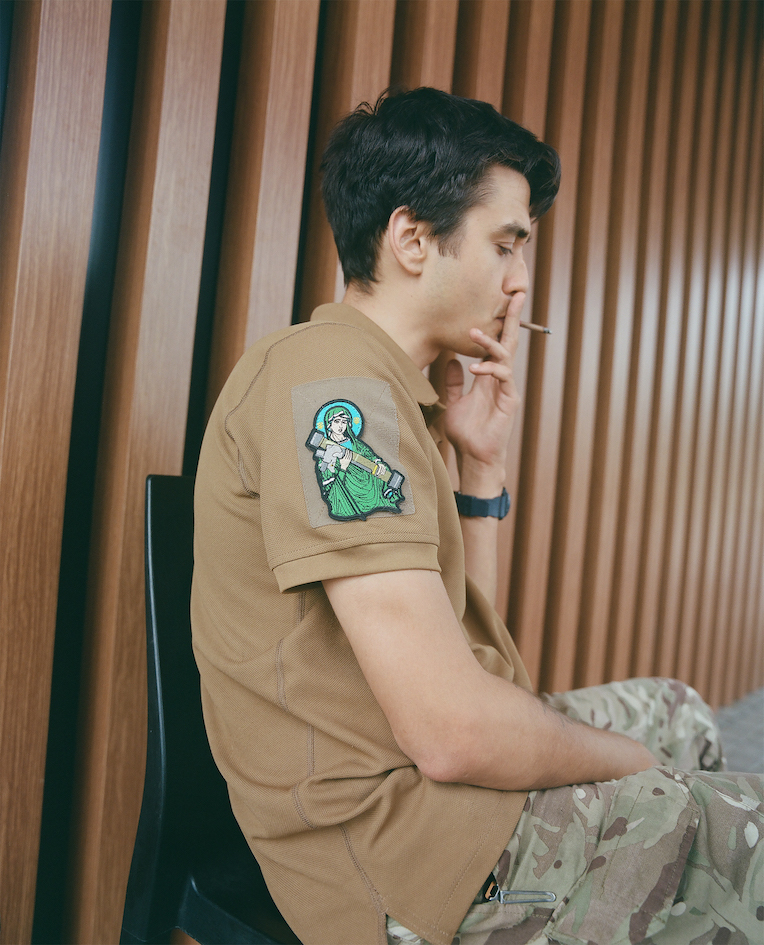
Tymur A., a 26 y.o. tech project manager who volunteered to join the Armed Forces of Ukraine as a platoon commander. He is pictured at a gas station in Vinnytsia, Ukraine, wearing a Saint Javelin patch. 2022

Street dancers on the Independence day celebration on the capital’s main Khreshchatyk street. The performance has been stopped because of the air raid alert. Kyiv, Ukraine, 2022

A car overturned as a result of Russian fighting on the streets of Irpin, Ukraine. 2022

Ukrainian military couple hugging at the Lanzheron beach, Odesa, Ukraine. 2022
Time of Phoenix is on view at Wembley Park until November 15, 2022.
Follow Isaac Muk on Twitter.
Enjoyed this article? Like Huck on Facebook or follow us on Twitter and Instagram.
You might like

The raw, fledgling intimacy of Peter Hujar’s contact sheets
Hujar:Contact — A new photobook highlights the process of the legendary queer photographer, and his process of growing into the artist he ultimately became.
Written by: Miss Rosen

Jesse Glazzard’s messy portrait of queer friends, lovers and chosen family
The Sound of Dirt and Beauty — The photographer’s debut monograph explores tender, unpolished moments shaped by the people who he surrounds himself with, while offering a window into the UK’s working-class LGBTQ+ community.
Written by: Sunny Sunday

Behind the curtain at Alternative Miss World 1981
Olympia glamour — Running a subversive take on the traditional beauty pageant, the Andrew Logan organised event prioritised underground creativity and invention. Photographer David Corio went behind the scenes at its biggest edition.
Written by: Miss Rosen

New exhibition highlights British radical living over 200 years
Earthly Paradise — Taking place at the William Morris Gallery, it explores the homes and lives of artists, writers, musicians and more, as well as the conditions that allowed them to thrive.
Written by: Isaac Muk

What life on the Strait of Hormuz is really like
Southern Winds — Bandar Abbas based photographer Morteza Niknahad has been capturing the diverse communities and stories of his local region since he first picked up a camera. His new series highlights the human impact of war.
Written by: Isaac Muk

Nick Haymes’s intimate portrait of his family’s life
Chronograph — Over 25 years, the photographer documented his son’s lives as they grew into adults. The resulting photobook is an exploration of the passage of time, as well as the optimism of youth.
Written by: Miss Rosen


