Ahilya Bamroo is Gen Z India’s authentic ambassador

Reel relatable — The influencer turned actor speaks about trolls, beauty standards and youth activism.
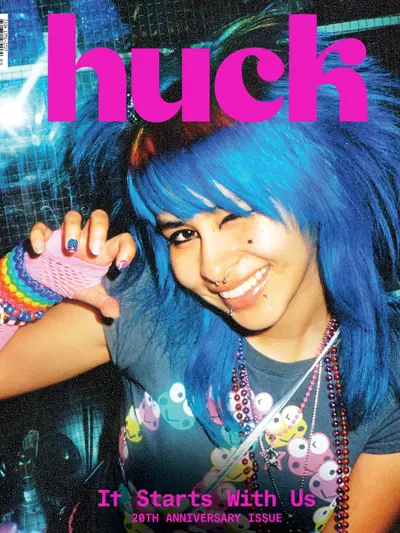
This story is originally published in Huck 84: It Starts With Us – The 20th Anniversary Issue. Order your copy now or join Club Huck+ to make sure you never miss an issue.
It was summer 2021, when Ahilya Bamroo posted a video of herself, riding a motorbike with a friend, zipping towards a secluded beach in Auroville, India, and spending a lazy morning there. For Bamroo, then 22, it was nothing out of the ordinary. She posted the Instagram Reel on a whim and went about her day. Before she knew it, it had garnered over 200,000 views. “At the time, I was like, ‘Wow. Is this stardom? Am I famous now?’” the 27-year-old laughs wryly.
Back then, India – and the world – was in the throes of a crippling pandemic. Bamroo’s fleeting morning by the sea seemed to embody a tender longing: the freedom of being outdoors; of having nowhere to be and nothing much to do. A month later, she posted another Reel where she shared her uncanny ability to effortlessly flit between accents – from Indian to French, British to Australian, American to Italian – drawing on her powers of cultural observation and preternatural ear for mimicry. It made even the serial doomscrollers pause and pay attention. “That video did exceedingly well,” Bamroo recalls. It kickstarted a journey as a content creator and most recently, film actor. Bamroo has built a following of nearly a million on Instagram, realising that something she does for fun piques the interests of many.
When we speak online, continents apart, Bamroo is sitting on the floor with her back slouched against what seems to be a bed. Her hair – an unapologetic flourish of curls – is left open. She’s in London, visiting the bustling city for “work-slash-holiday”. While talking, Bamroo holds her mobile phone so close to her face that it almost fills the screen. It’s a curiously fitting way to meet someone who has built an impressive following through the phone on Instagram.


Perhaps it’s her upbringing, she reflects, that sets her apart. She grew up in Auroville, an experimental township in southern India, founded in 1968 on the idea of creating a small community centred on human unity. Life in Auroville is a world away from the hamster-wheel hustle of urban life. It is communal, environmentally-conscious and sceptical of the relentless pursuit of mass-consumption and wealth. It shapes the way she sees the world and that seeps into the way she makes content for her audience.
Bamroo does her thing, documenting her life and laying it all bare. She exudes a vulnerability and rawness that seems difficult to manufacture. Online, we see her singing like an enchantress; candidly peeling layers of her first date as though we are her closest buddies; and heading out on self-driven, litter-cleaning drives in her neighbourhood.
Her charming wit, comedy timing and girl-next-door quality have carried her from Instagram to the big screen. She landed her first film role in the 2024 indie film by Shoojit Sircar, I Want to Talk, starring actor Abhishek Bachchan, where she plays the teenage daughter of an emotionally complex man battling cancer, with whom she has a prickly relationship. Critics applauded Bamroo’s ability to convey her character’s frustration and teenage exasperation with ease. Then, in 2026, she appeared in Sing Geetham, a fantastical, let’s‑save-our-planet musical directed by the 94-year-old filmmaker Singeetham Srinivasa Rao, one of the oldest directors in the world. “He’s older than Clint Eastwood,” Bamroo points out.
Read next: Inside the Los Angeles scene kid revival
For the film, she had to learn Telugu from scratch – and then sing in it. Learning a language that wasn’t her mother tongue was hard. She had to surrender herself to the process, she says, and accept that she might sound “stupid” in front of a crew largely of native Telugu speakers. Bamroo had to let go of the need to be perfect and simply embrace the experience.
Two films in and one might think that Bamroo is naturally drawn to scripts that pivot from the ordinary. But it’s the character, she insists, that makes her choose a film. “I think it would be hard for me to do a part where my character is one-dimensional,” she says. “I really need a backstory and some emotion to explore or play with.”
She seems to have found that in Mukti too, a first-person narrative video game for PlayStation 5 (produced by UnderDOGS Studio), where she plays the lead. The adventure game takes place in an Indian museum and is centred on exploring the dark underbelly of human trafficking. Based on compelling research and real-life experiences, Mukti is groundbreaking in its own right, seeking to raise awareness on the issue. “It’s a game made by Indians in India for an Indian audience, so I feel it’s something one can feel quite proud of releasing on Play Station 5,” Bamroo notes. As a medium, the game has offered her a different kind of creative challenge, too. “The story of Mukti is really well-written,” she adds. “In fact, I think it has the potential to be developed into a show, similar to The Last of Us.”
“I saw the sheer solidarity with which people were standing up for the rights of the young people in this country.” Ahilya Bamroo

Bamroo speaks in a measured way, with a kind of surprising maturity you might expect from someone at least a decade older. She talks candidly about things that matter to her, including her humanitarian beliefs. During the tumultuous 2026 student-led protests in India that brought thousands onto the streets over paper leaks in the national medical entrance examination, Bamroo was among the few public figures who came forward to voice her support.
It was tough, she confesses, because she was still carrying the trauma of an incident that happened a year ago. At the time, Bamroo had posted “something political” expressing her anti-war sentiments. “In my head, it was a no-brainer statement,” she says resolutely. “Like, of course, we all are anti-war, right?” But almost immediately, Bamroo witnessed the wrath of the internet. Her personal information, including her phone number, was leaked online. “And thousands of men descended upon my DMs with rape threats,” she recalls. “The threats felt very real, very visceral.”
It left her depressed for weeks; she turned off her phone and changed her number. “After that point, I decided to just shut up. I did not speak about the war nor did I speak about politics.” But this year, during the student protests, something shifted in Bamroo. “I saw the sheer solidarity with which people were standing up for the rights of the young people in this country, and I told myself it happened once and I dealt with it. And I’ll deal with it again.”
Read next: What went down at Huck’s 20th birthday party


That willingness to be grounded and real is what makes Bamroo relatable. She is as warm and open in our conversation as she appears to be through her content. There are no airs, no gloss, no fuss. Even her appearance feels uncontrived, particularly in an industry where looking “good” can come with its own list of interventions – Looksmaxxing, Ozempic, lip fillers and more.
When Bamroo speaks to me, she has no visible make-up on. “I do value authenticity more,” she says, but that doesn’t protect her from the pressures of being in an industry which thrives on appearance and perfection. “Of course, there are days when a stray comment or something a critic said can really stay with you,” she admits. “I’ve heard some pretty painful things about my weight – about how certain parts of my body don’t look as good on camera as they should. That definitely hurts.”
Of late, she does find herself looking in the mirror more than she used to. But there’s a limit to how much attention she wants to give it. “Right now, I want to be the best performer I can be. I will do what’s within my power to look good and feel good, but I don’t want to become obsessed with it.”
Instead, Bamroo is preoccupied with what she can do as a “privileged person” who has a platform. When she’s not working, she’s talking about a zero-waste lifestyle or using Instagram to cheerlead projects focused on protecting the planet. She’s also the global ambassador for the All Living Things Environmental Film Festival (ALT EFF), which champions films that raise environmental awareness.
All of this is instinctively a part of who she is. Bamroo has a clear sense of what matters to her. “I do feel that we need to care more about the world,” she says. “It’s really the bare minimum.”
Huck 84: It Starts With Us is out now. Sign up to Club Huck+ to make sure you never miss another issue.
Radhika Iyengar is an arts and culture journalist based in Mumbai. Follow her on Instagram.
Get more from Huck
Club Huck+
Full membership
£28/year
This story is part of Club Huck+, our paid membership. Upgrade to unlock this story and much more!
- The print magazine, straight to your door
- Digital access to back issues of the magazine
- Vouchers and discounts from our partners
- Priority access to Club Huck events
- The Huck Long Read, exclusively dispatched to your inbox
- Zines and special issues
Secure checkout via Stripe. Cancel anytime.
Get more from Huck
Club Huck+
Full membership
£34/year
This story is part of Club Huck+, our paid membership. Upgrade to unlock this story and much more!
- The print magazine, straight to your door
- Digital access to back issues of the magazine
- Vouchers and discounts from our partners
- Priority access to Club Huck events
- The Huck Long Read, exclusively dispatched to your inbox
- Zines and special issues
Secure checkout via Stripe. Cancel anytime.
Already a member?
Enter your email and we'll send you a link to log in.
You might like

Capturing stasis and uncertainty during the Covid pandemic
Four years since countries across the world locked down, photographer Valentin Goppel revisits the experience of a suspended youth in new photobook ‘Between the Years’.

Introducing our new issue of Huck Magazine: It Starts With Us
Huck 84 — For our second 20th anniversary issue, we spotlight 20 people and groups providing the world with a hopeful future.

Inside the Los Angeles scene kid revival
The Rawring ’20s — For the cover of Huck 84, photographer Alexis Gross and writer Anna Zanes meet the latest faces of scene, who are finding freedom to express themselves through its technicolour, unafraid aesthetic.

Intimate, empowering portraits of India’s ‘third gender’ Hijra community
Call Me Heena — Photographer Shahria Sharmin’s new photobook provides the ancient trans and intersex group with space to tell their stories and express themselves, against a backdrop of marginalisation and violence in their daily lives.

What went down at Huck’s 20th birthday party
84 issues and counting — We took over east London’s Jaguar Shoes with friends old and new to celebrate two decades and our new issue, with Tony Bontana taking the decks for a special set.

The Delhi basement forging India’s top skaters
Below deck — In a supermetropolis with little to no infrastructure for skaters, an underground academy is leading the city’s development of elite athletes, as well as providing a space for boarders of any level to try out and train.


