Dismaland to be reassembled as shelters at Calais’ Jungle refugee camp
- Text by Alex King
- Photography by James Cannon

At one of the darkest attractions in Banksy’s Dismaland, visitors were invited to pilot remote-controlled coastguard vessels to ram into model boats packed full of migrants. A depressing caricature of Europe’s response to the Mediterranean migrants crisis, war-weary model refugees looked out from the dangerously over-crowded boats while drowned bodies floated by face-down in the murky water.
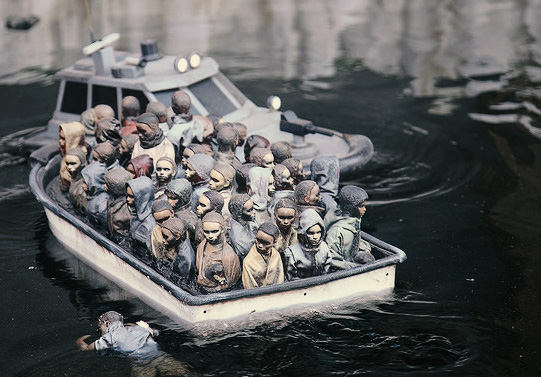 As builders begin dismantling the infamous ‘bemusement park’ at Weston-super Mare, Banksy has announced that the timber and fixtures from Dismaland will be sent to the Calais ‘Jungle’ refugee camp to build shelters.
Naturally, there will be the haters, weary of Banksy’s antics, who see him using the Calais refugees as extras in another publicity stunt. However, there is no doubt the support is desperately needed. When Huck visited the camp in August with Critical Mass activists, we met people living in dire conditions and saw torrential rain wash away tents and other makeshift shelters.
Between three to five thousand displaced people are estimated to be living in the camp, mostly from countries such as Sudan, Afghanistan and Eritrea. The majority hope to make it to Britain, but as security around the port and Eurotunnel have been beefed up, growing numbers have been stuck in the Jungle, with many applying for asylum in France.

The image released by Banksy to announce his new plans for Dismaland.
Banksy released a picture with Dismaland’s centrepiece, Cinderella’s castle, photoshopped into the middle of the Jungle camp. However, it’s unlikely that anything will be recognisable of installations such as Guerrilla Island, the Jeffrey Archer Memorial Fire Pit or Water Cannon Creek, when material from the park is reassembled in Calais.
As Huck reported, government indifference and inaction on both sides of the channel has spurred groups of ordinary people to come together to donate clothing, bicycles and other supplies to the Calais refugees.
In August, French prime minister Manuel Valls pledged a £3.6m humanitarian camp – but that won’t be ready until next year, and weeks after Valls’ speech French police marched in to destroy a section of the camp.
Whatever you think of Banksy, it looks like he’ll be putting roofs over people’s head in Calais long before the French (or British) government does anything meaningful to help.
Enjoyed this article? Like Huck on Facebook or follow us on Twitter.
You might like

Kristina Rozhkova’s scatty, confronting portrait of captivity
Gut Feeling — The Russian artist’s 2024 arrest and subsequent detention opened her eye towards the omnipresent dynamics of power and control. Her new photobook is a stark exploration of being trapped.
Written by: Isaac Muk

Washing strangers’ feet at Houghton Festival
Pedilavium — As part of artist Henry Krokatsis’s performance piece at the weekender, we sat down with over 30 others to clean the dusty digits of passersby, while reflecting on the power of collective ritual and human connection.
Written by: Isaac Muk

The anti-tourism guides revealing Lisbon’s true, radical heart
We Hate Tourism Tours — The Portuguese capital sees millions of people visit a year, against a backdrop of political turbulence and a housing crisis fuelled by short term holiday lets. Jack Burke meets the crew subverting their city’s perception, while bringing lesser seen stories and monuments to light.
Written by: Jack Burke

The art of paying attention: How Austria’s Alps reward slowing down
Lebensgefühl — With a growing movement of art and music rooted in the area’s mountains, trees and waterfalls, the region is showcasing the importance of the human relationship to nature.
Written by: Sophie Lou Wilson

Inside Parkuir: the art project queering sport, space and our bodies
Lie and play — Founded by Maria Laudes and Guiu Gimeno, it provides a framework for engaging, subverting, and celebrating the small details that make people unique – and queer.
Written by: Molly Lipson

A major Nan Goldin exhibition is coming to London
You Never Did Anything Wrong — Opening at the Hayward Gallery in November, the show will debut a new film from the artist and activist, alongside a slate of recent work.
Written by: Jack Dennison-Thompson


