How documentary photography transforms the way we see
- Text by Miss Rosen
- Photography by Elliott Erwitt (main image), all photography courtesy Alex Webb/Magnum Photo

The documentary photograph, both art and artefact, occupies a singular place in the historical record. It acts as testimony, bearing witness to those whose voices might otherwise go unheard, and it can be used as a form of activism to change the world.
A new exhibition, For the Record, brings together the work of some 35 photographers whose innovative approaches have redefined not just the genre but also the medium writ large. From Berenice Abbott’s Changing New York to Danny Lyon’s Bikeriders, to Larry Clark’s Tulsa, and Bruce Davidson’s Brooklyn Gang, the exhibition chronicles the role of documentary photography in shaping the way we see and think about the times in which we live.
By combining classical and contemporary approaches, the exhibition explores the ever-evolving language of photography and the ways in which it simultaneous straddles the realms of reportage and fine art. As 17th-century clergyman Thomas Fuller famously said, “Seeing is believing, but feeling is the truth” — a sentiment that captures documentary photography’s extraordinary ability to communicate the emotional impact of people, places, and events.

Untitled, (Boy Showing Tattoo on Arm) from Brooklyn Gang, 1959, gelatin silver print © Bruce Davidson/Magnum Photos

Haiti, 1979, Alex Webb
At a time when notions of “truth” have been undermined by conspiracy theory and profound distrust, documentary photography offers a moment of respite in the rhetorical storm. For Magnum Photos member Alex Webb, adopting an exploratory approach instead of fact-finding is paramount.
“I’m interested in the intuitive journey, the discovery of the surprising or unexpected, not the preconceived notion,” Webb says. “I like photographs that take me somewhere I’ve never been before – both visually and emotionally – and images that open my eyes to something new, often something enigmatic. That’s why I tend to see my photographs as a series of questions, and not as answers.”
In 1975, long before the use of colour photography was accepted in professional circles, Webb had reached what he described as a “dead-end in my photography…. Somehow the work wasn’t going anywhere, wasn’t expansive enough.” After embarking on life-changing trips to Haiti and to the U.S.-Mexico border, Webb realised colour was an integral part of the story.
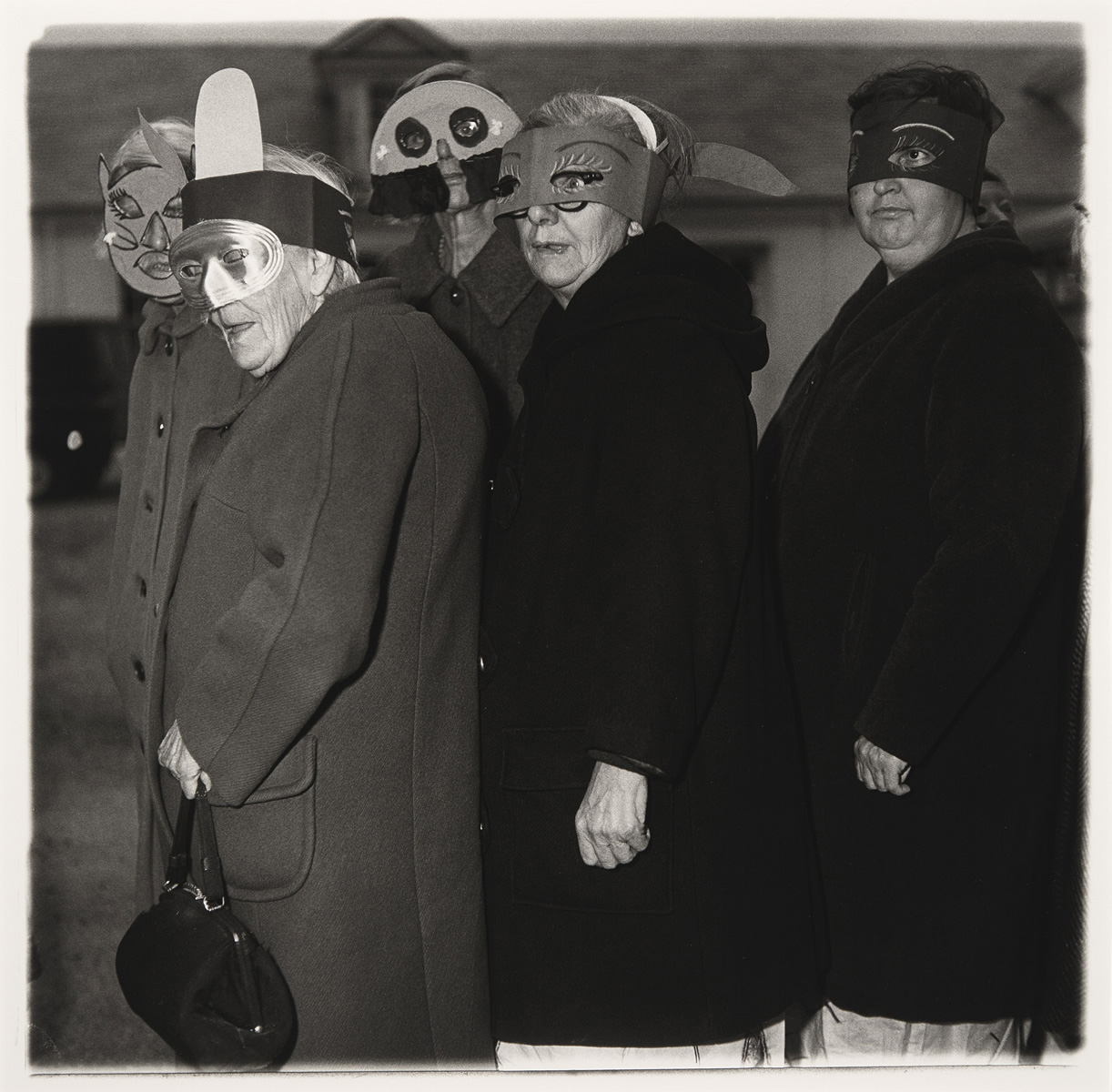
Untitled (14), 1970-71, gelatin silver print © The Estate of Diane Arbus

Mujer ángel, Desierto de Sonora, México, 1979, gelatin silver print © Graciela Iturbide
Like W. Eugene Smith, whose photo essays from 1950s-era LIFE Magazine are featured in the show, Webb adopts an immersive approach, believing that walking in the world with one’s camera is how photographers learn. “A slow, measured pace allows for a kind of gradual immersion into a world,” Webb says, “not too aggressive, not too intrusive, allowing me to slip slowly in and out of situations. Walking gives me a visceral sense of a place and its people.”
This understanding is shared by exhibiting artists like Robert Frank, whose influence on documentary photography spans generations. “I was drawn to The Americans for Frank’s edge and spontaneity,” Webb says. “I remain a believer in more exploratory and personal work – authored work that reflects a sense of discovery of the unexpected or of the unknown.”

Billy Mann, from Tulsa, 1968, gelatin silver print © Larry Clark

Grenada Smoke, Alex Webb

London, 1951, gelatin silver print © The Estate of Ernst Haas/ Alexander Haas
For the Record is on view at Etherton Gallery in Tucson, AZ, through May 29, 2021.
Follow Miss Rosen on Twitter.
Enjoyed this article? Like Huck on Facebook or follow us on Twitter.
You might like

In photos: Black Texas life since emancipation
Kinship & Community — A new photobook and exhibition showcases the rich culture, history and community of African American folks in the Lone Star State, whose existence in the region predates colonial Britain.
Written by: Miss Rosen

Youthful joy & end-of-era poignancy at a London school prom
Leavers — For several years, Lewis Khan documented young people as they celebrated the last of their school days and the completion of their exams. The series is now collated in a new self-published photobook and short film.
Written by: Zoe Whitfield

Harry Gruyaert’s vintage, kaleidoscopic scenes of New York
A Sense of Place — For 50 years, the Belgian photographer and Magnum Photos member has been capturing NYC’s colourful chaos. A new photobook and exhibition showcase his unique, technicolour view of the city.
Written by: Miss Rosen

Inside Lower Duck Pond, the nicest town on the internet
/r/HaveWeMet — With a population of 2,500 and no fixed location, the subreddit is a space for roleplaying citizens to solve mysteries, host fictional events and ultimately connect. In an internet that’s often divided and toxic, Vicky Jessop hangs out in one of its most wholesome corners.
Written by: Vicky Jessop

A major Nan Goldin exhibition is coming to London
You Never Did Anything Wrong — Opening at the Hayward Gallery in November, the show will debut a new film from the artist and activist, alongside a slate of recent work.
Written by: Jack Dennison-Thompson

Sepia splashed memories of Britain’s ’90s squatting and free party scene
Bygones — Moving into a Hackney squat at the age of 19, Tom Hunter spent years living on London’s edges, while documenting the vibrant, creative community and culture that it enabled. Huck’s art director Sam White chats to him about the freedom that existed, the collectivism and what’s been lost over the decades since.
Written by: Samuel White


