
A humorous look at Japanese family life, in photos

This story appears in The Documentary Photography Special VII. Get your copy now, or subscribe to make sure you never miss another issue.
I don’t remember my first photographs. There were never really any signs I wanted to be a photographer – I didn’t even know what one was as a child. I was born in Tokyo and raised in Shizuoka and Kanagawa Prefecture, the eldest son alongside my two brothers and two sisters. For the most part we all did whatever we wanted. At the time, I mostly spent my days wishing I had been born into a wealthy family.
But I started taking photography seriously at around 19 years old – not long after I had begun photography school. By the end of my time studying I had decided that becoming a photographer would be my life’s work. I graduated in 2008, and within a year I put on my first solo exhibition which presented photographs of my family. That was the beginning of my career.
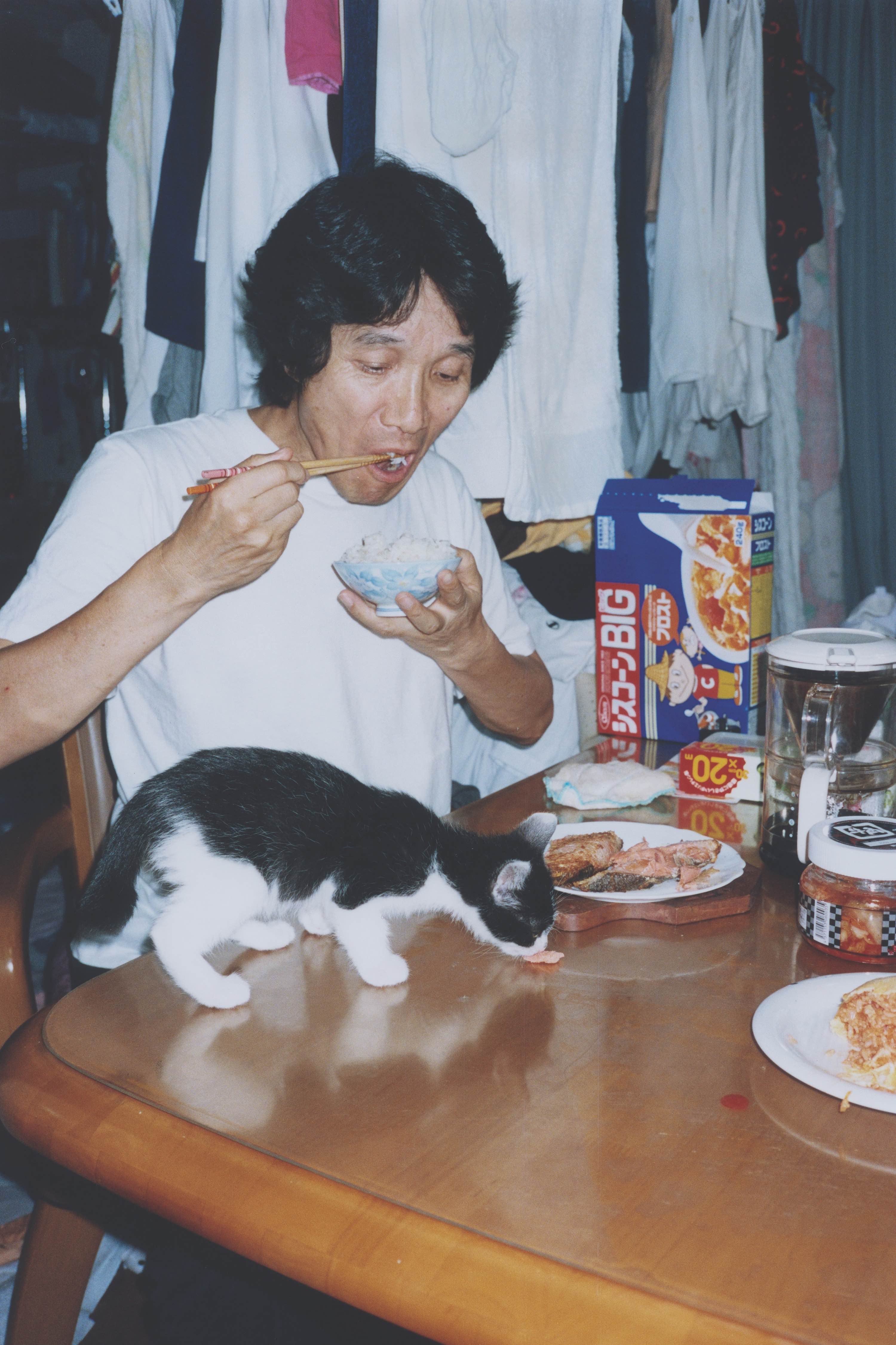 My parents have been living in their home in Yokohama City since my second year of high school. I’ve been photographing them for over a decade now as part of my ongoing projects: Project Family, Still Life and Untitled (Surround).
Project Family shows photographs of my family that I started in my early period. Still Life is focused on the things found on a table in my family’s kitchen. And Untitled (Surround) is landscape photography taken around the area of my family’s home. Now with Hypermarché – Novembre, they’re being mixed into a single book.

 I take a close look at the things around me and look for the moments of non-ordinariness in everyday life. I search for the moments when there’s something off or odd – even when things seem to be going as usual. Then I capture them. I have an impression that home is a hidden place, which makes us all the more curious to peek inside.
My family don’t mind being part of my work. For them it’s part of life the same as watching television. Me shooting is nothing special to them now, they spend their days as they would normally, which means I can access our private and intimate spaces in my work. As a family we were never particularly close. That’s changed since I began taking my photos. There’s more communication now, we talk more. I’ve never really cared that I’m exposing them in my work but I do get a fright when I think that someday they may be recognised around the world.
 Some of my friends find my family very particular, but as far as I know, we are nothing extraordinary. There are families across Japan who live just like we do, and I’m sure there are families who live in sparkling clean rooms like a model house. There are all kinds of truths. I just happen to think my family looks special when seen from a certain angle.
The decision to pair my work with poems by Michel Houellebecq was proposed and realised by the team at The Gould Collection and I’m really happy with how it turned out. Before I only knew Michel by name but I can feel how his poems resonate with my work. They bring something out.
I’ve never really taken much influence or inspiration from other photographers. But for anyone looking to pick up a camera and try it themselves I say, ‘Good luck!’ And if you’ve got any feedback for me, I’d love to get more.


 This story appears in The Documentary Photography Special VII. Get your copy now, or subscribe to make sure you never miss another issue.
Hypermarché – Novembre is published by The Gould Collection.
Enjoyed this article? Like Huck on Facebook or follow us on Twitter.
You might like

The lasting community legacy of a legendary Californian boxing gym
Moretón — Since opening in the ’80s, the Coachella Valley Boxing Club has trained multiple world champions, while providing a vital hub for local youth. In his new photobook, Darren Vargas documents its tight-knit, Chicano-led community, while also weaving a deeply personal story.

Inside the grunge golden age with Hole’s former bassist
My ’90s Rock Photographs — Melissa Auf der Maur’s new photobook is a sprawling visual memoir of her time at the heart of the US scene, from Tinker to The Smashing Pumpkins.

Introducing ‘The Chaos Isles’, a new photozine by Huck and Yushy
Normal Island — From unlicensed raves to the solstice at Stonehenge, furries to giant vegetable growers, Yushy is one of the UK’s best lensmen of its wild side. ‘The Chaos Isles’ will be sent out exclusively to Club Huck+ members.

Join Club Huck+ to get the most from Huck
Dispatches from the sharp edge of culture — Members get our print magazine, special photozines, The Huck Long Read newsletter, discounts from our friends and partners, digital versions of back issues and priority access to events.

Signs of solidarity as London marks three years of genocide in Palestine
Never forget — 250,000 people gathered on Saturday as Israeli attacks have continued in Gaza and the West Bank. Daisy Schofield photographed the diverse people and placards in attendance.

Landmark new exhibition is celebrating 50 years of female punk
God Save the Queens — The Museum of Youth Culture is bringing together rare photography, archive material and a one-night-only supergroup featuring members of X-Ray Spex, The Slits and The Raincoats.


