Nation State
- Text by Vince Medeiros
- Illustrations by Anna Lise Dunn

Let’s start with the basics. The modern nation-state is a construct. As in France, Pakistan, Swaziland, etc. All made up. Some earlier than others, but they were all invented and made to represent a particular chunk of earth at some point. The USA: 1776. Switzerland: 1848. Italy: 1861. And so the idea of timeless historical, cultural, territorial, whatever divisions among men and women is untrue.
As such, nationalism – that longing for group identity, a shared past and culture, sometimes elevated to superiority and uniqueness – is hardly the natural state of things. Instead, it’s typically (and crudely speaking) the result of the intersection of community rites and beliefs and the state’s appropriation of these traditions, which are then elevated to the national level through policy, the educational system, national holidays and, ultimately, through the media. For more, see the Fourth of July, the Queen’s Jubilee, Bastille Day, etc.
The thing that’s fucked-up about nations is that they do appear self-evident, like they’ve always been there in some way or another. You feel pride, speak the same language and watch the same programmes while sipping the same plant-based drink (tea, coffee, mate, etc). But in reality, that common history has more often than not been created through coercion – with a little help from handed-down mythologies and customs that help separate the narcissistic ‘us’ (our country’s blessed) from the foreign and threatening ‘them’ (let’s launch some drones on their asses!).
Some Factoids
As French thinker Ernest Renan said: “Getting its history wrong is part of being a nation.” A few examples, in no particular chronology or order of importance:
The British Isles: Pinning down a nation and related nationalism would be weird for many reasons. Here’s one: a history of conquest and migration that involves Picts, Scots, Romans, Britons, Anglo-Saxons, English, Welsh, Irish, Normans, Scandinavians, Highlanders, etc. More recently: Caribbean, Indians, Pakistanis, Bengalis, Polish, etc, etc, etc. Literally three etceteras or more.
Italy: Unified in 1861. As per Massimo d’Azeglio’s dictum: “Italy has been made; now it only remains to make Italians.” At the time of unification, only two and a half per cent of the population spoke Italian for everyday purposes. In fact, few Italians spoke Italian until television sets became widespread in the 1960s, proving there’s no causal connection between nation and language.
The New World: Europeans had to subjugate and kill the original inhabitants before they could partition the land and eventually give it names like Brazil, Argentina, the US and so on. The mass killing of indigenous peoples is a key function of the creation of these new nations. “They willingly traded everything they owned… They do not bear arms, and do not know them… They would make fine servants… With fifty men we could subjugate them all and make them do whatever we want,” wrote the cuddly Christopher Columbus in his travel log. (How someone can ‘discover’ a place that already exists is beyond me, by the way.) And so Chris’ team went about their daily slaughter, tearing babies from mothers, dashing their heads against rocks, feeding their dogs on living children, and committing a wide array of unspeakable crimes.
What Columbus did to the Arawaks – what Cortes did to the Aztecs; Pizaro to the Incas; and the Portuguese to the Tupis – would foreshadow the creation of nations that were defined by that which they were not; indigenous survivors became largely invisible in the societies that ensued.
The same applies to the United States. Settlers had to kill or subjugate the locals and separate from Britain first – and then invent flag, anthem, kitsch iconography, and other state paraphernalia of imagined ‘national cohesion’ despite internal conflict (class, race, gender, etc).
Passports: Oh yes, the pocked-sized booklet that tells you who you are and where you’re entitled to live. Wanna live somewhere else (say the UK, ‘cause you met a girl or boy who accidentally happened to be born there)? Welcome to a fun li’l journey whose sequence goes more or less like this: apply for Student Visa, followed by Work Permit, Work Permit Extension, Certificate of Approval (where the state sanctions – or not – the marriage between indigenous and alien), Limited Leave to Remain, Life in the UK Test, Unlimited Leave to Remain and, if you can stomach pledging allegiance to the queen (sorry, ‘Queen’), Citizenship Application. Total cost: £5,000 or so at last count. Probably more. No wonder people go illegal, whatever that means.
Then look at the lines at the airport: if you’re scum (i.e. holder of a passport deemed to be of little economic or political value as per treaty between heads of state of questionable legitimacy), go to that long queue next to the border patrol robocops with machine guns. If you’re one of us, move speedily through the good people’s queue.
Passports, by the way, weren’t even required in Europe for a large chunk of the nineteenth century all the way through to WWI. People just moved around, crossed borders, happily enjoying their planet and ours – the planet that we share with animalia and trees, lest we forget.
War: As you know, our governments looove going to war. Examples abound: Falklands, Afghanistan, Iraq, Libya and counting. The ideological cover for this? Nationalism. Or feelings of that nature, such as: us, good; them, evil. Basic Star Wars shit, kept in place by a largely sycophantic media.
Philosopher Alasdair Macintyre elaborates: “The modern nation-state… presents itself on the one hand as a bureaucratic supplier of goods and services, which is always about to, but never actually does, give its clients value for money, and on the other hand as a repository of sacred values, which from time to time invites one to lay down one’s life on its behalf… it is like being asked to die for the telephone company.”
Er… ok, so what?
Next time you fill in a government form or choose to define yourself based on the colour of your passport, remember how random and historically contingent the whole thing is i.e. you could have been born anywhere; it is an accident you were born here [insert landmass represented by country of birth]. You are not who the state says you are, nor do you owe it anything for it, the nation-state, doesn’t even exist – in the sense that T-shirts and frogs and lawnmowers exist.
Or, as historian Eric Hobsbawm says, putting the matter to rest: “Nationalism requires too much belief in what is patently not so.”
You might like
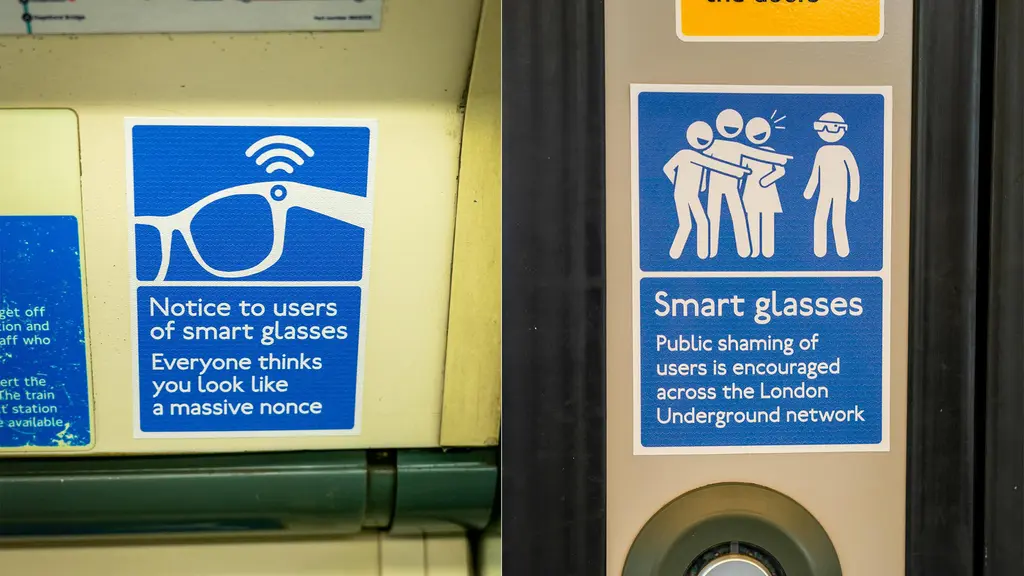
Activists slam “pervert glasses” in new guerrilla campaign
Everyone Hates Elon — Stickers have appeared on the London Underground network, criticising the wearable technology’s covert filming capabilities.
Written by: Isaac Muk

New exhibition highlights British radical living over 200 years
Earthly Paradise — Taking place at the William Morris Gallery, it explores the homes and lives of artists, writers, musicians and more, as well as the conditions that allowed them to thrive.
Written by: Isaac Muk

Pink Floyd’s Roger Waters joins team of new Palestinian resistance documentary
Freedom Theatre — Directed by Rishi Pelham, the film spotlights a theatre operating in the Jenin refugee camp.
Written by: Ella Glossop

Just Stop Oil holds first protest in 17 months
No new drilling — Having previously said that it was “hanging up the hi-vis”, the climate activist group has blocked a road outside Parliament to protest Andy Burnham opening the door for new oil and gas extraction licenses in the North Sea.
Written by: Ella Glossop

The rise of the outdoor’s punks
Future is unwritten — As demand for the outdoors has grown, so has the codification of its rules and styles. Phil Young searches for those adventuring against the mainstream and asks if the industry is about to get its own record label moment?
Written by: Phil Young

In photos: The enduring resistance of Notting Hill Carnival
Carnival of Resistance — A new photobook by Wayne Campbell and Wayne Crichlow reflects on the protest beginnings of Europe’s biggest street festival, along with the traditions keeping its original spirit alive today.
Written by: Isaac Muk


