In Pictures: Cracker politics in the Deep South
- Text by Alex King
- Photography by Michael Adno

“Look how big that scar is, how much there is to consider in the past year of our country’s history let alone in its entirety,” explains Michael Adno, as he considers the protests that followed the killing of Mike Brown by Ferguson police and the awakening against institutionally racist violence that followed.
Cracker Politics, The Limits of Colonial Knowledge is a long-term documentary and research project by artist and photographer Michael Adno that explores how the collective construction of American history and identity impacts on the nation’s contemporary political climate. As a first generation immigrant, the son of a South African father and an Austrian mother, the project is a personal journey to find his position in his history and his country.

Michael, Gate 4, Little Orange Creek Nature Preserve, Hawthorne, Florida, 2016

Michael’s Truck Bed, Hawthorne, Florida, 2016

Rally Site near Rochelle, Florida, 2016
Michael began close to home, in his birth state of Florida. “I was initially researching the state of Florida’s pre-colonial era of Native American Indian cultures, the colonial tenure of Britain, Spain, France, and the ways in which these histories, cultures, and sites were preserved, recorded, and understood,” he explains. “That first month I traveled around the state visiting specific sites, archives, historical societies, and looking for evidence of things that could complicate or contradict what was understood and accepted as dominant histories.”

Historical Society, Hawthorne, Florida, 2016

Trail Camera, Little Orange Creek Nature Preserve, Hawthorne, Florida, 2016
This being Florida, it wasn’t long before he stumbled across the KKK. “In 2014, there was an FBI sting of some KKK members in Alachua County, where I been working for almost two years, for a sanctioned murder,” he recalls. “So I had one foot in the water, researching the Klan and other white supremacists in Florida from 1867 to the present, as well as these other fraternal organisations where there was clearly overlapping membership. I wasn’t sure how to approach it but my goal was to show the influence that these types of organisations had on local communities, municipal government, and state politics.”

Cracker Politics, The Limits of Colonial Knowledge, Spring/Break Art Fair Installation, 2016
The presence of white supremacists in law enforcement, politics, and everyday life throughout the many waves of Klan membership is relatively well recorded. “While it may not surprise anyone to hear how influential these types of organisations and their ideologies were in the development of this place, its politics, and its culture, their effects are still overwhelmingly present and in some cases seeing a resurgence,” Michael explains.

Atlas 4, Phantom Documents, Invisible Monuments, 40 x 50 inches, Digital pigment print, 2015
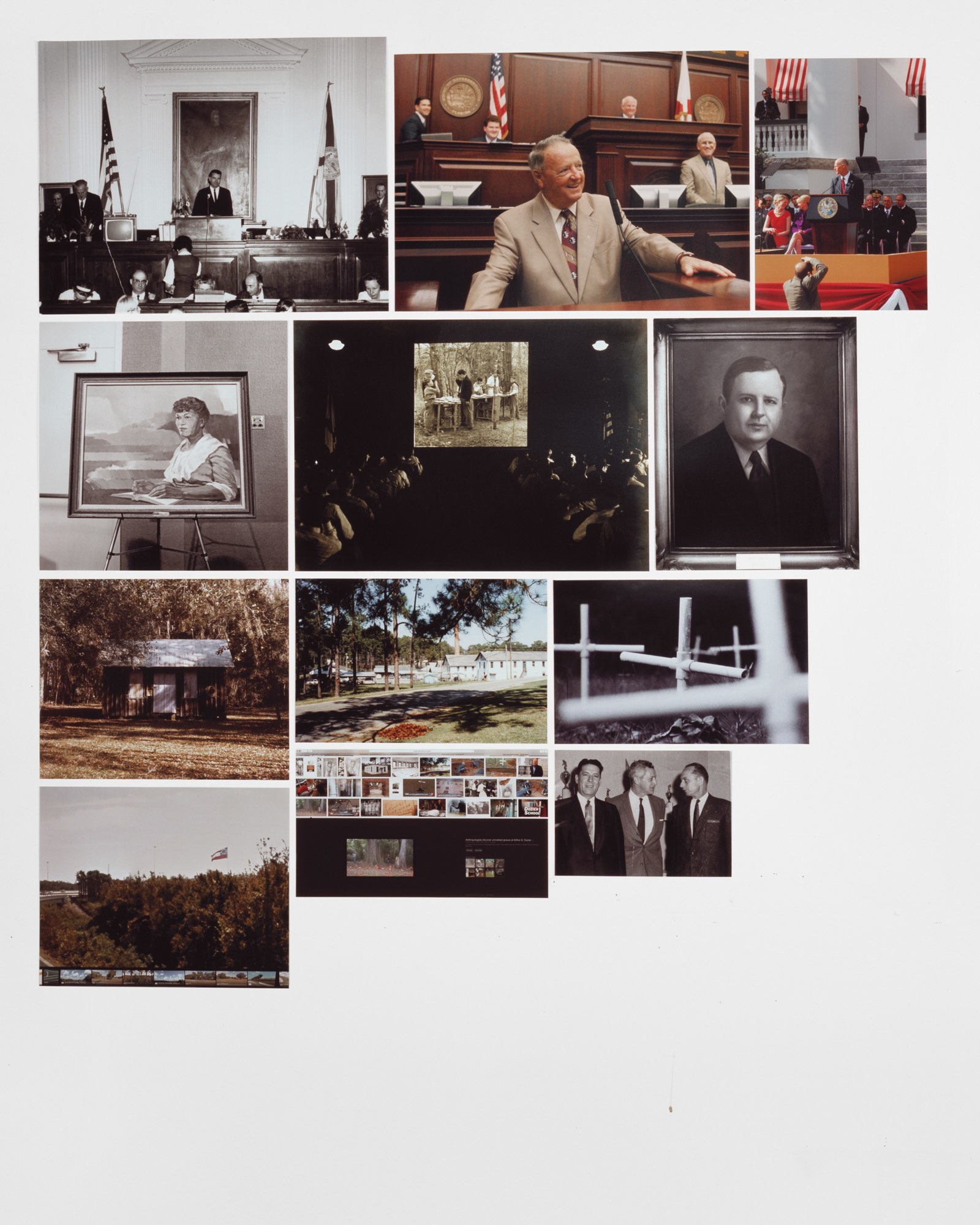
Atlas 3, Memory Suites Desire as if Free from History, 40 x 50 inches, Digital pigment print, 2015

Atlas 2, Salus Populi, Lex Suprema, 40 x 50 inches, Digital pigment print, 2015
Michael’s show at Spring/Break Art Fair showcases a small part of his investigative project, work from 2014 – 2016 that addresses the specific effects of fraternal organisations, far right ideologies, and corporate interests in Florida.
With the continued disproportionate killing of black people at the hands of police, the project couldn’t be more relevant today. “This pursuit is about tracing the history of white supremacists in this state at so many different levels but also to better understand its trajectory with the rise of far-right ideology and the role that institutions, communities, and individuals play in that phantom presence,” Michael explains. “All of this has become increasingly urgent with the current presidential election, the countless traumatic events of last year, and the current global conversation centred on xenophobia and the refugee crisis.”
Michael Adno’s Cracker Politics in the Deep South: The Limits of Colonial Knowledge is on show at Spring/Break Art Fair, New York, March 1-7.
You might like

Jesse Glazzard’s messy portrait of queer friends, lovers and chosen family
The Sound of Dirt and Beauty — The photographer’s debut monograph explores tender, unpolished moments shaped by the people who he surrounds himself with, while offering a window into the UK’s working-class LGBTQ+ community.
Written by: Sunny Sunday

Behind the curtain at Alternative Miss World 1981
Olympia glamour — Running a subversive take on the traditional beauty pageant, the Andrew Logan organised event prioritised underground creativity and invention. Photographer David Corio went behind the scenes at its biggest edition.
Written by: Miss Rosen

New exhibition highlights British radical living over 200 years
Earthly Paradise — Taking place at the William Morris Gallery, it explores the homes and lives of artists, writers, musicians and more, as well as the conditions that allowed them to thrive.
Written by: Isaac Muk

What life on the Strait of Hormuz is really like
Southern Winds — Bandar Abbas based photographer Morteza Niknahad has been capturing the diverse communities and stories of his local region since he first picked up a camera. His new series highlights the human impact of war.
Written by: Isaac Muk

Nick Haymes’s intimate portrait of his family’s life
Chronograph — Over 25 years, the photographer documented his son’s lives as they grew into adults. The resulting photobook is an exploration of the passage of time, as well as the optimism of youth.
Written by: Miss Rosen

Kristina Rozhkova’s scatty, confronting portrait of captivity
Gut Feeling — The Russian artist’s 2024 arrest and subsequent detention opened her eye towards the omnipresent dynamics of power and control. Her new photobook is a stark exploration of being trapped.
Written by: Isaac Muk


